


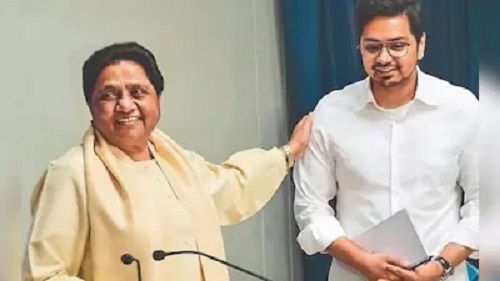
The political drama within the Bahujan Samaj Party (BSP) has taken a decisive turn, with Mayawati cutting ties with her nephew Akash Anand despite his father-in-law Ashok Siddharth announcing his retirement from politics. The BSP chief’s latest action underlines that loyalty to the party and its movement, in her view, cannot be compromised by family relationships. What began as a dispute over Siddharth’s political influence has now ended with Akash Anand being completely removed from the organisation, raising fresh questions over the BSP’s succession politics and its strategy ahead of crucial electoral battles.
BSP chief Mayawati on Thursday announced the complete removal of Akash Anand from the party, making it clear that Ashok Siddharth’s decision to retire from politics had failed to satisfy her concerns.
In a strongly worded statement on X, Mayawati questioned Akash Anand’s priorities and accused him of giving greater importance to personal relationships than to his political responsibilities and the interests of the BSP. Her remarks suggested that the dispute was no longer merely about the political role of his father-in-law, but about Anand’s own commitment to the organisation.
Mayawati particularly pointed to Akash Anand’s failure to repost her social-media statement concerning Ashok Siddharth. According to the BSP chief, the post was intended to protect Anand’s own political future, yet he did not consider it necessary to share it.
For Mayawati, this omission appeared to be more than a social-media disagreement. She interpreted it as evidence of where Anand’s loyalties lay at a critical moment.
The BSP chief also revived her criticism of Ashok Siddharth, alleging that the party had taken both Siddharth and Anand from modest beginnings to positions of considerable prominence. Her message was that such political advancement carried with it an obligation to put the organisation and the Ambedkarite movement above personal equations.
The confrontation escalated rapidly after Mayawati had already stripped Akash Anand of the important post of National Coordinator on September 3. The latest announcement takes that disciplinary action much further. Anand is now completely outside the BSP, ending what had once appeared to be a carefully cultivated political succession within the party.
The decision came shortly after Ashok Siddharth announced his retirement from politics and social life. Siddharth said he was stepping away immediately, apparently responding to Mayawati’s demand that his political exit was necessary if Anand’s future within the BSP was to be protected.
In an emotional message, Siddharth reiterated his personal loyalty to Mayawati. He said that all relationships were secondary to her instructions and described his association with her as a debt that he could never repay.
Yet even Siddharth’s retirement did not prevent Anand’s expulsion. That development indicates that Mayawati’s concerns went beyond the continued political presence of her former close associate and son-in-law’s father-in-law.
The episode also exposes the unusual pressures surrounding the BSP’s leadership transition. Akash Anand had been projected at different stages as an important young face capable of taking the party forward. His political rise was therefore closely watched, particularly because Mayawati has dominated the BSP for decades.
The latest rupture, however, suggests that the BSP chief is unwilling to allow any competing centre of influence to emerge around her successor, particularly if she believes personal networks could affect organisational discipline.
Mayawati has now sought to shift the focus back to the party’s traditional political objective: rebuilding the BSP in Uttar Pradesh and securing a majority government. She called upon party workers to remain fully committed to the organisation and its broader social movement.
Her reference to the BSP’s long-standing principle of “Sarvajan Hitay, Sarvajan Sukhay” also signals the political direction she wants the organisation to maintain—one centred on social mobilisation, law and order, development and electoral expansion.
For Akash Anand, however, the latest decision represents a dramatic reversal. From being positioned as a prominent young leader and potential inheritor of the BSP’s political legacy, he has now been separated entirely from the organisation.
The immediate political consequences remain uncertain. But one thing is clear: Mayawati has once again demonstrated that when questions of authority, discipline and loyalty collide with family relationships, the BSP chief intends to have the final word. The expulsion of Akash Anand may therefore be remembered not merely as another internal party dispute, but as a defining moment in the BSP’s continuing struggle over leadership, succession and political control.





















Leave Your Comment