


The Supreme Court’s October 1 decision keeps the dispute over the Trinamool Congress’s finances firmly within the framework of the ongoing legal proceedings, rather than settling the ownership question itself. The court has declined to grant interim access to four frozen accounts while asking the Calcutta High Court to move faster on the substantive matter.
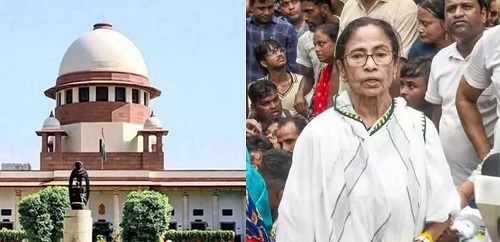
The Supreme Court’s refusal to allow the Mamata Banerjee-led Trinamool Congress faction to operate four debit-frozen bank accounts has added another layer to the widening legal contest over the party’s organisational identity, finances and control. The bench of Justices MM Sundresh and PB Varale, while declining to interfere with the Calcutta High Court’s earlier order, made it clear that it was not entering into the merits of the underlying dispute. Instead, it asked the High Court to expedite the proceedings.
The four accounts, reportedly containing around Rs 804 crore, were frozen following action by the West Bengal Police’s Cyber Crime authorities in connection with a complaint filed by MLA Bishwanath Das. The Mamata-led faction had challenged the freezing and sought permission to operate the accounts, arguing that there were deficiencies in the FIRs forming the basis of the action. The Calcutta High Court, however, declined to grant interim relief on August 27.
The Supreme Court’s latest order is significant because it separates the immediate question of access to the money from the larger question of who is legally entitled to control the party’s funds. The bench observed that the Election Commission has already frozen the party’s name and symbol amid the factional dispute, while the entitlement to the money lying in the accounts remains to be adjudicated. In declining to exercise its jurisdiction under Article 136, the court therefore avoided making a determination that could pre-empt the proceedings before the High Court.
The High Court had earlier taken a similar cautious approach. It noted that it had already created a mechanism allowing the party to meet its day-to-day expenses through a court-appointed Special Officer. According to the August 27 order, allowing the four additional accounts to be operated at this stage could undermine that earlier arrangement.
This creates an important distinction between keeping a political organisation functioning and granting it unrestricted access to disputed funds. The existing judicial arrangement seeks to ensure that essential expenses can be met while the competing claims over the party’s finances remain unresolved. The Supreme Court’s decision effectively leaves that framework intact for now.
The financial dispute is also unfolding alongside a separate battle over the TMC’s name and election symbol. The Election Commission’s intervention has created a broader institutional question over which faction can claim the organisational identity and associated assets of the party. The Supreme Court has recently directed the poll panel to resolve that dispute within a defined timeframe, underlining the need to prevent prolonged uncertainty.
For the Mamata-led faction, the immediate consequence is that the approximately Rs 804 crore in the four accounts remains outside its operational control unless the High Court subsequently orders otherwise. For the judiciary, the case illustrates the difficulty of dealing with financial assets during an unresolved internal political-party dispute: protecting the integrity of potentially contested funds while ensuring that a functioning political organisation is not completely deprived of the means to meet legitimate expenses.
The Supreme Court’s direction to expedite the High Court hearing therefore becomes the immediate focus. Rather than deciding who owns or controls the disputed funds, the apex court has left that question to the pending proceedings. The larger legal battle will consequently turn on the evidence concerning the accounts, the circumstances surrounding their freezing and, ultimately, the question of which faction has the legal authority to exercise control over the party’s financial assets.





















Leave Your Comment