


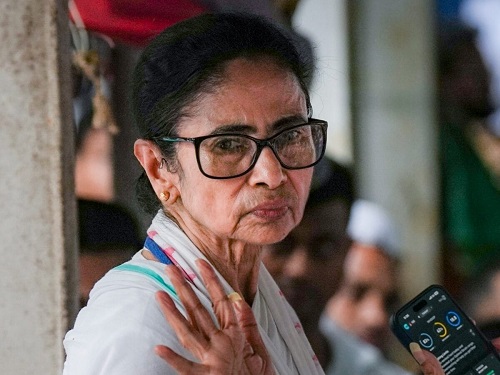
The political turmoil within the Trinamool Congress (TMC) intensified on Tuesday as party chief Mamata Banerjee filed an election petition before the Calcutta High Court challenging the result of the Bhabanipur Assembly constituency, where she was defeated by BJP leader Suvendu Adhikari in the recently concluded West Bengal Assembly elections.
According to TMC sources, Banerjee personally visited the High Court registry to affirm the petition contesting the outcome of the election. The move comes at a time when the party is grappling with an unprecedented internal rebellion and leadership crisis following its poor performance in the 2026 West Bengal Assembly polls.
Suvendu Adhikari secured a decisive victory over Mamata Banerjee in Bhabanipur, winning the seat by a margin of 15,105 votes. The counting of votes for the Assembly elections was conducted on May 4, and the BJP emerged victorious in the state. Following the party's landmark triumph, Adhikari became the first BJP Chief Minister of West Bengal.
The legal challenge marks Banerjee's second visit to the Calcutta High Court since the party's electoral setback, underlining the significance of the Bhabanipur defeat for the TMC leadership.
Amid the growing unrest, Mamata Banerjee has initiated a major organisational overhaul within the party. In a significant move, she removed Saayoni Ghosh as president of the TMC's youth wing and appointed youth leader Arnab Banerjee as her replacement.
The party also replaced Kolkata Dakshin MP Mala Roy as president of the Trinamool Mahila Congress. The responsibility has now been entrusted to Alifa Ahmed, the TMC MLA from Kaliganj in Nadia district.
Party insiders indicate that both Ghosh and Roy were perceived as being sympathetic to the faction of rebel MPs currently challenging the party leadership. The dissenting lawmakers have reportedly planned to approach Lok Sabha Speaker Om Birla with a letter seeking recognition as the “real TMC” following the party's electoral debacle.
The crisis deepened further after reports emerged that senior MP Sudip Bandyopadhyay had joined the dissident camp. Leaders of the breakaway faction claim that 20 of the TMC's 28 Lok Sabha MPs have signed the letter seeking separate recognition.
The list of signatories reportedly includes both Saayoni Ghosh and Mala Roy. Rebel MP Kakoli Ghosh Dastidar has publicly stated that once recognised, the faction would extend support to the BJP-led National Democratic Alliance (NDA) in Parliament.
The rebellion follows earlier unrest within the state Assembly, where sections of the party's legislators had expressed dissatisfaction with the leadership.
In response to the growing dissent, Mamata Banerjee dissolved all existing party committees and frontal organisations across West Bengal on June 5 before unveiling a restructured leadership framework dominated by loyalists and senior party veterans.
As part of the reorganisation, she reappointed her nephew and Diamond Harbour MP Abhishek Banerjee as the party's National General Secretary. Interestingly, both Saayoni Ghosh and Mala Roy had initially retained their respective organisational positions during the restructuring before being removed in the latest reshuffle.
A senior TMC Rajya Sabha MP, speaking on condition of anonymity, said the latest replacement decisions had been finalised during a party meeting held three days earlier.
Expressing frustration over the rebellion, the leader remarked that several MPs who had benefited from the party's support had now turned against its leadership.
In another key appointment, TMC MP Kunal Ghosh was named president of the party's North Kolkata organisational district, a position previously held by Sudip Bandyopadhyay.
Speaking to reporters, Ghosh said the party had entrusted him with the responsibility in light of recent developments.
Meanwhile, veteran parliamentarian Saugata Roy has been appointed chief advisor to the TMC's Lok Sabha wing, which currently consists of eight MPs who continue to remain loyal to Mamata Banerjee.
As the legal battle over Bhabanipur begins and the internal revolt gathers momentum, the Trinamool Congress faces one of the most challenging phases in its political history, with Mamata Banerjee fighting simultaneously on judicial, organisational and political fronts to retain control over the party she founded.



















Leave Your Comment