


What began as a discreet operation in a remote village of Bihar's Madhubani district has now evolved into a major anti-terror investigation that security agencies believe could expose an extensive radicalisation network operating across multiple Indian states with alleged links to handlers based in Pakistan and Afghanistan.
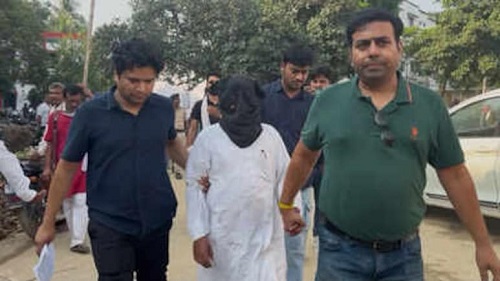
In a joint operation conducted by the Madhya Pradesh Anti-Terrorism Squad (ATS) and Bihar ATS, authorities arrested Maulana Izhar-Ul-Haq from Nautol Sarisabpali village under the Pandaul police station limits in Madhubani district on Monday. The accused, who was associated with a local madrasa as a teacher, is being viewed by investigators as one of the most significant figures apprehended so far in the ongoing probe.
According to ATS sources, Izhar-Ul-Haq was not merely a participant in the alleged network but is suspected to have functioned as its "Amir" — an ideological guide and operational commander responsible for identifying, mentoring and radicalising individuals across different states. Investigators believe the network's objective was to cultivate potential "lone wolf" attackers capable of carrying out independent acts of violence.
Security agencies allege that Izhar maintained regular contact with overseas handlers and was entrusted with rebuilding dormant sleeper cells, coordinating financial activities and expanding the network's influence. Intelligence inputs suggest that while operating discreetly from Bihar's Seemanchal region, he allegedly remained connected to foreign-based operatives through secure communication channels.
The arrest itself was conducted under extraordinary secrecy. Soon after being taken into custody, a local court granted a 72-hour transit remand, allowing ATS teams to transfer him to Madhya Pradesh for detailed interrogation.
A senior ATS officer said that questioning Izhar-Ul-Haq could provide crucial insights into the recruitment and radicalisation mechanisms allegedly employed by the network.
"One of the key reasons why Izhar is important is that he comes from the Seemanchal region. We want to understand how he motivated people, how potential recruits were identified, what kind of individuals were targeted and how they were gradually drawn into the network," the officer said.
Investigators are now focusing heavily on digital evidence recovered during the operation. Preliminary examination of mobile phones seized from the accused has reportedly revealed indications of communication with numbers located in Pakistan and Afghanistan. Security agencies are working to determine the structure of the alleged network, identify its coordinators and establish the extent of its reach across different regions.
The investigation traces its origins to June 12, when the Madhya Pradesh ATS conducted a covert operation in the densely populated lanes of Old Bhopal. During the operation, officials arrested 35-year-old Mohd Faraz near Nanhe Bee's Mosque in the Qazi Camp area. Sources familiar with the case said the operation was executed with such secrecy that even local police personnel were reportedly informed only after the arrest had been completed.
Faraz, who worked at a doctor's clinic, soon emerged as a central figure in the investigation. ATS officials allege that he had been consuming extremist content circulated by foreign handlers and had become deeply radicalised through encrypted online platforms.
The arrests have raised fresh concerns among security agencies about the use of digital communication tools, encrypted messaging channels and online propaganda in facilitating radicalisation. Investigators believe the interrogation of both accused could reveal critical details about recruitment strategies, funding channels and the role of foreign-based handlers in influencing vulnerable individuals within India.
As the probe expands, security agencies are expected to examine possible links in other states and assess whether additional sleeper cells or recruits may have been connected to the alleged network. Officials maintain that the investigation remains at a sensitive stage, with several leads currently being pursued.

















.jpg)


Leave Your Comment