


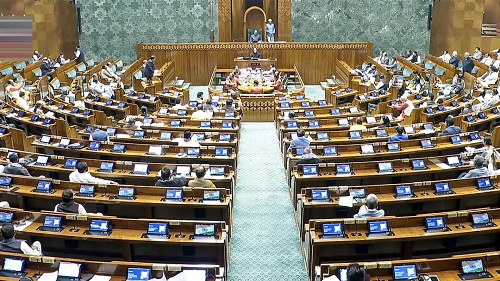
The Lok Sabha on Thursday passed the Viksit Bharat – Guarantee for Rozgar and Ajeevika Mission (Gramin) Bill, 2025 (VB–G Ram G Bill) amid loud protests and disruption by Opposition parties, marking another contentious chapter in Parliament’s winter session. The legislation, which seeks to restructure and rebrand the rural employment guarantee framework, will now be taken up for consideration in the Rajya Sabha.
As the Bill was put to vote, Opposition members stormed the Well of the House, tearing copies of the legislation and demanding that it be referred to a parliamentary standing committee for detailed scrutiny. Despite the uproar, the Speaker proceeded with the passage, stating that the Bill had already been discussed at length. Following the passage, the Lok Sabha was adjourned for the day and is scheduled to reconvene on Friday at 11 am.
Opposition leaders mounted a coordinated attack on the government, accusing it of undermining the legacy of Mahatma Gandhi by removing his name from the rural employment guarantee law. Congress leader Priyanka Gandhi Vadra, DMK’s T R Baalu, and Samajwadi Party MP Dharmendra Yadav were among those who spoke out strongly against the proposed legislation.
They argued that Mahatma Gandhi’s association with the employment guarantee programme was not merely symbolic but reflected its rights-based approach, and that dropping his name amounted to an insult to the Father of the Nation. The Opposition also warned that the new framework would impose a heavier financial burden on state governments, potentially weakening cooperative federalism and affecting rural livelihoods.
Union Rural Development Minister Shivraj Singh Chouhan defended the Bill forcefully, rejecting the charge that the government was diminishing Mahatma Gandhi’s legacy. He alleged that the Congress had added Gandhi’s name to the Mahatma Gandhi National Rural Employment Guarantee Act (MGNREGA) for electoral considerations rather than out of ideological commitment.
Replying to the debate, Chouhan said that job guarantee schemes had existed even before MGNREGA, introduced under successive governments, and argued that the new Viksit Bharat mission aimed to make rural employment more outcome-oriented, sustainable, and aligned with long-term livelihood generation rather than short-term wage employment alone.
He accused the Opposition of politicising the issue and misleading rural workers, asserting that the proposed law would strengthen transparency, efficiency, and accountability while ensuring employment and livelihood security in villages.
With the Bill now headed to the Rajya Sabha, the political confrontation is far from over. The Opposition has indicated it will continue to resist the legislation, pressing its demands for wider consultation and a standing committee review.
The passage of the VB–G Ram G Bill, 2025 underscores the deep ideological divide over rural welfare, federal responsibilities, and the political symbolism attached to flagship social legislation—an issue likely to remain at the centre of parliamentary and public debate in the days ahead.



















Leave Your Comment