


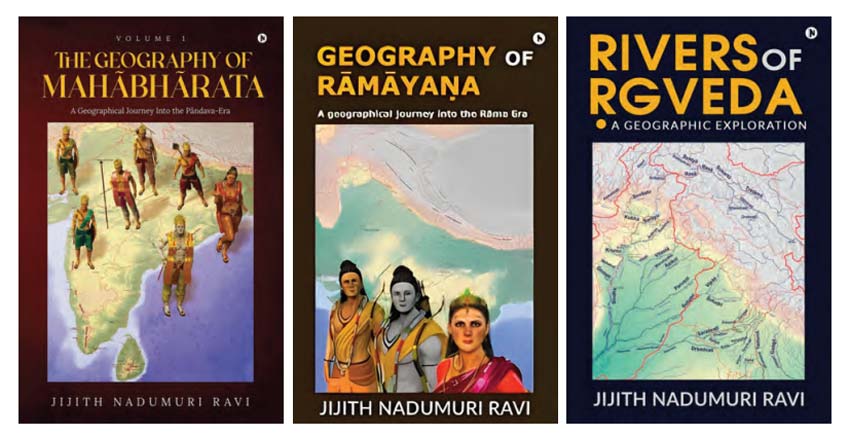
Aren’t you surprised to know that Lanka of the Ramayana was not Sri Lanka, Kiskindha was not in Hampi and that Sri Rama never crossed the river Narmada! These are the interesting findings of Sri Jijith Nadumuri Ravi, a former space scientist turned researcher and author on the trilogy Geography Rivers of Rgveda (2022) Geography of Ramayana (2023), and the Geography of the Mahabharata(2024). He is of the view that despite deep-rooted notions in the psyche of the believers, archaeology has found no trace of evidence for any urban culture in Sri Lanka during the Rama-Era.)
The first book is a geographical journey into the Rgveda through its rivers as the primary guides. The Ramayana book, relying on Valmiki Ramayana, focus on the Geography of Bhāratavarṣa as known to Rāma, Vālmīki, Agastya and others who lived in the Rāma Era. It provides several surprising new insights on the Geography of Rāmāyaṇa. The last in the series details the geography and chronology of the Pāṇḍava Era and analyses the entire 1995 Adhyāyas and 18 Parvas of Mahābhārata without missing any events in the life of the Pāṇḍavas.
An Engineering Graduate (Electronics and Communication) and MBA (IT), while in service Jijith had contributed to the Chandrayan 1 GSO-LTO orbit design, and the GSLV launches D2, F01, and F02. He founded the website ‘AncientVoice’ (ancientvoice.wikidot.com), containing 25,376 pages on Mahābhārata, Rāmāyaṇa, Vedas, Purāṇas, Upaniṣads and the classical Tamil literature. He has presented several research papers on his work at several international conferences and had worked as a mediator and analyst for the dating of the Kurukṣetra War. His platform Dharma Digital (dharmadigital.in) promotes Dharma using digital technologies like Virtual Reality and Artificial Intelligence.
To my query on Sri Lanka, Jijith said that Valmiki Ramayaṇa describes Lanka city as having a Harappan-style urban culture and it is identified as the Bhagatrav island in the mouth of Narmada where it joins the sea. “It matched perfectly with the prosperous city of Lanka,” he added.
If anyone interested in knowing the geographical data underlying the RgVeda or the fascinating itihasas, the Ramayana and the Mahabharata, Jijith’s books are the best. He wholeheartedly welcomes objections and criticism to his findings, saying, “let noble thoughts come to us from every side.” But to counter his well research contentions, one must read the book.
What attracted me to Jijith’s works are his articles, “No, Mr. Devdutt Patnaik, Krishna was not a negligent father,’1 rebutting the depiction of Krishna as a ‘bad father who neglected his son and turned him into a spoilt adult of bad manners and bad character,’ ‘The Human Soul: A dialogue Between East And West,’2 his private correspondence with Lawrence David Moon, an American Poet, Novelist, Dramatist, Librettist, Lyricist, Songwriter, Opera Composer, and Book Editor and his interview with Shri Srikant Talageri on the much debated Aryan Invasion Theory, Out of India Theory and the Indo European Migration3.
Shri Jijith’s works assume significance in the light of the accusation that Hindus don’t have a historical consciousness, there are no detailed accounts of their historical past, their history can be deciphered only through the accounts of foreign travellers and their past revealed through the epics and other texts are unreliable. See the present-day quarrels about Arya and Dravida, oppressors and oppressed and Brahmins and Shudras.
Hearteningly, a new historical consciousness is emerging in India and several authors who are not trained as “historians” but who with their skills, talents, and rigor of logic delving deep into the Indian past, have begun “recovering “our true past. They are doing this commendable work despite opposition from so-called ‘eminent historians’ who are wedded to their Marxist, anti-Hindu, syncretic “idea of India” and who have “sold” the Hindu/Indian past to their western audiences.
The works of scholars like Shrikant Talageri, Michel Danino, Jijith Nadumuri Ravi, Vishwa Adluri, Joydeep Bagchi and others assume significance in this context making us more informed, helping us sort out original texts from interpolations, tracking data that enables us to map the geographic ambit in the epics, and so on. They resolve the questions, in the Indian/Hindu context: What is history, what myth is, what itihaasa is and how to sift the “real” from the “myth.”
Excerpts from an exclusive interview Pradeep Krishnan had with Jijith Nadumuri Ravi:
How did an ISRO scientist develop interest in Vedas, Itihāsas and puranas, particularly their geography?
Right from age of 10, I was interested in Vedas, Itihāsas and Purāṇas, space exploration, solar system and planets. When I was in the 6th standard, I used to mark the pathways of the Pāṇḍavas in the blank maps of India borrowed from my senior cousins. After joining ISRO, reading books on the discovery of Sarasvati River, taken from the office library, re-kindled my interest in the Vedas. In 2004 I started contributing articles to Wikipedia on each Janapada (kingdom) mentioned in the Mahābhārata and Rāmāyaṇa. Then on finding that the articles in Wikipedia are changeable, I created my own Wikipedia like website- AncientVoice. It now has 25000 plus Wiki pages on the four Vedas, Itihāsas and Viṣhṇu Purāṇa.
What prompted you to write your first book, ‘Rivers of the Rg Veda,’ and please give a brief introduction to the book?
Actually, initially, I wanted to write a book on the Geography of the Mahābhārata. Though, started writing in 2020, soon I realized that without studying the oldest book Ṛgveda, and the Vālmīki Rāmāyaṇa, I will not be able to do justice to my work. The evolution of our Veda-Itihāsa- Purāṇic culture commenced with Ṛgveda, where the oldest settlements on the banks of the rivers like Gaṅgā, Yamuna, Sarasvati, Śutudrī (Sutlej), Vipāśa (Beas), Paruṣṇī (Ravi), Asiknī (Chenab), Vitastā (Jhelum), Sindhu (Indus), Gomatī (Gomal), Sarayu (Haro) and Kubhā (Kabul River) have been mentioned. The Ṛgvedic Geography is identical to the Indus Valley / Harappan Geography of the North West India, spanning from western Uttar Pradesh to eastern Afghanistan and Kashmir to eastern Maharashtra. It is this Ṛgvedic Geography that led to the Aitihāsic Geography of Rāma Era and Pāṇḍava Era. This is what prompted me to write my first book Rivers of the Ṛgveda.
Left historians often allege that our itihasas are nothing but mythology. However, you have traced the Geography of Ramayana. What are your comments?
I absolutely disagree with the leftist point of view. However, without rooting into Ṛgveda, Vālmīki Rāmāyaṇa, with its exaggerations and magical narratives may appear as a work of fiction. Though Ṛgveda is poetic, it is more realistic. For example in the Dāśarājña Battle, in Ṛgveda, the mention of participation of 6000 men is realistic. This rootedness to reality enables one to analyze Vālmīki Rāmāyaṇa vis-à-vis the Rgveda and extract the core historical information from the Itihāsa Kāvya. The results are startlingly realistic: we find that Rāma and Śaṃtanu (the great grandfather of the Pāṇḍavas), both mentioned in the 10th Mandala of Rgveda (the final Mandala), were contemporaries and lived towards the end of the late Ṛgvedic Period. Similarly, we can come to the conclusion that Rāvaṇa was a Harappan king who ruled along the Narmada River. Rāvaṇa’s Laṅkā was a Harappan seaport located along the mouth of Narmada. This aligns with the fact that Rāvaṇa’s grandfathers married daughters of Narmada (Gandharvis). One of them Mālyavat belonged to the Mālyavat Range of the Northern Vindhyas, close to Yamuna.
Then, what about the authenticity of Ramsetu and Sri Lanka?
The Ram Setu between Rameshwaram to Srilanka is spread in an east to west direction. But, Valmiki Ramayana has no term called "Rama Setu". It is called Nala Setu. This Nala Setu is built in north to south direction. Hence it is very clear, the Nala Setu mentioned in Valmiki Ramayana is not Ram Setu of Rameshwaram.
Nala - son of Visvakarma - refers to Harappan engineers. Visvakarma means engineer. Hence Lanka built by Visvakarma and a bridge to Lanka, all alludes to Harappan Civilisation Region which extends to Narmada but not up to Srilanka. The ancient name of Srilanka mentioned in ancient texts is Tamra Dvipa and Simhala Dvipa etc and never as Lanka. When Cylone got freedom from British they just renamed it as Sri Lanka in 1970s. Only in some later Puranas that evolved later to Rama's lifetime, Rameshwaram, Dhanushkoti and other places are mentioned as connected to Rama.
Interestingly, every state in India claims to have a connection with the Ramayana. Wherever one travels, one can find a place connected either with the Ramayana or the Mahabharata.
Since Rāmāyaṇa is a popular text which blended with the cultural DNA of India, everyone in India claimed their local region is related to Rāmāyaṇa. This is how many later identification of the places related to Rāmāyaṇa came about. For example, Nasik and Parṇaśāla near Bhadrachalam as Pañcavatī, Hampi and a hill near Tirumala as Kiṣkindhā, Lepakshi as the place related to Jaṭāyu, southern Kanyakumari and the present day Srilanka as Laṅkā. In contrast to these popular identification, an analysis rooted in Ṛgvedic Geography reveals that all the places in Vālmīki Rāmāyaṇa were located to the north of the Narmada river, with the exception of a few, like the location of Mārīca’s Tapovana, identified in my book as a backwater bay close to a Harappan port city settlement close to Gujarat-Maharashtra boarder with full of coconuts and plantains. This aligns with the final expansion of the Ṛgvedic Geography up to Narmada in the south, as evident in the expansion of the Harappan archaeological culture from Sarasvati and Sindhu to Narmada in the south, and beyond upto Daimabad in northern Maharashtra. This analysis provides an archeological base for the places mentioned in Vālmīki Rāmāyaṇa.
What are your findings on ‘Saraswathy- Sindhu- Narmada’ Civilization?
One of the common terms used to define the ‘Sarasvati Sindhu Narmada’ Civilization is “Harappan Civilization”. This term was used at a time when we knew only about a settlement in Harappa, near the Ravi River in Pakistan. Later we discovered many settlements of this civilization along the Indus River like Mohan jo Daro. Then it was rebranded as Indus Valley Civilization. But soon we discovered the largest number of settlements were located along the Sarasvati River. Thus it was renamed as Sarasvati Sindhu Civilization. Even later, we discovered settlements along the Narmada River in the south and beyond as far south as Daimabad in Maharashtra. This is why this large civilizational area spanning the north west of Indian subcontinent is correctly termed as the Sarasvati Sindhu Narmada Civilization (SSNC). Then, Vālmīki Rāmāyaṇa can be correctly defined as an expedition of an Ayodhya Prince from Sarayū River in Uttar Pradesh to a Harappan port city in the mouth of Narmada River, from where he rescued his abducted wife.
Please tell about your website ancientvoice.com
The website, similar to Wikipedia, with 25000 plus pages, was established in 2009, to focus on Ṛg, Yajur, Sama and Atharva vedas. It also contains articles on Rāmāyaṇa, Mahābhārata and Viṣṇu Purāṇa. One can browse through the site to read any of the texts from start to finish or its subsection (Maṇḍalas, Sūktas, Kaṇḍas, Sargas, Parvas and Adhyāyas). The site can also be used as a research tool. It also contains my analysis articles, charts, maps and my illustrative paintings of Pāṇḍavas, Indraprastha etc.
What about your platform ‘Dharmadigital’?
Ten years after the establishment of ‘AncientVoice,’ a textual website to promote Sanātana Dharma and research, Dharma Digital was established in 2019. It uses latest technologies like Virtual Reality, Augmented Reality, Mixed Reality and Artificial Intelligence to digitally create Devata Holograms – of Krishna, Balarama, Pāṇḍavas, Pāncālī, Sītā, Rāma, Hanumat and other divine personalities - capable of virtually interacting with the viewer using the medium of a mobile phone or a head mounted VR device. These devatas, while interacting, instruct the viewer various aspects of Sanātana Dharma.
Are Sri Rama and Sri Krishna historical personalities?
One of the conclusions of my trilogy of books is that Sri Rāma and Sri Krishna are historical personalities. The various activities of them, directly indicated by Vālmīki and Vyāsa, are human in nature. Nevertheless, they are divine based on the principle of Advaita Vedānta, which concludes that every individual is divine by nature and is one with Brahman. Certain individuals, who are self-aware, and express their Brahman consciousness, more clearly are considered as divinities. In Rāmāyaṇa and Mahābhārata, in later days, several poets have added many magical narratives. What we see today is the depictions of Sri Rāma and Sri Krishna through these evolved texts. That is why they apparently appear as non-historical or fictitious.
What are your findings on the link between Veda-Itihāsa-Puranic chronology and Archeology?
There are clear correlations between the literary culture of Early and Middle Ṛgveda with the archaeological Early Harappan Period (3300-2600 BCE). Both in the literary text (Ṛgveda) and its corresponding archaeological material culture (Harappan Culture) we see the humble beginnings of a pastoral and agrarian life, with small settlements on the banks of rivers. The Late Ṛgveda correlates well with the Mature Harappan Period (2600-1900 BCE). During this period, we see more settlements in the Harappan culture. Correspondingly more than 210 kings and more than 420 sages are mentioned in Ṛgveda. During the 8th Maṇḍala composition period of the Late Ṛgveda, the 4.2 kilo year dryness event (2200 BCE) with no rains for more than 12 years hit all world civilizations, including the Ṛgvedic / Harappan civilization. During this period, there was a shift from the drying Sarasvati to Yamuna and Gaṅgā in the east. This shift is captured in the Late Ṛgveda, Rāmāyaṇa and Mahābhārata, in the migrations of the lineage of Ikṣvākus and Kurus respectively. (Ikṣvākus:- Sagara, Asamañja, Aṃśumat, Dilīpa, Bhagīratha, Raghu, Aja, Daśaratha and Rāma; Kurus:- Kuru, Pradīpa, Śaṃtanu), The Aitihāsic Period of Rāma and Pāṇḍavas corresponds with the declining Late Harappan Period (1900-1300 BCE). The Aitihāsic Period is divided into Rāma Era (1950-1850 BCE) and Pāṇḍava Era (1850-1750 BCE). This is why in the Yuga System, Treta and Dvāpara are described as the declining periods. After the Aitihāsic Period, the Purāṇic Edit Period, started. This corresponds to Kali Yuga. The period before the Aitihāsic Period viz. the Ṛgvedic Composition Period - was the Ṛta Yuga, Krita Yuga or Satya Yuga.
It is alleged that Indians have no historical consciousness, do not have any detailed and clear accounts of their historical past, whatever history they have is through the accounts of foreign travellers, the accounts of their past in the epics and other texts are unreliable as it is a mixture of myth and hagiography, a reflection of the discriminatory, hierarchical, patriarchal, misogynist practices created and curated by crafty Brahmins. What are your comments?
These allegations are canards. There is a good balance of masculine and feminine in our texts. All the texts are meant for every individual who aspire for it, irrespective of their social affiliations and classifications. Since our civilization is very old, record keeping was not easy like the cultures in the West, which began 2000 or 4000 years later. That is why some historical accounts became hazy. Through my books, I proved that reasonable reconstruction of our extreme past is possible through a deep study of Vedas, Itihāsas and Purāṇas. My books have extended the historicity of Indian kings beyond Chandragupta Maurya into the past to include Pariksit, Yudhiṣṭhira, Śaṃtanu, Rāma, Sudās, Divodāsa, Bharata and his ancestors up to Manu as historical kings and leaders. Cross comparison of these texts are extremely important to derive the proper chronological sequencing of the events mentioned in these texts. If the dates are arrived by treating the texts as silos, we have the danger of coming out with exaggerated dates, that breaks the historical chains. For example, treating Rāmāyaṇa and Mahābhārata as silos, and using archaeo astronomy we get the wrong result that Rāma lived in 12209 BCE and Pāṇḍavas fought Kurukṣetra War in 5561 BCE. But this breaks the historical thread, because some individuals like Parasurama, Hanumat, Markandeya, Durvasa, Jāmbavat, Mainda, Dvivida, Vibhīṣaṇa, Vaiśravaṇa and others interacted with both Rāma and Pāṇḍavas. This means, time period of Rāma and Pāṇḍavas occurred in quick succession, without any big gap of a few decades.
What is your message to upcoming researchers?
Always start your chronological and geographical analysis of the Itihāsas and Purāṇas only with the proper chronological and geographical study of the Ṛgveda. This would enable them rooted in the reality rather than being carried away by the poetic imaginations that are predominant in the Itihāsas and Purāṇas. This is what will help us to reconstruct the pre-history beyond the kings like Chandragupta Maurya and Mahāpadma Nanda, who are currently accepted as historical kings. The biggest hurdle that people who study Itihāsas and Purāṇas face, is that they cannot separate facts from fiction embedded in these texts. The attitude that everything mentioned in these texts are equally real is a false premise. Similarly the attitude that everything mentioned in these texts are equally imagination is a false premise. The researcher needs to approach the information in the Itihāsa Purāṇas with a balanced view, and anticipate surprises. They should have a thorough background in related fields like archaeology; ancient technology evolution, archaeo astronomy analysis etc. make sense of the data.
I also urge the reader to spread and multiply these Dharmic efforts by reading my books. I appreciate support to sustain the Dharmic efforts in the form of these geochronology books, Dharma Digital platform and AncientVoice website. I also encourage the reader to work for Dharma, and spend some time and effort for it, in whatever way you can, whichever be your profession and social background.
Foot Notes:
1. https://www.indiafacts.org.in/no-mr-devdutt-patnaik-krishna-not-negligent-father/
2. https://www.indiafacts.org.in/human-soul-dialogue-east-west/
3. https://swarajyamag.com/culture/the-shrikant-talageri-interview-true-dharma-should-be-based-on-the-principles-of-truth-and-justice
By Pradeep Krishnan
(The content of this article reflects the views of writers and contributors, not necessarily those of the publisher and editor. All disputes are subject to the exclusive jurisdiction of competent courts and forums in Delhi/New Delhi only)




















Leave Your Comment