


The Supreme Court’s intervention on front-of-pack warning labels has brought an important public-health question into sharper focus: should consumers have to decode complicated nutritional information before knowing whether a packaged food is high in salt, sugar or fat? By questioning the delay in making such warnings mandatory, the court has placed consumer awareness, childhood nutrition and regulatory accountability at the centre of the debate.
The significance of the issue extends well beyond the design of a label. India is witnessing a transformation in eating habits, particularly among children and adolescents. Traditional meals are increasingly competing with packaged snacks, sweetened beverages and highly processed foods that are aggressively marketed, conveniently available and often attractive to younger consumers. In such an environment, nutritional information that is technically available but difficult to understand may not be sufficient.
The Supreme Court’s concern with the proposed Front-of-Pack Labelling (FoPL) framework therefore reflects a larger principle: public-health information must be accessible at the point where consumers make purchasing decisions. A lengthy nutritional table at the back of a packet may satisfy a regulatory requirement, but it does not necessarily enable a parent, student or ordinary consumer to make an immediate and informed choice.
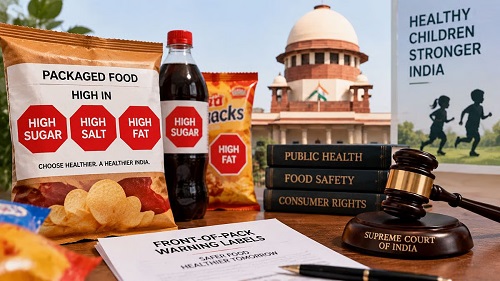
The proposed system seeks to address this gap through prominent warnings for products containing high levels of specified nutrients of concern. The FSSAI has proposed a red-coloured hexagonal warning for products high in two or more of added saturated fat, added sugar and salt, based on thresholds drawn from the Dietary Guidelines for Indians, 2024. Such declarations could make warnings considerably more visible than conventional nutritional panels.
Yet the controversy demonstrates that good regulation depends not only on the objective but also on the method. The court’s questioning of a phased implementation indicates concern that prolonged transition periods could dilute the effectiveness of a measure designed to protect public health. If the scientific basis for identifying excessive levels of nutrients is sufficiently established, the regulatory process must also explain why consumers should wait indefinitely for clear warnings.
The court’s observation regarding the proposed red hexagonal symbol raises another important dimension: communication. A warning system must be immediately understandable and should not create ambiguity. If consumers associate a particular colour or shape with another established food classification, the very purpose of the warning could be undermined. Regulatory design must therefore be tested not merely by experts but by ordinary consumers.
The strongest dimension of the court’s intervention, however, is its emphasis on children. Schools are among the most important environments in which lifelong dietary habits are formed. The contrast between freshly prepared food inside schools and the large availability of packaged snacks around them illustrates the challenge. Children may leave the school premises and encounter an environment where convenience, aggressive marketing and taste compete with nutritional considerations.
This makes nutritional education as important as labelling. A warning printed on a packet can inform, but education can create understanding. Children should gradually learn what excessive sugar, salt and saturated fat mean, how food labels work and why frequent consumption of highly processed foods can affect long-term health. Nutritional literacy should therefore become part of a broader educational framework rather than being treated as an isolated health campaign.
At the same time, responsibility cannot be shifted entirely onto consumers. Parents and children need information, but food manufacturers also have a responsibility to formulate products more responsibly. Clear warnings can encourage competition around healthier formulations, giving companies an incentive to reduce excessive quantities of sugar, salt and unhealthy fats.
The debate also requires a balance between public health and legitimate industry concerns. Regulatory changes can affect manufacturing processes, packaging, product reformulation and marketing strategies. These concerns deserve consideration, but they cannot become a permanent justification for postponing measures intended to protect consumers.
India’s food environment is changing rapidly, and regulation must keep pace with that transformation. Front-of-pack warnings should not be viewed simply as another compliance requirement imposed on the food industry. Properly designed, they can become an instrument of consumer empowerment.
The Supreme Court’s intervention has consequently opened a wider conversation about what responsible food regulation should look like in modern India. The objective should not be to dictate what people eat, but to ensure that they know what they are buying. When the consumer is properly informed, choice becomes meaningful. And when that consumer is a child, society has an even greater responsibility to ensure that the choice is not shaped solely by packaging, advertising and convenience.





















Leave Your Comment