


The Supreme Court’s response to the protests in Delhi has brought into focus a delicate constitutional balance between the right to dissent and the need to preserve the functioning of democratic institutions. Chief Justice of India Surya Kant’s insistence that the country’s highest court should not be “dragged into any politics” reflects the judiciary’s concern that political confrontations must not obstruct the administration of justice. At the same time, the court’s directions to protect peaceful demonstrations, freedom of movement and access to essential services underline that maintaining institutional order cannot come at the cost of fundamental rights. The challenge lies in ensuring that protest remains a legitimate democratic expression while public institutions continue to discharge their responsibilities without interference.
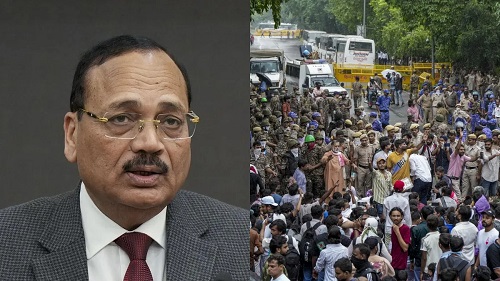
Chief Justice of India Surya Kant has made it clear that the Supreme Court must remain insulated from political confrontations even as it addresses legal questions arising from the protests in Delhi. His remarks on Monday were directed at ensuring that demonstrations do not interfere with court proceedings or prevent lawyers, court employees and litigants from entering and leaving the premises. The message was straightforward: democratic protest is permissible, but the functioning of the justice system cannot become collateral damage in a political dispute.
The CJI’s observations came after Supreme Court Bar Association president and senior advocate Pradeep Rai sought an early hearing of a fresh petition concerning the alleged detention of lawyers and the suspension of internet services. Agreeing to list the matter on Tuesday, the Chief Justice urged members of the Bar to ensure that the court’s functioning remained uninterrupted. He also told senior advocate Gopal Sankaranarayanan that lawyers were entitled to protest at designated locations, reiterating that the court had no objection to democratic forms of dissent.
The distinction is significant. The judiciary is not expected to prohibit peaceful protest merely because it is inconvenient to the authorities or politically contentious. Equally, a protest cannot claim unlimited space if it obstructs access to courts, restricts the movement of citizens or interferes with the administration of justice. The constitutional question, therefore, is not whether demonstrations should take place, but how the rights of protesters can coexist with the rights of others.
The Chief Justice’s remarks must be viewed alongside the directions issued a day earlier by a special bench comprising Justices Joymalya Bagchi and V. Mohana. The bench issued measures aimed at protecting peaceful protest, restoring freedom of movement and ensuring that no individual was detained except in accordance with the procedure established by law.
It also directed that metro and railway services operate normally, internet connectivity remain undisturbed and restrictions around court complexes be removed to facilitate access to justice. These directions addressed concerns that measures taken in response to the protests could extend beyond maintaining public order and begin affecting ordinary citizens and the functioning of essential institutions.
The interventions demonstrate the importance of distinguishing between legitimate security arrangements and restrictions that unnecessarily burden civil liberties. Public authorities have a responsibility to prevent violence and maintain order. However, preventive measures must remain proportionate to the situation and consistent with the law. Blanket restrictions on transport, communications or access to public institutions can impose costs on people who may have no involvement in the demonstrations.
The right to peaceful assembly is an important democratic safeguard. It enables citizens to express disagreement, draw attention to grievances and demand accountability. Its protection becomes particularly important when protesters allege excessive state action. Such allegations require impartial scrutiny rather than automatic acceptance or dismissal.
At the same time, the protection of peaceful assembly does not remove the responsibility of organisers and participants to respect the rights of others. A democratic protest gains legitimacy when it communicates dissent without unnecessarily paralysing public life.
The CJI’s warning against dragging the Supreme Court into politics also raises a broader question about judicial independence. Courts frequently become the arena in which disputes involving governments, political parties, law enforcement agencies and citizens are resolved. Their involvement in politically sensitive matters is not itself evidence of politicisation; it is often a necessary consequence of their constitutional responsibility.
The distinction lies in how the judiciary performs that responsibility. Courts must examine petitions on their legal merits, evaluate the material placed before them and issue directions where constitutional or statutory violations are established. They must neither become instruments of political mobilisation nor avoid scrutiny simply because a dispute has political implications.
In the present situation, the Supreme Court faces the dual responsibility of preserving institutional functioning and ensuring that allegations concerning detention, internet restrictions and limits on public movement receive appropriate judicial consideration. These responsibilities are complementary rather than contradictory. An independent judiciary must be accessible to citizens, including those challenging the conduct of the state, while remaining protected from pressure intended to influence its proceedings.
The Chief Justice’s appeal to lawyers is therefore also an appeal to the legal community to preserve the distinction between advocacy, activism and the institutional obligations of the Bar. Lawyers have every right to participate in democratic movements, but their professional responsibilities include ensuring that litigants are not denied access to justice and that court proceedings are not disrupted.
The directions concerning transport services, internet connectivity and access to court complexes highlight another important dimension of the controversy: the impact of protest-related restrictions on the wider public.
Metro and railway networks are essential to the daily lives of millions. Internet connectivity supports communication, employment, education, commerce and access to information. Restrictions around courts can affect litigants, witnesses, lawyers and members of the public seeking legal remedies. Measures intended to manage a demonstration can consequently create difficulties far beyond the immediate protest site.
Authorities must therefore assess not only whether restrictions might help maintain order, but also whether they are necessary, narrowly tailored and supported by a legitimate legal basis. Where less restrictive alternatives are available, they deserve serious consideration. Security cannot become a blanket justification for measures that unnecessarily interfere with ordinary life.
The same principle applies to the protesters. The right to express dissent should not be exercised in a manner that deliberately prevents others from accessing public services or pursuing legal remedies. The democratic space must accommodate competing rights, not allow one group’s demands to erase the interests of everyone else.
The Supreme Court’s intervention offers an opportunity to reinforce this principle through lawful and proportionate action. Its effectiveness will ultimately depend on whether the authorities implement judicial directions faithfully and whether protest organisers exercise their rights responsibly.
The unfolding developments are a reminder that constitutional democracy requires more than the freedom to protest or the authority to maintain public order. It requires institutions capable of accommodating disagreement without abandoning their responsibilities.
The CJI’s remarks should not be interpreted as a rejection of dissent. His explicit acknowledgement that lawyers may protest at designated places makes that distinction clear. His concern is that demonstrations should not compromise the Supreme Court’s functioning or obstruct those who depend on it. Meanwhile, the special bench’s directions underscore that the state must respect peaceful assembly, lawful procedure and the public’s access to essential services.





















Leave Your Comment