


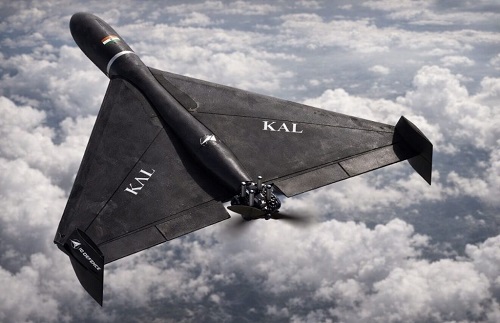
India has taken another step towards strengthening its indigenous unmanned warfare capabilities with the successful trial of KAL, a long-range one-way attack drone developed by Noida-based IG Defence. Tested at the Pokhran Field Firing Range in Rajasthan, the platform is designed for missions extending up to 1,000 kilometres and represents the growing focus on domestically developed systems capable of delivering precision effects at long distances.
The successful Pokhran trial comes against the backdrop of a rapidly changing battlefield, where unmanned systems have emerged as an increasingly important component of modern military operations. The Russia-Ukraine conflict, in particular, has demonstrated how long-range one-way attack drones can be employed in sustained strike campaigns while placing considerable demands on opposing air-defence networks.
According to Noida-based IG Defence, KAL has been developed indigenously as a long-range unmanned strike platform. The company says the system has a maximum stated range of up to 1,000 kilometres, an endurance of around 7-8 hours, and a payload capacity of up to 50 kg. It is designed to operate at altitudes of up to 5,000 metres above mean sea level.
The Pokhran test is significant because it provides an opportunity to validate the integration of several critical systems under field conditions. These include the airframe, propulsion system, avionics, navigation architecture and mission systems that together determine the performance of an unmanned platform.
The expanding use of systems such as Iran-origin Shahed-136 and Russia's Geran-2 in the Russia-Ukraine conflict has underlined the military relevance of relatively low-cost, long-range unmanned platforms. Their use has demonstrated how drones can complement conventional strike capabilities and be deployed in large numbers to place sustained pressure on defensive systems.
The technology has also acquired wider strategic significance beyond the European battlefield. Shahed-type systems and related unmanned platforms have featured in conflicts and attacks in the Middle East, including operations affecting maritime traffic around the Red Sea.
This changing environment has encouraged countries to develop indigenous alternatives, particularly systems that can combine long endurance, meaningful payload capacity, autonomous navigation and scalable production.
KAL incorporates a navigation architecture combining multi-band Global Navigation Satellite System (GNSS) technology with an inertial navigation system (INS). Such a combination is intended to support autonomous flight and navigation during different stages of a mission.
The platform has been conceived for precision engagement of designated targets. According to the company, potential target categories include infrastructure, radar installations, air-defence systems and other strategic targets, depending on mission configuration and applicable operational authorisations.
The emphasis on autonomous navigation is particularly relevant to modern unmanned warfare, where systems increasingly need to undertake long-distance missions with limited direct intervention.
KAL is part of IG Defence's GRID Strike portfolio of long-range precision-strike systems. The company says the drone can also be integrated with its GRID Battle Management System, an AI-enabled C5ISRT architecture intended to coordinate unmanned platforms and battlefield information.
The development reflects a broader shift in India's defence-industrial landscape, with private-sector companies increasingly contributing to indigenous unmanned and precision-strike technologies. For a country seeking greater strategic autonomy in defence production, developing complete unmanned systems—from propulsion and avionics to navigation and mission architecture—can reduce dependence on imported platforms and technologies.
The Pokhran trial therefore represents more than a single flight test. It is an important development milestone for IG Defence as it works towards an indigenous long-range unmanned strike platform. Further testing, operational evaluation and validation will determine how the system evolves from a successfully demonstrated platform into a mature military capability.





















Leave Your Comment