


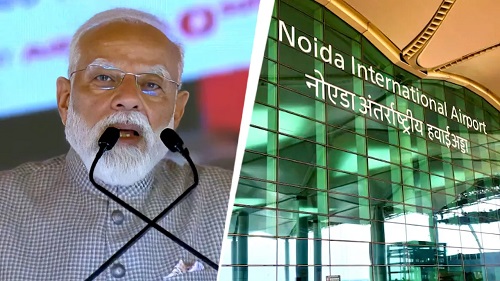
Uttar Pradesh’s decision to rename the Noida International Airport at Jewar after Prime Minister Narendra Modi has added a political and symbolic dimension to one of the country’s most ambitious infrastructure projects. Announced by Chief Minister Yogi Adityanath following a high-level Cabinet meeting in Lucknow, the move is intended to honour Modi’s 25-year journey in executive leadership. Beyond the symbolism, however, the decision highlights the BJP government’s effort to connect infrastructure-led development, political leadership and national identity in Uttar Pradesh, a state central to India’s economic ambitions and electoral politics.
The Uttar Pradesh government’s decision to rename the Noida International Airport after Prime Minister Narendra Modi represents more than a change in the identity of a major transport facility. It reflects the importance that the BJP attaches to leadership, public recognition and the creation of a lasting political legacy. By linking the airport’s proposed new name to Modi’s completion of 25 years as head of a government, Chief Minister Yogi Adityanath has placed the project within a broader narrative of administrative experience, national transformation and development.
Announcing the decision on Friday after chairing a high-level Cabinet meeting in Lucknow, Adityanath said the Uttar Pradesh Cabinet had taken the step to honour Modi’s uninterrupted journey of public service as a head of state. He praised the Prime Minister for leading the country from the front and serving as a prominent public representative and Member of Parliament.
According to Adityanath, Modi’s leadership has helped India establish a stronger identity on the international stage while preserving its civilisational values. He also described Uttar Pradesh as a state entering a new phase in which heritage and development are advancing together.
The announcement carries political significance, particularly because Jewar airport is expected to become a major gateway for the National Capital Region and western Uttar Pradesh. Its proposed association with the Prime Minister places the infrastructure project alongside the government’s wider narrative of economic expansion, improved connectivity and India’s growing ambitions in global aviation.
Airports are essential components of economic infrastructure. They connect businesses with markets, facilitate tourism, support cargo movement and create opportunities for investment. In a rapidly urbanising region such as western Uttar Pradesh, improved aviation connectivity can also influence industrial development, employment and the growth of supporting services.
The Jewar airport project is particularly significant because of its location and its potential role in strengthening the National Capital Region’s aviation capacity. Its long-term importance will depend on passenger demand, connectivity with surrounding cities, cargo-handling capabilities and the development of commercial and industrial activity around it.
Renaming the airport after Modi gives the project an additional symbolic dimension. For the BJP, it reinforces the association between the Prime Minister’s leadership and large-scale infrastructure development. For supporters, the move can be presented as recognition of a leader whose tenure has placed roads, railways, airports and other infrastructure at the centre of the national development agenda.
Yet the success of an airport cannot be measured by its name alone. Its real significance will emerge from the quality of its operations, the affordability and frequency of flights, the efficiency of its transport links and the economic opportunities it generates. The proposed renaming may attract attention, but sustained performance will ultimately determine the airport’s contribution to the region.
The larger question is whether Jewar airport can fulfil its promise as a driver of regional development. Its strategic value will depend on the growth of aviation services, the expansion of road and other transport connections, and the creation of a reliable ecosystem for businesses and travellers.
The airport could strengthen the appeal of the region for logistics, manufacturing, hospitality and other aviation-linked industries. Better connectivity may also help businesses access national and international markets. These benefits, however, are not automatic. They require coordinated urban planning, reliable utilities, effective public transport, environmental safeguards and attention to the needs of local communities.
The government must also ensure that the economic gains extend beyond large investors and property developers. Local employment, skill development, small businesses and improved public services will be important indicators of whether the project delivers inclusive growth.
Equally important is the distinction between the symbolic recognition of leadership and the institutional character of public infrastructure. Naming a major airport after a political leader can serve as an expression of public appreciation, but the airport itself remains a long-term public asset whose performance must be judged by professional standards and public benefit.
Adityanath’s announcement captures the BJP government’s effort to present leadership, infrastructure and national identity as interconnected elements of development. The proposed renaming of Jewar airport after Modi is intended to commemorate 25 years of executive leadership while reinforcing the state government’s argument that Uttar Pradesh is undergoing a significant transformation.
Ultimately, the airport’s enduring legacy will not be determined solely by the name displayed on its terminal. It will depend on whether the facility improves connectivity, attracts sustainable investment, creates employment and strengthens Uttar Pradesh’s economic position.
Political recognition can give a project symbolic importance, but its practical achievements will give it lasting public value. If Jewar airport fulfils its economic promise, it could become an important milestone in the development of western Uttar Pradesh. The challenge for the government is to ensure that the symbolism surrounding the project is matched by measurable benefits for the people it is meant to serve.




















Leave Your Comment