


BASANTA KUMAR SAHOO
"न हि ज्ञानेन सदृशं पवित्रमिह विद्यते।
तत्स्वयं योगसंसिद्धः कालेनात्मनि विन्दति ॥"
"There is nothing in this world so purifying as knowledge.” (Bhagavad Gita - 4.38)
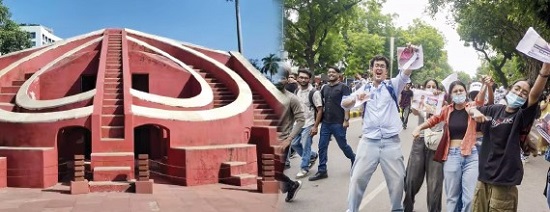
Few places in India have undergone such a remarkable transformation as Delhi’s Jantar Mantar. Once, built to study the movement of celestial bodies, it has, over the centuries, acquired another identity—as one of the country’s best-known public spaces for demonstrations, dharnas and expressions of democratic dissent.
A Monument to Scientific Vision-
' Jantar Mantar' was constructed way back in the year 1724 by Maharaja Sawai Jai Singh II of Jaipur, a ruler deeply interested in astronomy and mathematics. He established similar observatories also at Jaipur, Ujjain, Varanasi and Mathura.
The Delhi Jantar Mantar comprises a remarkable collection of large masonry astronomical instruments, including the Samrat Yantra, Jai Prakash Yantra, Rama Yantra and the compound Misra Yantra, together with several specialised instruments and components. The Principal yantras/instruments at Delhi Jantar Mantar are as follows :
The important point is that some names represent individual instruments, while others are components of the larger Misra Yantra or groups of instruments.
The Delhi observatory's Misra Yantra, for example, incorporates Karka Rashi Valaya, Dakshinottara Bhitti, Laghu Samrat and Niyat Chakras, among others.
At a time when modern telescopes and electronic instruments were unknown, these enormous structures represented an extraordinary combination of architecture, geometry and scientific knowledge.
From Observatory to “Dissent Square”:
Jantar Mantar was not originally built as a political venue. Its transformation into a centre of protest came much later. Delhi's Boat Club had traditionally been the preferred location for large political gatherings. After restrictions were imposed on large demonstrations there, Jantar Mantar increasingly emerged from the 1990s as a designated protest venue.
Its location, close to Parliament and important government offices, made it particularly significant. Over time, farmers, workers, students, social activists, government employees and political groups began using the site to put forward their demands.
Thus, a place once designed to measure the movement of the stars gradually became a place where people sought to make their voices heard by those in power.
Major Movements That Made History -
The history of Jantar Mantar as a protest site contains several important chapters :
Anna Hazare's anti-corruption movement in 2011 was one of the most significant. Hazare began a hunger strike demanding a strong Lokpal mechanism to combat corruption. The movement attracted enormous public attention and became a major turning point in contemporary Indian politics. It also contributed to the emergence of a new political force in Delhi.
The 2012 protests following the Nirbhaya case brought large numbers of young people onto the streets demanding greater safety for women and stronger legal action against sexual violence.
In 2017, Tamil Nadu farmers staged a prolonged and highly visible protest at Jantar Mantar, drawing national attention to agricultural distress, drought and farmers' demands.
The venue also witnessed demonstrations relating to the Citizenship Amendment Act, farmers' issues, labour concerns and other political and social questions.
In 2023, India's prominent wrestlers held a widely publicised protest at Jantar Mantar, bringing questions concerning sports administration and their allegations to the national stage.
The Political Importance of Jantar Mantar :
Jantar Mantar has never belonged exclusively to one political party or ideology. Governments and opposition parties have both faced demonstrations there. Political parties, civil-society groups and ordinary citizens have used the site to express support, opposition and demands for change.
Its importance lies precisely in this diversity. In a democracy, disagreement is not necessarily a sign of weakness; peaceful disagreement and dialogue can be part of the democratic process.
The CJP Movement of 2026 :
The latest major chapter in the story came in 2026, when the youth-led Cockroach Janta Party (CJP) movement brought a large student and youth mobilisation to Jantar Mantar. The protests centred on examination irregularities, concerns over the examination system, employment prospects and governmental accountability. The movement subsequently spread beyond Delhi.
The agitation reached a major turning point in July 2026, when Union Education Minister Dharmendra Pradhan resigned amid the political pressure generated by the protests. The government also agreed to several demands concerning examination reforms and related issues. Following these developments, CJP called off the physical agitation at Jantar Mantar on 25 July 2026, while protesters said that their broader campaign for justice and reform would continue.
The episode once again demonstrated the political importance of Jantar Mantar as a place where public mobilisation can attract national attention and compel political institutions to respond.
A Living Symbol of India –
The story of Jantar Mantar is therefore a fascinating journey—from astronomy to activism, from measuring time to recording the pulse of democracy.
The massive stone instruments built by Jai Singh II remind us of India's scientific heritage. The demonstrations that have taken place there remind us of the continuing importance of public participation, peaceful protest and democratic dialogue.
Jantar Mantar has consequently become much more than an archaeological monument. It is a place where history, science, politics and public opinion meet.
“The instruments once measured the movement of the heavens; today, the place reflects the movement of public opinion."
That remarkable transformation is what makes Jantar Mantar one of India's most unique historical and democratic landmarks.
“From the silent shadows of astronomical instruments to the powerful voices of the people, Jantar Mantar has travelled a remarkable journey—reminding us that knowledge illuminates the mind, while democracy gives that knowledge a voice.”
“The stars may have been its first subjects, but the people became its lasting voice.”
“Let Jantar Mantar return from a temple of agitation to a temple of knowledge—so that the vision of Maharaja Jai Singh II may once again shine through the light of science.”
(The content of this article reflects the views of writer and contributor, not necessarily those of the publisher and editor. All disputes are subject to the exclusive jurisdiction of competent courts and forums in Delhi/New Delhi only)





















Leave Your Comment