


Jamia Millia Islamia’s ongoing student agitation over the restoration of the students’ union has taken a contentious turn, prompting the university administration to shift classes online as a precautionary measure. The decision comes amid clashes between students and campus security personnel, controversy over slogans relating to Kashmir and Sharjeel Imam, and a political exchange involving the Congress and the BJP. As tensions mount, the challenge before the university is to address students’ democratic demands while maintaining campus discipline, academic continuity and the integrity of the institution.
The decision to conduct classes online, announced by Jamia Millia Islamia on Saturday, October 24, reflects the administration’s concern over the prevailing atmosphere on campus. In its notification, the university directed deans, heads of departments, directors, faculty members and students to adhere to the online class schedule and ensure regular participation in academic activities. Faculty members were also instructed to make appropriate arrangements for virtual teaching and provide students with the necessary learning materials and academic support. Although the administration described the move as a precautionary measure intended to safeguard students’ well-being, the development underlines how prolonged campus agitation can disrupt the primary responsibility of an educational institution: providing an uninterrupted academic environment.
The protests, which began on October 12, centre on the demand for the restoration of an elected students’ union. Jamia’s last students’ union elections were held in 2005, and the union was dissolved the following year. Students have since demanded an official notification establishing a schedule for fresh elections, arguing that an elected representative body is necessary to articulate their concerns and participate in campus affairs. The university administration, meanwhile, has constituted a committee to draft a new constitution for the proposed union. The dispute therefore concerns not merely an immediate election schedule but also the framework through which student representation will operate in the future.
The agitation intensified on October 17 when university authorities attempted to remove demonstrators from the Ghalib Lawn near Gate No. 7. The confrontation deepened the tensions between the protesting students and the administration, while several student organisations extended support to the movement. The appearance of slogans such as “VC go back” on campus walls added another dimension to the dispute. The university condemned the graffiti and initiated efforts to identify those responsible. Officials also reported that certain CCTV cameras had been tampered with and their wiring disconnected or damaged in areas where slogans appeared. Security arrangements were subsequently tightened, with students facing checks before being permitted to enter departments and centres.
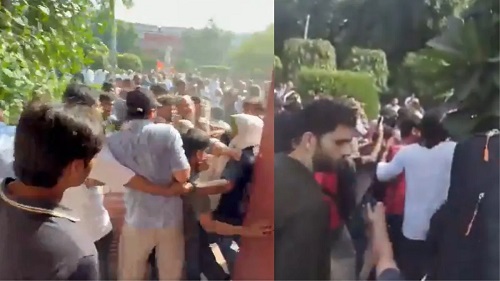
The controversy acquired a wider political dimension after videos circulated on social media purportedly showing clashes between students and university security personnel, with posters bearing the slogans “Free Kashmir” and “Free Sharjeel Imam”. The emergence of these slogans has drawn attention away from the students’ stated demand for an elected union and towards questions of political expression, national integrity and the conduct of demonstrations within university premises. However, the presence of particular slogans in circulating videos does not, by itself, establish the responsibility of the entire protesting group. Any inquiry into their origin and the circumstances surrounding the clashes should be based on verifiable evidence rather than assumptions about all participants in the agitation.
Congress MP Imran Masood, who was briefly detained on Friday after visiting the campus in support of the protesters, distanced himself from slogans advocating the division of India. He asserted that his party would not support anyone seeking to break up the country and maintained that Kashmir was an integral part of India. His statement appeared aimed at separating his support for the students’ protest from the controversial slogans that had become a subject of political debate.




















Leave Your Comment