


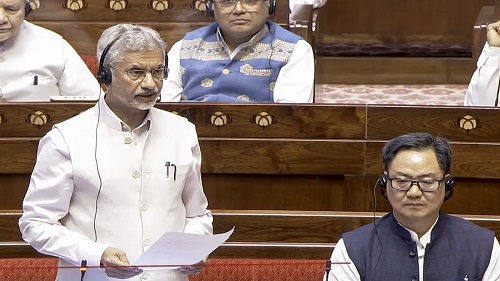
External Affairs Minister S. Jaishankar on Monday addressed the Rajya Sabha amid sloganeering by opposition members, presenting a detailed account of the escalating conflict in West Asia and its implications for India’s security, economy and diaspora.
The crisis began on February 28 after joint strikes by the United States and Israel reportedly killed Iran’s Supreme Leader Ali Khamenei. The development triggered retaliatory attacks by Iran targeting American military bases, Israeli assets and strategic installations in Gulf nations, significantly intensifying regional tensions.
Speaking in the Upper House, Jaishankar described the unfolding situation as deeply concerning for India. He pointed to the scale of violence, loss of lives and widespread damage to infrastructure across the region, which has disrupted normal life and created uncertainty in global supply chains. The minister noted that India has significant stakes in West Asia due to its geographic proximity, the presence of nearly one crore Indians living in Gulf countries, and thousands of Indian students and workers currently in Iran.
He also highlighted India’s reliance on the region for energy supplies, noting that several major oil and gas exporters critical to India’s energy security are located in West Asia.
Jaishankar reiterated that India had issued a statement on February 28 urging restraint and calling on all parties to prioritise civilian safety and avoid further escalation. The statement emphasised dialogue, diplomacy and respect for sovereignty.
He added that India followed up with another appeal on March 3 stressing the need for immediate de-escalation, especially as disruptions to global trade routes and supply chains began to emerge amid the intensifying conflict.
The minister informed the House that the government had undertaken extraordinary evacuation operations to assist Indian nationals in the region. According to him, nearly 67,000 Indians had crossed international borders to safer locations by the previous day.
Indian missions across the region have been operating in high-alert mode, providing round-the-clock assistance to citizens.
In Tehran, the Indian Embassy relocated students to safer areas while also helping business travellers leave the country through neighbouring Armenia. Jaishankar said advisories urging Indian nationals to leave Iran were issued well before the conflict intensified.
These advisories were released on January 5 and later strengthened on January 14, February 14 and February 23 as tensions mounted. The government also asked Indian seafarers to exercise caution, with the Directorate General of Shipping issuing warnings to maritime workers operating in the region.
Jaishankar also mentioned a humanitarian gesture extended by India during the crisis. An Iranian warship, IRIS Lavan, was permitted to dock at Kochi Port, a move that was acknowledged and appreciated by Iran’s foreign minister.
The minister said communication with Iranian leadership had been difficult due to the volatile situation, but India continued diplomatic outreach wherever possible.
The External Affairs Minister informed the House that the government was closely monitoring developments at the highest level. Narendra Modi and the Cabinet Committee on Security reviewed the situation in a meeting on March 1, coordinating responses across multiple ministries to ensure the safety of Indian nationals.
Jaishankar also conveyed the government’s condolences over the loss of Indian lives during the crisis. Two Indian mariners were killed in separate merchant shipping incidents linked to the ongoing conflict, while another remains missing.
He said the entire House shared the grief of the affected families and assured that all possible assistance would be extended.
Emphasising India’s deep economic and human ties with the region, Jaishankar said the government continues to assess the evolving situation and maintain contact with partners across West Asia. He noted that officials have also been in touch with fishermen from Iraq and other affected communities.
The minister reaffirmed the government’s commitment to protecting the Indian diaspora and facilitating safe returns where necessary. He added that Indian missions remain prepared to respond to emerging needs as the conflict continues to unfold.
Jaishankar concluded by stressing that the crisis in West Asia poses serious challenges not only to regional peace but also to global energy flows and the welfare of millions of expatriates, including Indians. He assured Parliament that the government, under the leadership of Prime Minister Narendra Modi, would continue to monitor the situation closely and take all necessary steps to safeguard India’s interests and citizens.




















Leave Your Comment