


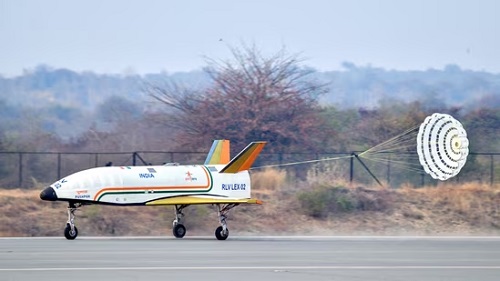
In a historic leap towards enhancing India's capabilities in space exploration, the Indian Space Research Organisation (ISRO) achieved a significant milestone with the successful landing mission of its Reusable Launch Vehicle (RLV) named 'Pushpak' on Friday (March 22). This groundbreaking endeavor unfolded at the Aeronautical Test Range (ATR) situated in Karnataka's Challakere, marking a pivotal moment in India's space journey.
Named after the legendary spaceship depicted in the ancient Indian epic, Ramayan, this was the third landing mission of the Pushpak RLV. ISRO had previously accomplished similar missions in 2016 and April of the preceding year, illustrating the agency's continuous strides in advancing space technology.
The culmination of this mission exemplifies ISRO's dedication to pioneering cutting-edge technologies aimed at revolutionizing space exploration. Pushpak is part of ISRO's ambitious initiative to develop essential technologies for a fully reusable launch vehicle, thereby facilitating low-cost access to space. S Somanath, the chairperson of ISRO, emphasized the significance of this mission, stating that Pushpak represents India's bold endeavor to make space exploration more affordable and sustainable.
Pushpak's design embodies innovation and efficiency, incorporating elements such as the X-33 advanced technology demonstrator, the X-34 testbed technology demonstrator, and the upgraded DC-XA flight demonstrator. This all-rocket, fully reusable single-stage-to-orbit (SSTO) vehicle holds immense promise in revolutionizing space transportation.
Key features of Pushpak include its fuselage, nose cap, double delta wings, and twin vertical tails. Additionally, the vehicle boasts symmetrically placed active control surfaces known as Elevons and Rudder, enhancing its maneuverability and control during flight.
One of the most noteworthy aspects of Pushpak is its potential to minimize space debris—a growing concern in the realm of space exploration. By enabling the safe retrieval and refurbishment of satellites from orbit, Pushpak aims to contribute towards mitigating space debris and ensuring sustainable practices in space exploration.
During Prime Minister Narendra Modi's visit to the Vikram Sarabhai Space Centre in Trivandrum, ISRO chairperson S Somanath briefed him about the RLV mission, highlighting its significance in India's space program. With an estimated cost of ₹100, Pushpak underscores India's commitment to leveraging indigenous innovation and technology to propel its space aspirations forward.
The successful landing mission of Pushpak heralds a new era in India's space odyssey, positioning the nation as a formidable player in the global space arena. As ISRO continues to push the boundaries of innovation, the journey towards unlocking the mysteries of the cosmos becomes ever more exhilarating. Pushpak stands as a testament to India's unwavering determination to explore new frontiers and inspire generations to come.

















.jpg)


Leave Your Comment