


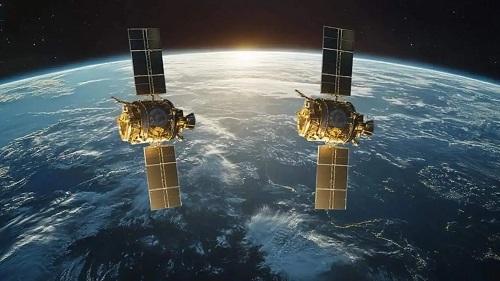
The Indian Space Research Organisation (ISRO) is gearing up for a historic moment as it prepares to launch two satellites from Sriharikota tonight to demonstrate in-orbit docking and undocking of spacecraft. This groundbreaking mission, if successful, will place India among an elite group of nations—the United States, Russia, and China—that have mastered this complex space technology.
The launch will be carried out using ISRO’s trusted workhorse, the Polar Satellite Launch Vehicle (PSLV). The two satellites, named SDX01 and SDX02, will be placed in a 476-km circular orbit. The mission’s centerpiece, the Space Docking Experiment (SpaDEx), is scheduled to take place in the first week of January.
The SpaDEx mission is a crucial stepping stone for India’s ambitious space exploration agenda. It involves the controlled docking and undocking of two satellites in orbit, a feat requiring precision engineering, advanced navigation, and sophisticated control systems. Successful execution will validate ISRO’s capabilities in autonomous spacecraft operations and open up avenues for a variety of future missions.
SpaDEx lays the groundwork for several upcoming initiatives in India’s space program:
Mastering space docking is a critical requirement for long-duration space exploration, including constructing space stations, conducting interplanetary missions, and performing in-orbit refueling. Until now, only the US, Russia, and China have achieved this technological milestone. ISRO’s success with SpaDEx will elevate India’s standing in the global space community.
Tonight’s launch is more than just another milestone; it represents India’s unwavering commitment to advancing space science and exploration. As the PSLV roars into the skies from Sriharikota, it carries not only two satellites but also the aspirations of a nation poised to achieve a historic breakthrough in space technology.
With SpaDEx, ISRO continues to chart a bold trajectory, inspiring future generations and reinforcing India’s position as a major player in the global space race.





















Leave Your Comment