


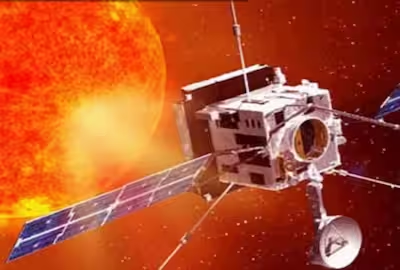
India's foray into space exploration has reached a new milestone with the successful activation of the Aditya Solar Wind Particle Experiment (ASPEX) onboard the Aditya-L1 satellite. The Indian Space Research Organization (ISRO) announced the operational status of ASPEX on Saturday, showcasing the country's achievements in space-based solar observation. Launched on September 2 from the Satish Dhawan Space Center in Sriharikota, the Aditya-L1 spacecraft is the first-of-its-kind space-based observatory dedicated to studying the Sun.
Aditya-L1's primary objective is to observe and study the Sun from a unique vantage point known as the halo around the Lagrangian point 'L1.' This point is situated approximately 1.5 million kilometers away from Earth, allowing the spacecraft to capture unprecedented data about the Sun and its various phenomena.
The Aditya Solar Wind Particle Experiment (ASPEX) comprises two cutting-edge instruments: the Solar Wind Ion Spectrometer (SWIS) and the Suprathermal and Energetic Particle Spectrometer (STEPS). These instruments play a crucial role in gathering valuable data about solar winds and other high-energy particles emitted by the Sun.
The STEPS instrument was successfully launched on September 10, 2023, marking a significant step in the mission. Following this achievement, the SWIS instrument was activated on November 2, 2023, and ISRO has reported that it is functioning exceptionally well.
ISRO's statement reveals that the Solar Wind Ion Spectrometer (SWIS) has successfully measured solar wind ions, focusing primarily on protons and alpha particles. This success is a testament to the precision and efficiency of the instrument, showcasing its capability to analyze the composition and behavior of solar winds emanating from the Sun.
The Aditya Solar Wind Particle Experiment holds immense scientific importance in advancing our understanding of the Sun and its impact on space weather. Solar wind, a continuous stream of charged particles from the Sun, plays a crucial role in shaping the space environment around our planet. By studying these particles, scientists can gain insights into solar phenomena, such as solar flares and coronal mass ejections, which can have significant implications for Earth's technological infrastructure.
India's Aditya-L1 mission, with the successful activation of the Aditya Solar Wind Particle Experiment, marks a significant achievement in space exploration and solar observation. The functioning of SWIS and the earlier launch of STEPS contribute valuable data to the global scientific community, enhancing our understanding of the Sun and its influence on space weather. As ASPEX continues its operations, it promises to unravel new mysteries of our star and contribute to advancements in space science.




















Leave Your Comment