


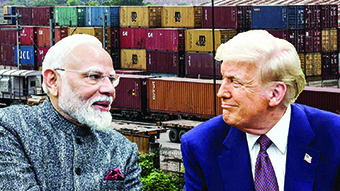
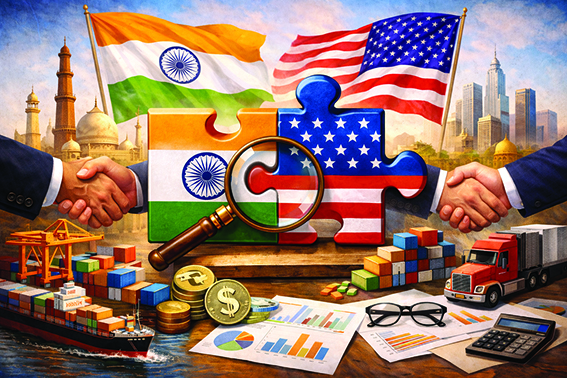
The Indo-U.S. trade relationship is often judged by what it lacks — a comprehensive free trade agreement, sweeping tariff reductions, or a single headline-grabbing deal. But when Viewed through the lens of negotiation skill, the India–United States trade engagement is not a failure of diplomacy; it is a case study in deliberate, disciplined, and strategically restrained negotiation.
India had limited room to confront Trump head-on because his aggressive, headline-driven trade style made escalation financially risky for India’s valuable exposure: the U.S. market and $70B+ services exports. Unlike China, India lacked—manufacturing depth, state support, and shock-absorbing capacity—to sustain a trade war without damaging exports, investor confidence, and IT services. So, India chose restraint: it absorbed rhetoric, offered small symbolic concessions, held firm on core red lines like agriculture and data, and played for time. This avoided $20–30B a year in potential losses and preserved its much larger ongoing gains, meaning India didn’t “lose” to Trump’s arrogance—it pragmatically paid a small ego tax to protect far bigger financial interests.
The Limits of Rahul Gandhi’s Leadership: Absence, Erraticism, and Moral Posturing
Without engaging with the economic and strategic nuances of the Indo-US trade arrangement, Rahul Gandhi has criticised the deal in the familiar style of an opposition leader—but without facts. The criticism reflects a pattern: his limitations as a leader stem less from ideology and more from persistent deficits—chronic absence from Parliament and campaigns, erratic and dramatic interventions that bypass institutional process, and a weak command over policy detail. Moral condemnation becomes his default because it plays to his strengths while masking these shortcomings, often amplified by selective reading of media narratives and secondary sources.
In doing so, Rahul Gandhi also invites yardsticks he cannot win on historically. Once the debate shifts from intent to competence, the record of Rajiv Gandhi—on Bofors, Sri Lanka, China re-engagement, and internal security—appears far more exposed. This is why critics argue he is “digging his own grave”: by escalating disagreement into accusations of leadership failure, he opens his own family legacy to harsher scrutiny.
That scrutiny is not new. Insider accounts such as former home secretary C.G. Somaih’s book ‘The Honest Always Stand Alone’ portray Rajiv Gandhi as well-meaning but indecisive, poorly briefed, and overly reliant on advisers—a narrative long familiar in policy circles. When Rahul accuses the present government of weakness or compromise, he inadvertently revives these comparisons, where the historical record offers him little protection.
From Vulnerability to Leverage: India’s Energy Diplomacy in Perspective
The United States has been deeply woven into India’s strategic journey since the freedom struggle, from facilitating colonial India’s entry into the League of Nations and later the United Nations—backed by the U.S. president despite British resistance. For decades, India approached Washington from a position of vulnerability: Nehru sought U.S. intervention during the 1962 China war, and Indira Gandhi depended on American food grain supplies in the late 1960s. That imbalance persisted even in recent history. Under the UPA, India’s response to U.S. pressure on Iranian oil was swift and compliant. By contrast, the Modi government adopted a firmer stance on Russian oil. Despite Western sanctions, Russia’s share of India’s crude imports rose from 1.7 per cent in FY20 to about 35 per cent in FY25, making it India’s largest supplier.
Best Alternative to a Negotiated Agreement (BATNA).
At its core, the Indo-U.S. trade dialogue reflects high preparation on both sides. Neither country enters talks casually. The United States comes armed with clear commercial objectives — market access, regulatory transparency, and intellectual property protection. India arrives equally prepared, but with a defensive posture shaped by domestic political economy: protecting farmers, MSMEs, and policy autonomy. This asymmetry in objectives does not signal weakness; it signals clarity. Skilled negotiators know what they cannot concede as much as what they want to gain.
A defining feature of these negotiations is the strength of both sides BATNA. India’s large domestic market and diversified trade partners reduce pressure to accept unfavourable terms. The U.S., meanwhile, has alternative sourcing destinations and powerful trade tools. The result is predictable but telling: negotiations move slowly. In negotiation theory, urgency often forces compromise; its absence allows patience. The Indo-U.S. case demonstrates how strong alternatives can lead to incrementalism rather than breakthroughs.
Managing positions and interests.
Perhaps the most underappreciated skill on display is the ability to distinguish — and strategically blur — positions and interests. Publicly, the two sides clash over tariffs, data localization, and subsidies. Privately, their deeper interests converge around supply-chain resilience, technology cooperation, and geopolitical alignment in the Indo-Pacific. Progress has occurred precisely where negotiators shifted the conversation from rigid positions to shared interests — in semiconductors, defence manufacturing, and clean energy. This is textbook negotiation competence.
relationship management
Equally significant is relationship management. Trade disputes that might otherwise escalate are carefully ring-fenced. Political leadership on both sides has consistently signalled that trade disagreements will not define the partnership. This restraint reflects mature negotiation skill: knowing that preserving the relationship can be more valuable than extracting marginal economic gains.
Preserving flexibility
Communication, however, reveals a trade-off. The process is dense with dialogues, working groups, and joint statements, yet thin on public clarity. For governments, this ambiguity preserves flexibility; for businesses, it is on leverage, the imbalance is real but nuanced. The U.S. wields economic and technological power; India counters with market scale and geopolitical relevance. India’s ability to convert strategic importance into negotiating leverage — without overt confrontation — is a notable skill, allowing it to resist pressure while remaining engaged.
Concessions, when made, are small, reciprocal, and reversible. Neither side gives away core interests for symbolic wins. This cautious concession strategy reflects mutual scepticism and long-time horizons — hallmarks of negotiations where trust is built slowly rather than assumed.
If there is a weakness, it lies in closure. The relationship produces frameworks more often than binding commitments. From a negotiation-skills perspective, this suggests risk aversion rather than incapacity. Both sides prefer managed ambiguity to irreversible commitments.
Ultimately, the Indo-U.S. trade deal — or lack of a grand one — reveals negotiators who prioritize control, patience, and strategic alignment over speed or spectacle. In an era of transactional diplomacy, this may seem underwhelming. In reality, it is a reminder that the most skilled negotiations are often the quietest — measured not by dramatic agreements, but by relationships that endure despite unresolved differences. Let’s explore minor details.
Big picture first (important context)
• Trade volume: ~USD 190–200 billion annually (goods + services)
• Balance: India runs a trade surplus with the U.S. (roughly USD 30–35B)
• Nature of “deal”: Not an FTA — more of a managed trade relationship
What India gained (financially & economically)
1. Protection of its domestic manufacturing
India successfully avoided a full FTA, which means:
• No forced deep tariff cuts on Agriculture, Dairy, MSME-heavy manufacturing and no large-scale opening to subsidized U.S. farm goods
2. Services.
India’s strongest export to the U.S. is not goods but services, led by IT, consulting, engineering, and back-office digital work. Despite periodic visa and political tensions, Indian firms retained market dominance, faced no major outsourcing restrictions, and continued deep access to U.S. corporate clients. Financially, this mattered most: services exports to the U.S. exceed USD 70 billion annually, generate high margins, and remain strongly forex-positive. This income stream—where India makes its real money—stayed fully intact.
3. Resolution of WTO disputes (tariffs)
India and the U.S. resolved key trade disputes covering steel and aluminium tariffs and India’s retaliatory duties on U.S. products like almonds, apples, and walnuts. This settlement reduced uncertainty, lowered compliance and litigation costs, and restored predictability to cash flows for Indian exporters—especially in metals. While not headline-grabbing, the financial value of stability and certainty was significant.
4. Strategic access to U.S. capital & tech.
Through trade-linked cooperation, India enabled easier U.S. investment in strategic sectors such as semiconductors, defence manufacturing, and clean energy, with an emphasis on joint production rather than pure imports. This brought capital inflows, job creation, and technology spillovers while allowing India to retain control over market access. The approach was selective and strategic, not a wholesale opening.
What the U.S. gained (financially & economically).
India offered targeted tariff reductions on medical devices, ICT products, energy equipment, and select agricultural goods, giving U.S. firms higher sales volumes and early positioning in a fast-growing market. The financial value lies mainly in future revenue potential, especially as U.S. access to China becomes more uncertain.
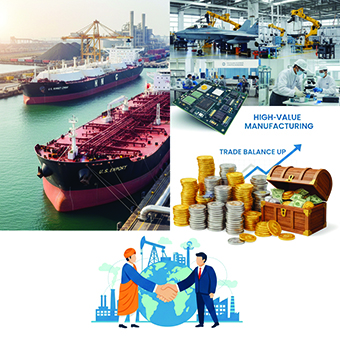
India increased imports of U.S. crude oil, LNG, and temporarily coal, generating billions of dollars in energy export revenue for the U.S. These flows helped narrow the U.S. trade deficit with India and created long-term supply contracts that provide stable, predictable cash flows—one of the most direct financial wins for Defence and high-value manufacturing sales:
U.S. companies benefited from Indian purchases of aircraft, drones, engines, and defence technology components. These are high-margin exports with strong domestic multiplier effects in the U.S., further reinforced by long-term maintenance and upgrade contracts. Defence trade is structurally asymmetric, favouring the seller.
Strategic de-risking from China: Beyond trade flows, U.S. firms used India as a destination for supply-chain diversification away from China. This reduced long-term geopolitical risk exposure, delivering risk-adjusted economic gains through lower expected future losses—more like insurance value than immediate trade revenue.
Who got the better financial deal?
Short-term cash flow winner: India
• Trade surplus remains
• High-margin services exports untouched
• Domestic sectors protected
• No painful structural concessions Medium-to-long term strategic winner: U.S.
• Energy exports locked in
• Defence sales growing
• Early access to India’s consumer market
• Supply-chain diversification payoff
One-line takeaway
The Indo-US trade engagement is a study in asymmetry by design: India secured immediate financial protection and safeguarded its high-margin services exports, while the United States gained energy and defence sales along with long-term strategic access to India’s market—an equilibrium that allows both sides to credibly claim victory.
The financial scorecard
For India, the numbers speak plainly. A sustained trade surplus of $30–35 billion, services-sector profits of $13–18 billion, avoided losses in sensitive domestic sectors worth $15–23 billion, and $1.5–2 billion in tariff-dispute relief together deliver an annual benefit of roughly $60–78 billion. These are immediate, cash-flow-positive gains that reinforce economic stability rather than defer it.
The U.S. outcome is more patient and strategic. Annual gains of $12–17 billion are concentrated in energy exports, defence sales, and early positioning in a fast-growing consumer market. While the trade balance remains negative for Washington, the payoff lies in high-margin defence contracts, long-term energy supply agreements, and reduced exposure to China-centric supply chains.
A balanced but unequal bargain
Side-by-side, the contrast is clear. India focused on near-term cash flows and low structural risk, anchored by services exports. The U.S. accepted smaller immediate gains in exchange for gradual, strategic returns in defence, energy, and market access. That asymmetry is not a flaw—it is the logic of the deal. India monetised the relationship in the present; the U.S. is betting on the future.
Final Verdict (pure finance, no geopolitics)
• India clearly won on annual cash flow and income protection.
• U.S. accepted lower short-term gains for long-term positioning.
Does the deal worth more than losses expected on reduced Russian oil imports?
While the full details of the wIndo-US trade arrangements are still emerging and some elements may cause short-term discomfort, the broader outcome remains clearly positive. Critics may point to the potential loss of discounted Russian crude, but it is important to recognize that Indian negotiators successfully delayed reduction for a prolonged period, ensured it would not be abrupt, and retained flexibility—especially since sanctions could ease if the Ukraine conflict de-escalates. Even after assuming a complete reduction in Russian oil supplies, India continues to preserve a substantial net annual gain of roughly $46–68 billion from its Indo-US trade engagement.
Conclusion.
The deal remains financially significant. Even the worst-case scenario, oil-related losses eroding only about 15–20 percent of the overall gains and does not dilute the strategic or economic value of closer ties with the U.S. More importantly, the agreement lowers the risk of escalation in other trade and geopolitical friction points and strengthens India’s position as a preferred destination for Western investment as global firms seek to de-risk supply chains away from China. Markets have already delivered their verdict: equities rallied, the rupee strengthened, and foreign investor interest revived. For investors and policymakers alike, the message is clear—the Indo-US trade arrangement reduces uncertainty, enhances long-term growth prospects, and reflects a pragmatic, financially rational strategy by India.
RAKESH KUMAR
(The content of this article reflects the views of writer and contributor, not necessarily those of the publisher and editor. All disputes are subject to the exclusive jurisdiction of competent courts and forums in Delhi/New Delhi only)




















Leave Your Comment