


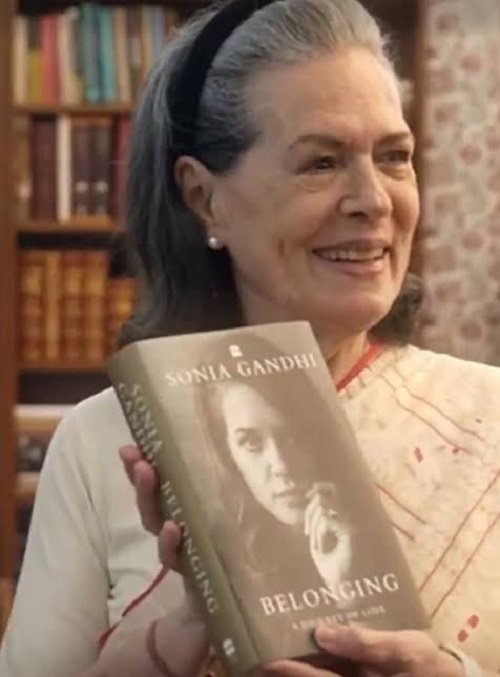
For Sonia Gandhi, the road to becoming India's Prime Minister in 2004 was not simply a question of political destiny or the mandate of an election. It was a deeply personal struggle involving family tragedies, political obligations, emotional pressure and an intense search for her own convictions. In a revelation in her memoir Belonging: A Journey of Love, released on November 10, 2026, the Congress leader has opened up about the dramatic hours that preceded her decision to decline the country's highest political office. She recalls how she initially rejected the possibility outright, briefly appeared to yield to pressure from alliance leaders with a barely audible 'Theek hai', and subsequently reversed course after an emotional confrontation with Rahul and Priyanka Gandhi.
For nearly 22 years, Sonia Gandhi's decision to decline the Prime Minister's post after the Congress-led alliance secured victory in the 2004 Lok Sabha elections has remained one of the most discussed episodes in contemporary Indian politics. While the public witnessed her announcement and the subsequent elevation of Dr Manmohan Singh as Prime Minister, the personal conflict behind that decision largely remained unknown. In her newly released memoir, Belonging: A Journey of Love, Sonia Gandhi has now provided an account of the events, conversations and emotional turmoil that shaped her choice.
According to her recollection, the question of her becoming Prime Minister had been discussed within the family several months before the elections. Rahul Gandhi and Priyanka Gandhi had directly asked their mother whether she would accept the position if the Congress returned to power. Her response was unequivocal: "Absolutely not!" When they sought confirmation, she reiterated that she was clear about her decision. Both children opposed the idea because of the traumatic history of their family. Their grandmother, former Prime Minister Indira Gandhi, was assassinated in 1984, while their father, former Prime Minister Rajiv Gandhi, was killed in a suicide bombing in 1991. For them, the office of Prime Minister carried an association with extraordinary personal danger and the possibility of another devastating family tragedy.
The political situation, however, changed dramatically after the 2004 election results. The Congress emerged as the largest party in the alliance that would form the next government, and Sonia Gandhi became the natural choice of coalition partners to lead it. At her residence, 10 Janpath, senior alliance leaders assembled in Rajiv Gandhi's conference room and pressed her to accept the premiership. She listened to their arguments but maintained that she did not wish to occupy the office. What followed, as described in her memoir, was an unusually forceful exchange. The leaders stood up, approached her and insisted that her refusal was unacceptable. Their message was unmistakable: they would not take no for an answer.
Feeling overwhelmed by the collective pressure, Sonia Gandhi uttered a faint "Theek hai". Before she could explain herself further, the leaders began congratulating one another, interpreting her hesitant response as acceptance. But outside the conference room, Priyanka had witnessed the exchange. Disturbed by what she believed was her mother's capitulation under pressure, she rushed to find Rahul. Both immediately confronted Sonia.
Rahul's reaction was particularly emotional. When he asked whether she had agreed to become Prime Minister, Sonia explained that the leaders had refused to listen and that she had been pressured into giving the response. Rahul's angry question, "Pressurised? You are being pressurised? What about us?", reflected the deep anxiety that the family had carried since the assassinations of Indira and Rajiv Gandhi. Priyanka, meanwhile, reminded her mother that she had always been certain about not accepting the post. She urged her not to surrender her decision to political pressure and assured her that the family would stand beside her.
The confrontation left Sonia Gandhi emotionally exhausted. She withdrew to her bedroom and lay on Rajiv Gandhi's side of the bed. It was there that the most difficult part of her decision unfolded. As she describes it, two competing voices occupied her mind. One questioned whether a woman born and raised in Italy should assume the leadership of a country of more than a billion people. The other reminded her that India had become her country, had embraced her after Rajiv Gandhi's assassination and had given her and her family support through their darkest moments. She also felt a responsibility towards the Congress workers and millions of supporters who had placed their confidence in her leadership.
Sonia Gandhi's account in Belonging: A Journey of Love goes beyond explaining why she did not become Prime Minister. It reveals the intersection of personal loss, political expectations and the burden of leadership in a family whose history had been repeatedly shaped by violence. Her refusal was neither an overnight impulse nor simply a decision dictated by her children. It emerged from a prolonged internal struggle between the obligations of political leadership and the determination to remain faithful to a deeply held personal conviction.




















Leave Your Comment