


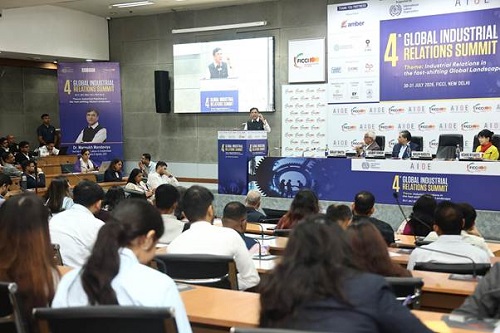
India’s social protection system now covers nearly 101 crore people—more than 68 per cent of the country’s population—Union Minister for Labour & Employment and Youth Affairs & Sports Dr. Mansukh Mandaviya said while addressing the 4th Global Industrial Relations Summit in New Delhi on Friday. The Minister described the achievement as a significant milestone in India's journey toward inclusive growth and social security, adding that it has received global recognition through the International Labour Organization (ILO).
Speaking at the summit, Dr. Mandaviya said the International Labour Organization had highlighted India's expanding social protection coverage during the BRICS Labour Ministers' Meeting held in Hyderabad last week. He said the acknowledgement reflects the international community's recognition of India's efforts to extend social security benefits to a large section of its population through various welfare initiatives and labour reforms.
The 4th Global Industrial Relations Summit was organised by the All India Organisation of Employers (AIOE) in association with the Federation of Indian Chambers of Commerce and Industry (FICCI) and the International Labour Organization. The event brought together policymakers, employers, industry leaders, labour representatives and international experts to deliberate on the future of industrial relations, employment and workforce welfare.
Highlighting the importance of collaborative policymaking, Dr. Mandaviya said harmonious industrial relations can only be achieved through continuous coordination among governments, industries, employers, workers and trade unions. Such cooperation, he noted, is essential to ensure that economic development goes hand in hand with employment generation and worker welfare.
The Minister stressed that industrialisation remains a key driver of national development, creating employment opportunities and strengthening the country's economic foundation. However, he added that industrial growth must be accompanied by robust social protection measures to ensure that workers benefit from the country's economic progress.
Dr. Mandaviya also underscored the growing role of self-help groups and cooperative models in generating livelihoods, particularly for women. He said women-led self-help groups have emerged as powerful instruments of economic empowerment by promoting entrepreneurship, financial inclusion and community development. According to him, strengthening these grassroots institutions can contribute significantly to expanding employment opportunities while making economic growth more inclusive.
Emphasising the need for balanced development, the Minister said policies should simultaneously protect the interests of workers and create a business-friendly environment for employers. "It is essential to have a balanced development model that advances the welfare and social security of workers, as well as ensure ease of doing business for employers," he said.
He noted that sustainable industrial growth depends on trust and cooperation between employers and employees. Strong labour-management relations, transparent communication and effective dispute resolution mechanisms, he said, are critical for maintaining industrial peace and enhancing productivity.
The Minister's remarks come at a time when India is pursuing labour market reforms and expanding social welfare programmes to support a growing workforce. The government's emphasis on extending social security coverage, promoting employment generation and encouraging entrepreneurship is aimed at ensuring that economic growth translates into improved livelihoods and greater social inclusion.
The summit concluded with discussions on strengthening industrial relations frameworks, enhancing workforce participation and promoting policies that support both enterprise growth and worker welfare. Participants emphasised that collaboration among governments, employers, trade unions and international organisations will remain central to building resilient labour markets and achieving sustainable economic development.



















Leave Your Comment