



AMARTYA SINHA
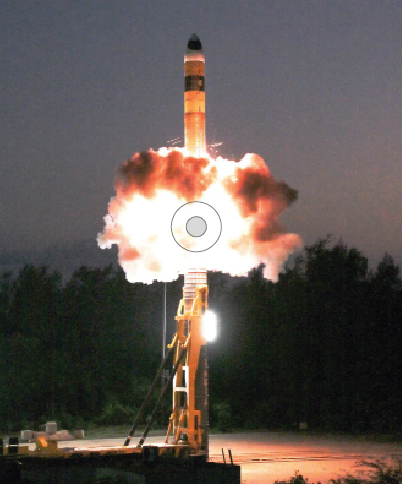
On May 8, 2026, India successfully carried out the second flight test of Agni-V missile’s MIRV version. Agni-V had already undergone the first ever successful test-flight with MIRV (Multiple Independently targetable Re-entry Vehicle) warheads capability under Mission Divyastra on March 11, 2024. India’s Agni-V ICBM (Intercontinental-range Ballistic missile) has undergone a total of 12 successful trials since its maiden flight in April 2012. But an effective Indian minimum credible nuclear deterrence against China still remains unfulfilled due to Agni-V’s limited payload carrying capacity of 1.5 tonnes. India’s integrated guided-missile development programme needs to go the extra mile in many aspects.
As per reports, the entire launch system of Agni-VI is now fully ready. DRDO is also working on the launcher for ‘DRDO Veda’ (Vehicle for Defence Application)- a satellite launch vehicle (SLV) variant of Agni-VI which will have similar specifications as the ICBM. All three wings of the Indian armed forces will be able to launch military satellites into low earth orbit at a very short notice by using DRDO Veda which will significantly decrease their dependence on ISRO and boost their objectives of self-reliance. DRDO Veda will also implement the method of horizontal stacking of stages and payloads for assembling the launch vehicle before launch, which will be completely different from the vertical stacking method used in ISRO’s SSLV rocket. The vehicle will be highly agile and mobile, and can be launched from a multi-axle TEL (Transporter Erector-Launcher) vehicle. This conclusively confirms the existence of the ambitious Agni-VI ICBM programme.
A year after Operation Sindoor, China has overtly declared its strategic support for Pakistan. Moreover, USA’s hegemonic actions in Venezuela and Iran have proved the significance of having a strong nuclear deterrence capability. Thus, the situation leaves a big window of opportunity open for India to expand its nuclear deterrence umbrella by openly testing the Agni-VI ICBM.
The legacy of Agni-V
While the Agni-V, the nuclear capable intercontinental range ballistic missile (ICBM), has undergone ten successful test flights since 2012, there has been very little movement on the much-awaited Agni-VI missile project. After Agni-V’s maiden trial on April 19, 2012, former DRDO Chairman, Dr Vijay Kumar Saraswat had very clearly stated that India had no intention to cap the Agni missile programme and that there would be more missiles in the Agni series as a follow-up of Agni-V in the coming years. The Agni-V has an effective range of almost 5500 kms with a 1.5-tonne nuclear warhead. A basic law of physics is that due to gravity and momentum, there is an inverse relationship between the weight of a warhead and the range of a missile. If the same rocket boosters of Agni-V (better with a slow burning propellant) for the heavy load is used for a lighter load amounting to a 500 kg warhead, the range of the missile can be enhanced up to 10,000 km. So, by this theory, the Agni-V is already a 10,000 km-class ICBM albeit with a less powerful warhead. And this is one of the prime gaps in India’s nuclear deterrence which the Agni-VI is supposed to plug. Agni-VI is expected to have a range between 10,000 kms and 12,000 kms with a 3-tonne nuclear payload, and a range between 14,000 kms and 16,000 kms with a lighter 1.5 tonne package. Guidance system of Agni-VI will include inertial navigation system with Ring laser gyroscope, optionally augmented by IRNSS (Indian Regional Navigation Satellite System) along with terminal guidance with possible radar scene correlation (this is a kind of terrain contour mapping which will improve the accuracy of missile).
A very strong case for Agni-VI
In 2011, IAF’s former Chief of Air Staff, Pradeep Vasant Naik, who was also the head of Chiefs of Staff Committee had vehemently argued in favour of broadening India’s nuclear striking capabilities beyond the immediate neighbourhood. The higher range of Agni-VI will bring at least four of the capitals of major world powers (veto powers) within India’s thermonuclear strike envelope. A 12,000 km-plus range will increase India’s flexibility which is very important for an effective deterrence and will also enable the country to hit Chinese ballistic missile submarines (SSBNs), aircraft carriers and warships attempting to hide as far out as the Southern Indian Ocean and Central Pacific Ocean. This is assuming that India develops more accurate ICBM guidance systems (on the lines of China’s DF21D anti-ship ballistic missile) against warships, aircraft carriers and submarines. India must wish that the Agni-VI should have the minimum range of 10,000 km (more than China’s JL-2 submarine-launched ballistic missile) which will make the ICBM programme worthy of its stature.
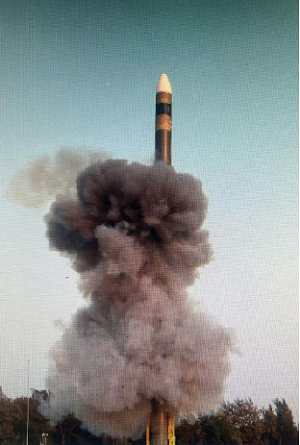
Agni-V MIRV ICBM during Mission Divyastra on March 11, 2024
Role of Indian private companies
The primary design and production of India's strategic ballistic missiles are strictly led by the government-run DRDO and manufactured by the public sector undertaking Bharat Dynamics Limited (BDL). However, India’s strategic missile architecture relies on an expansive network of private tier-1 and tier-2 defence companies. These private entities develop critical subsystems, propulsion components, structural materials, and electronics for the Agni series, including the Agni-VI ICBM programme.

Rangle of Agni-VI nuclear-capable ballistic missile
ICBM as a force multiplier
Agni-VI is supposed to be a solid-fuelled multistage ICBM capable of carrying up to ten nuclear/ thermonuclear warheads in MIRV (Multiple Independent Re-entry Vehicle) and MaRV (Manoeuvrable Multiple Independent Re-entry Vehicle) configurations. The rocket may also have the capability to carry light decoys and chaffs to beat the most formidable anti-ballistic missile systems and to confuse hostile radar defences. As India has reportedly developed a deadly arsenal of double-staged thermonuclear fusion devices and single stage boosted-fission bombs, each MIRV warhead may have explosive yields of up to 250 kilotons, thus capable of wiping out entire metropolitan areas of the enemy with a single strike. Having a gross weight of up to 70 tonnes, Agni-VI is supposed to be a four-stage rocket which will also enable the Indian military to launch military satellites into low earth orbit (LEO) during contingencies, thus also validating its FOBS (Fractional Orbital Bombardment System) capability. Renowned strategic experts like Bharat Karnad, Brahma Chellaney and Rakesh Krishnan Simha have repeatedly argued in the past that India must develop a global striking capability with a credible ICBM force in the near future.
“It is high time for India to develop genuine ICBMs with 12,000+ kms range. The Agni-VI project should be immediately approved for development and testing. Geopolitical pressures faced by a country are always the results of a nation’s will and its strategic vision. The incumbent union government must show the spine to stand up to such pressures without which India can never aspire to become a great power”, says Bharat Karnad, Emeritus Professor for National Security Studies at the Centre for Policy Research and a popular national security expert. A large ICBM force consisting of Agni-V and Agni-VI missiles will ensure a very strong security shield for the country in the strategic level battlefield and will severely deter big powers from attempting Balkanisation of India during future conflicts. It is high time for the incumbent government to prove its political will by swiftly approving the Agni-VI ICBM programme and by test launching the first prototype over the coming months, thus pushing India into the elite league of military superpowers like USA, Russia and China. Such a capability will give India tremendous diplomatic leverage at global high tables.
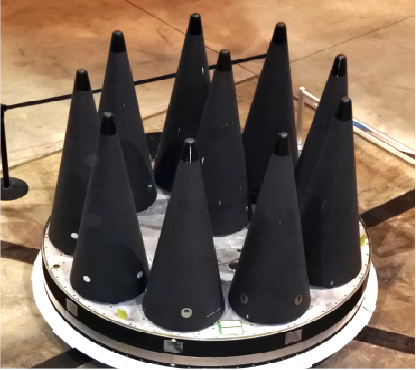
MIRV warheads of a long-range ballistic missile
Doing it smartly
A full-range test of Agni-VI (beyond 10,000 km) will probably raise eyebrows in Western media circles. The best way to execute the test is to declare the missile’s official range up to 10,000 km (tacitly stating the China-factor), but carry out the flight with a 3-tonne superheavy warhead. This will totally validate the new missile’s capability without creating a diplomatic row with the West. Moreover, such a test will also yield significant political advantage for the ruling dispensation as the scientific achievement can be narrated by the Prime Minister to the domestic electorate as a major historic milestone (on the lines of the ASAT test carried out in March 2019 and Mission Divyastra in March 2024).
Evading Western glare
As soon as Agni-VI is tested and validated, Prime Minister Narendra Modi may also declare a permanent voluntary moratorium on the development of longer ranged missiles and officially cap the ICBM programme at 10,000 km. Former Prime Minister Atal Bihari Vajpayee had declared a similar permanent voluntary moratorium on nuclear tests after the Pokhran-2 series of explosions in May 1998, and this had aided in his rise as a global statesman. Hence it is time to demonstrate this new strategic capability at the earliest.
The union government needs to complete the Agni-VI and DRDO Veda projects soon, as without a credible ICBM force, India will always be looked upon as nothing more than a subcontinental bully- a nation that aspires to play hardball with the giants but ends up relegated to the minor league. The ball is now in the ruling dispensation’s court.
(The content of this article reflects the views of writer and contributor, not necessarily those of the publisher and editor. All disputes are subject to the exclusive jurisdiction of competent courts and forums in Delhi/New Delhi only)




















Leave Your Comment