


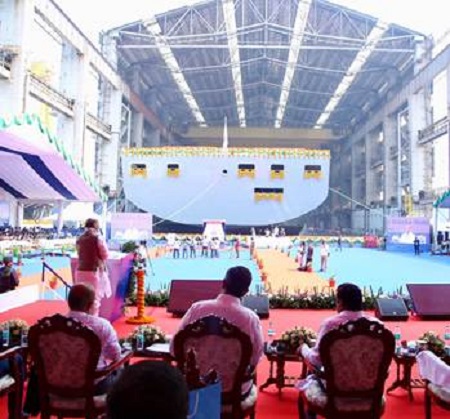
India’s maritime ambitions are entering a new phase, where indigenous shipbuilding is increasingly being viewed not merely as a defence requirement but as a strategic pillar of national power. The launch of the first Fleet Support Ship, the keel laying of the fifth vessel in the series and the inauguration of upgraded shipbuilding infrastructure at Hindustan Shipyard Limited (HSL), Visakhapatnam, underline this larger transformation. The milestones announced by Defence Minister Rajnath Singh on October 6, 2026, point towards an India that seeks not only to build more ships domestically but also to create the capacity, technology and industrial ecosystem required to compete with leading global shipbuilding nations.
The launch of FSS-1, named Surya, marks an important addition to the Indian Navy’s logistical and operational capabilities. Fleet Support Ships are critical to sustaining naval operations far from home bases because modern maritime power depends not only on frontline warships but also on the ability to replenish fuel, supplies and other essentials at sea.
For a Navy operating across the vast Indian Ocean Region, endurance is a strategic advantage. Fleet Support Ships can enable warships to remain deployed for longer periods, thereby expanding operational reach and flexibility. Their enhanced cargo and fluid capacity, maintenance facilities, helicopter deck and self-defence systems make them important components of a sustained naval presence.
The keel laying of FSS-5, meanwhile, represents continuity in the programme. If the launch demonstrates what HSL can deliver, the keel laying demonstrates its ability to sustain a larger shipbuilding pipeline. Together, the two milestones reflect both immediate capability and long-term industrial planning.
Rajnath Singh aptly described the launch of FSS-1 as a symbol of achievement, the keel laying of FSS-5 as a symbol of resolve and the upgraded slipway as a symbol of growing capability. The message is significant: maritime strength cannot be measured only by the number of warships in service; it also depends on the industrial infrastructure capable of designing, constructing, maintaining and upgrading those platforms.
The transformation at HSL is particularly significant because the shipyard is now preparing itself to handle larger and more sophisticated construction programmes. The upgraded Slipway-4 has been extended and strengthened to enable construction and launching of ships of up to 45,000 DWT.
The inauguration of the 300-tonne Goliath Crane is another major technological addition. Spanning Slipways 3 and 4, the crane has been manufactured by L&T Geostructure with Konecranes under the Make in India framework. Its PLC controls, variable-frequency drives, tandem lifting, remote diagnostics and condition-monitoring systems are designed to improve precision and efficiency in handling heavy ship blocks.
This matters because modern shipbuilding increasingly depends on block construction, where large sections are fabricated separately and subsequently assembled. The ability to handle heavier blocks efficiently can reduce construction time, improve productivity and create the capacity to undertake more complex platforms.
HSL’s transformation also has institutional significance. Its achievement of Miniratna Category-I status in 2025, after coming under the Ministry of Defence, reflects its evolving role within India’s defence industrial base. From its historic association with the construction of Jala Usha in 1948 to contemporary naval platforms, the shipyard represents a long arc in India’s indigenous maritime journey.
The larger challenge now is to convert individual shipyard achievements into a comprehensive maritime industrial ecosystem. Rajnath Singh’s emphasis on linking HSL with Andhra Pradesh’s MSMEs, universities, technology companies and startups therefore assumes considerable importance.
A globally competitive shipbuilding industry cannot be created by shipyards alone. It requires a network of component manufacturers, engineering firms, technology developers, research institutions, skilled workers, logistics providers and maintenance companies. Such an ecosystem can simultaneously generate employment, deepen domestic supply chains and reduce dependence on imported technologies and components.
Visakhapatnam has a natural advantage in this regard. The presence of the Eastern Naval Command, Naval Dockyard, HSL and Visakhapatnam Port gives the city an unusually strong maritime foundation. Integrating these capabilities could transform Visakhapatnam into a major Maritime Industrial Hub.
The strategic objective should therefore extend beyond self-reliance. As the Defence Minister emphasised, global competitiveness is the next leap. Indian shipyards will eventually have to compete internationally on quality, cost, technology, delivery schedules and reliability.
For HSL, this means making timely delivery an organisational culture, strengthening indigenous design capabilities, learning from leading international shipyards, developing partnerships with MSMEs and startups, and building comprehensive lifecycle capabilities covering construction, maintenance and repair.
The larger vision is clear: “Design better. Build faster. Deliver on time. Operate efficiently and do maintenance effectively.” If these principles are translated into institutional practice, the latest milestones at HSL could prove to be more than infrastructure announcements. They could become building blocks for a globally competitive Indian maritime industry—and a stronger, more enduring maritime power.





















Leave Your Comment