


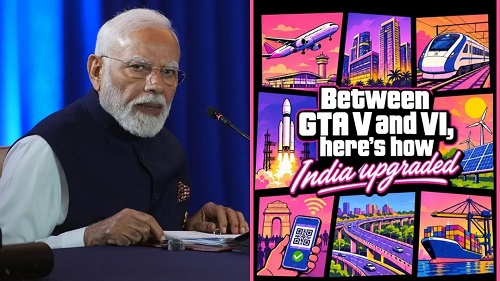
Thirteen years is a long time in the life of a nation. It is long enough for governments to change, economies to transform, technologies to advance and the lives of millions of people to take a different direction. Interestingly, the same period separates the release of two blockbuster video games, Grand Theft Auto V (GTA V) in 2013 and its much-awaited successor, GTA VI. Prime Minister Narendra Modi has turned this unusual coincidence into an opportunity to highlight India's transformation over the past 13 years, contrasting the country's position in 2013 with the progress made since his government came to power in 2014.
Through a presentation of 10 slides titled "Between GTA V and VI, here's how", PM Modi has drawn attention to changes in the economy, poverty reduction, infrastructure, sanitation, renewable energy, space technology, defence and internal security. His central message was simple but politically significant: while the gaming world was waiting for its next big edition, India was busy changing the rules of its own development journey.
The Prime Minister's comparison is more than an interesting reference to a popular video game. It is an attempt to put India's development journey into a time frame that millions of young people can easily understand. When GTA V arrived in 2013, India was governed by the Congress-led UPA, and the country was facing questions over economic growth, corruption allegations, infrastructure bottlenecks and the effectiveness of public welfare delivery. Since 2014, the Modi government has sought to present a different development model, placing infrastructure creation, digital technology, financial inclusion and direct delivery of welfare benefits at the centre of governance. Among the achievements highlighted in the presentation is India's emergence as the world's fastest-growing major economy. The slides also draw attention to the reduction in poverty, suggesting that economic growth has been accompanied by efforts to improve the living conditions of vulnerable sections. While development figures and their actual impact remain subjects for independent assessment, the comparison provides a broad picture of the changes the government wants the public to recognise.
Another important dimension of the presentation is the expansion of basic facilities and the development of new economic opportunities. The completion of the sanitation mission represents an effort to move cleanliness and toilet access from the margins of public policy to the centre of national development. Similarly, the expansion of solar energy reflects India's growing ambition to reduce dependence on conventional energy sources and strengthen its renewable energy capacity. The opening of the space sector to private participation and startups is another significant shift. What was once largely the domain of government institutions has gradually become an emerging field for private innovation, entrepreneurship and technological investment. The presentation also highlights the expansion of electricity access, the growth of defence exports and improvements in security conditions in Naxal-affected areas. These developments point towards a broader transformation in the country's approach to infrastructure, strategic capabilities and internal security. However, the real measure of progress will always lie in how effectively these changes improve the everyday lives of ordinary citizens.
By linking India's development story with the gap between two globally recognised gaming titles, Modi has also chosen a communication strategy that speaks directly to the younger generation. Instead of presenting development through conventional political language, he has used a cultural reference familiar to millions of people. The underlying political contrast is equally clear: 2013 represents the India before the BJP-led government assumed office, while 2026 represents the country that Modi wants people to compare with that earlier period. Ultimately, the message is that nations, like technology and entertainment, cannot afford to remain static. The world moves forward, expectations change and governments are judged by their ability to deliver results. Whether it is economic expansion, better public services, technological innovation or national security, India's next challenge is to sustain the momentum and ensure that the benefits of development reach every section of society. The wait for GTA VI may have lasted 13 years, but Modi's message is that India has not been waiting; it has been moving ahead.





















Leave Your Comment