


In the crisp February air of New Delhi, as the sun rose over the majestic Bharat Mandapam in February 2026, something historic stirred. Not just another conference, but a global inflection point. Prime Minister Narendra Modi, with his characteristic vision and resolve, stepped onto the stage to inaugurate the India AI Impact Summit 2026, the first-ever AI summit hosted by a Global South nation. The venue, once witness to the G20's diplomatic triumphs, now pulsed with the energy of over 500 global AI leaders, 20 heads of state, 60 ministers, and eventually more than five lakh visitors streaming through its halls over five transformative days.
This was no ordinary gathering. It was India's moment to showcase not just what AI could do, but what it should do for humanity, for the planet, and for shared progress. As world leaders, tech titans like Sundar Pichai, Sam Altman, Jensen Huang, and Mukesh Ambani converged, the air buzzed with possibility. Yet, beneath the spotlight, a quieter story unfolded: the world was finally waking up to India's unparalleled capacity defined by its 3Ts: Talent, Technology, and Trust. Despite a few predictable hiccups, the Galgotias University controversy and a disruptive shirtless protest by Congress Youth workers – the summit stood as a resounding triumph, drawing thousands upon thousands to Bharat Mandapam and etching India's name as the new nerve centre of responsible AI.
The Stage is Set: From Vision to Vibrant Reality
Imagine arriving at Bharat Mandapam on Day 1. The India AI Impact Expo sprawls across 70,000 square metres with 300+ exhibitors from 30+ countries and 10+ thematic pavilions dedicated to everything from AI in healthcare and agriculture to sustainable computing and ethical governance. Schoolchildren from the YUVAi challenge, women innovators from AI by HER, and startups from the AI for All Global Impact Challenge mingle with international delegates. Over 4,650 applications flooded in from 60+ countries for these challenges alone, a testament to the magnetic pull of India's vision.
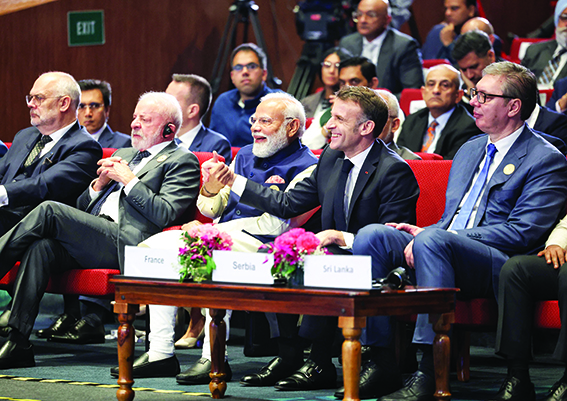
PM Modi's inauguration speech, delivered with the opening ceremony on 19 February alongside French President Emmanuel Macron and UN Secretary-General António Guterres, captured the essence: “AI must not remain the privilege of a few nations or corporations. It must serve Sarvajan Hitaya, Sarvajan Sukhaya, which means-the welfare and happiness of all.” Anchored in the three Sutras, People, Planet, and Progress, and seven Chakras (thematic working groups), the summit marked a deliberate shift from previous AI safety-focused summits in Bletchley Park, Seoul, and Paris. Here, the focus was impact: measurable, inclusive, and grounded in the Global South's realities.
As delegates explored the expo, stories unfolded in real time. A farmer from Uttar Pradesh demonstrated how AI-powered Kisan e-Mitra predicts crop yields and markets. A rural teacher showcased DIKSHA's adaptive learning platforms that personalise education in 22 Indian languages. Global CEOs nodded in appreciation, realising that India's scale, 1.4 billion people, diverse languages, varied terrains makes it the ultimate testbed and laboratory for AI that truly scales for humanity.
Navigating the Hiccups: Resilience in the Spotlight
No grand event of this magnitude attracting lakhs of visitors and global dignitaries escapes minor turbulence, especially in a vibrant democracy like India. The summit faced a few such moments, but they only underscored the strength of our systems.
First came the unfortunate Galgotias University incident. A representative at the university's stall presented a robotic dog named “Orion” as an indigenous innovation from their Centre of Excellence. Social media quickly identified it as a commercially available Chinese Unitree Go2 model. The claim was ill-informed at best, and the government acted swiftly and decisively. The university was asked to vacate its stall, issued an apology, and the episode was contained. Union IT Minister Ashwini Vaishnaw and authorities made it clear: integrity in innovation is non-negotiable. This isolated incident, amplified by opposition voices, was quickly overshadowed by genuine Indian breakthroughs like Sarvam AI's open-source 105-billion parameter LLM and BharatGen's multilingual Param2 model. It served as a reminder that while a few may falter, India's ecosystem demands and delivers authenticity.
Then, on 20 February, a group of Indian Youth Congress workers staged a shirtless protest inside Hall No. 5, removing shirts to reveal slogans criticising the government and an India-US trade framework. Four were detained, including their president. Academicians across 160 institutions condemned it as “ill-conceived” and inappropriate for an international platform. Opposition leaders defended it as dissent, but the public saw it for what it was; a desperate bid to disrupt India's moment of glory. Security handled it professionally; the summit continued uninterrupted. In a democracy as robust as ours, such voices are heard, but they cannot dim the collective aspiration of a nation marching towards Viksit Bharat.
Traffic snarls and organisational teething issues around the massive footfall? Expected in any mega-event drawing record crowds surpassing even the G20. Yet, the spirit remained undeterred. Delegates praised the warmth of Indian hospitality, the efficiency of digital entry systems, and the seamless integration of AI tools throughout the venue itself. These “hiccups” were mere footnotes in a story of unprecedented scale and success.
The 3Ts Unveiled: Why the World Took Notice
As the dust of minor disruptions settled, the true narrative emerged, India's 3Ts shining brighter than ever.
Talent: India boasts the world's largest pool of AI talent – over 5 million engineers and developers, with millions more graduating annually. The summit showcased this through the Research Symposium (partnered with IIIT-Hyderabad), where 250 submissions from the Global South highlighted indigenous research. Young innovators in YUVAi and AI by HER proved that talent is not concentrated in Silicon Valley but flourishes in Bharat's classrooms and startups. Global leaders like Demis Hassabis and Yoshua Bengio engaged with Indian researchers, forging collaborations that will define the next decade. The world saw: India's youth are not just coders; they are problem-solvers for humanity's toughest challenges.
Technology: Under the IndiaAI Mission and Digital India, Bharat is building sovereign, frugal, and scalable AI infrastructure. Key launches included Sarvam AI's groundbreaking LLMs (30B and 105B parameters with Mixture-of-Experts architecture), supporting text-to-speech, vision, and more. BharatGen Param2 – a 17B parameter model fluent in 22 Indian languages with multimodal capabilities. PM Modi himself tested Kaze smartglasses. Compute capacity is exploding: plans to expand beyond 38,000 GPUs with another 20,000+ under the IndiaAI Compute Portal. Partnerships with NVIDIA, Microsoft, Reliance, Tata, and others signal massive leaps in semiconductors, data centres powered by green energy, and edge intelligence. The summit announced over $200-250 billion in investment commitments across the AI stack – from critical minerals (via Pax Silica initiative) to enterprise AI. Technology is no longer imported; it is being created in India, for India and the world.
Trust: This is India's unique differentiator. In an era of geopolitical tensions and concerns over AI ethics, bias, and job displacement, Bharat offered a trusted alternative. The New Delhi Declaration on AI Impact, adopted by 88-89 countries and organisations (including the US, China, France, UK, and many from the Global South), embodies this. Built on the Sutras of People, Planet, and Progress, it promotes democratic diffusion of AI, a Global AI Impact Commons for shared use cases, Trusted AI Commons for benchmarks and tools, and principles for resilient, efficient, and inclusive AI. It echoes Vasudhaiva Kutumbakam – the world as one family. Voluntary governance commitments for frontier AI companies, knowledge compendiums on AI applications in health, education, agriculture, and more, and a Guinness World Record of 250,946 digital pledges for responsible AI in just 24 hours – all reinforced trust. India positioned itself as the bridge between Global North innovation and Global South needs.
What India Achieved: A Landmark List of Triumphs
The summit delivered concrete, measurable outcomes that will shape decades:
1. Hosted the Landmark First Global South AI Summit: Transitioning the global dialogue from “safety” to “impact,” with unprecedented participation and the most inclusive agenda yet.
2. New Delhi Declaration on AI Impact: Signed by 88-89 nations and organisations; the broadest multilateral consensus on democratising AI for social and economic good.
3. Massive Investment Mobilisation: Over $200-250 billion in commitments (with reports of up to $400 billion across the full AI value chain), including Microsoft's $50 billion pledge for lower-income countries.
4. Indigenous AI Breakthroughs: Launch of Sarvam AI's advanced open-source LLMs, BharatGen Param2 multilingual model, Kaze smartglasses, and expansion of sovereign compute infrastructure.
5. Global Challenges and Talent Pipeline: AI for All, AI by HER, and YUVAi challenges with thousands of applications; Research Symposium showcasing Global South innovation.
6. Knowledge and Policy Assets: Release of thematic compendiums on AI in key sectors; establishment of AI Commons frameworks; Guinness Record for responsible AI pledges.
7. Strategic Geopolitical Wins: India's entry into the Pax Silica initiative for secure supply chains; strengthened partnerships across Big Tech and multilateral bodies.
8. Record Public Engagement: Over five lakh visitors; expo extended due to overwhelming response; positioning New Delhi as the world's AI nerve centre.
9. Focus on Inclusion and Sustainability: Emphasis on women, youth, MSMEs, rural India, and green AI – ensuring no one is left behind.
10. Long-term Legacy: Catalyst for IndiaAI Mission 2.0, reskilling playbooks, and sustained international collaborations under “From Vision to Action.”
These achievements were not abstract; they were felt on the ground – in the handshake between an Indian startup founder and a global investor, in the applause for a rural AI solution that could transform millions of lives.
The World Wakes Up: Echoes from Global Leaders
Delegates left transformed. Sundar Pichai spoke of Google's deepened partnerships for accessible AI. Sam Altman highlighted OpenAI's collaboration on sovereign models. Mukesh Ambani outlined Reliance's vision for nationwide edge intelligence. Even amidst some minor protests, international media noted India's democratic maturity and organisational prowess. The narrative shifted: India is no longer a follower but a leader defining ethical, impactful AI for the Global South and beyond.
A New Chapter for Viksit Bharat
As the summit curtains drew on 20-21 February, Bharat Mandapam stood not just as a venue but as a beacon. The minor incidents, quickly addressed with transparency, only highlighted India's resilience. The opposition's theatrics faded into irrelevance against the backdrop of global acclaim.
India's hosting of the AI Impact Summit 2026 was more than an event; it was a declaration. The world has woken up to our 3Ts. Talent that innovates at scale. Technology that is sovereign yet collaborative. Trust that places humanity first.
Under the visionary leadership of Prime Minister Narendra Modi, Bharat is not just participating in the AI revolution, it is shaping it for the welfare of all. The road to 2047 is clear: an AI-powered Viksit Bharat, where innovation serves every citizen, every corner of the nation, and every aspiring society worldwide.
The glory belongs to India. The future is ours to build, together, with trust, technology, and the unmatched talent of one billion dreams.



















Leave Your Comment