


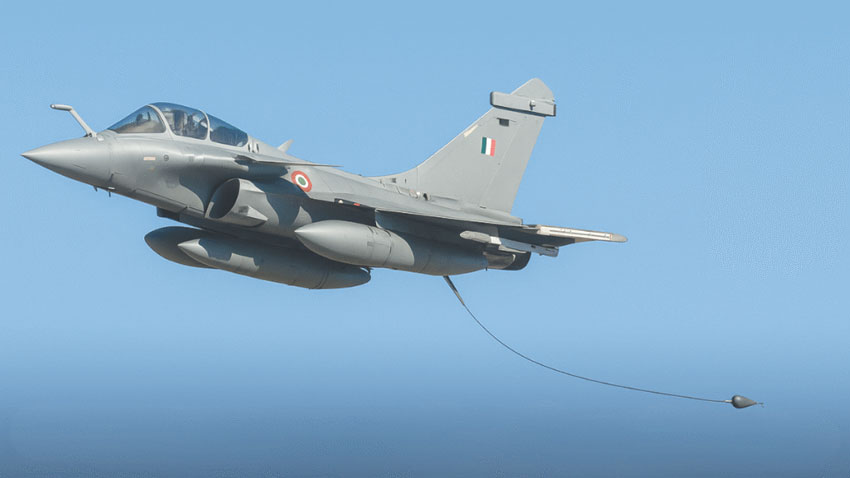
In May 2025, the Indian Air Force (IAF) conducted Operation Sindoor, a precision strike mission that will likely be remembered as a watershed moment in modern aerial warfare. The operation, while tactically successful, also highlighted a strategic evolution in India’s defense capabilities: the operational integration of artificial intelligence (AI) on the battlefield. Specifically, the deployment of AI-powered X-Guard systems on Rafale fighter jets gave India a clear technological edge and exposed the limitations of traditional military tactics employed by adversarial forces—most notably Pakistan.
At the heart of this operation was the X-Guard, an advanced electronic warfare (EW) system enhanced with AI algorithms. Traditionally, electronic countermeasures rely on predefined jamming patterns. However, the X-Guard represents a generational leap forward. Instead of merely jamming signals, it mimics the radar signature of the Rafale itself, projecting multiple false targets across the electromagnetic spectrum. The system doesn’t just disrupt enemy targeting—it deceives it. This AI-driven mimicry sowed confusion among Pakistani air defense units, whose radars and missile guidance systems were unable to distinguish between real and ghost targets. The result: missiles went astray, and India’s fighter jets returned unscathed.
The psychological and tactical advantage gained was profound. Pakistani forces, expecting conventional tactics, were blindsided by the sophistication of India’s approach. Multiple intercept attempts failed, and not a single Rafale was hit—despite being well within contested airspace for part of the mission. What India demonstrated wasn’t just air superiority—it was information superiority. By integrating AI into combat platforms, the IAF turned the fog of war into a weapon of its own.

More broadly, Operation Sindoor served as a stark declaration of India’s arrival as a tech-enabled military power. In a world where future conflicts will be fought as much in the digital spectrum as in physical arenas, AI is no longer a luxury but a necessity. India’s use of AI in active operations places it alongside nations like the United States, China, and Israel—countries that are shaping the doctrine of next-generation warfare. This isn’t just about defense; it’s about deterrence. When an adversary knows you can dominate the electromagnetic battlespace, they’re less likely to escalate a conflict.
India’s defense establishment, often criticized for slow procurement and bureaucratic inertia, deserves recognition for backing innovation and trusting indigenous and allied tech partnerships. The integration of X-Guard was not just a plug-and-play solution. It required months of testing, simulation, and strategic planning. What emerged was a seamless blend of human skill and machine intelligence. Pilots could rely on AI to handle jamming and deception, freeing them to focus on mission execution. It’s the kind of man-machine collaboration that defines 21st-century warfare.
Operation Sindoor also sends a powerful message to the global community: India is no longer content to be a buyer of legacy systems. It is now a developer and integrator of cutting-edge solutions. The battlefield of tomorrow will be dominated by those who can think and adapt faster—and India has shown that it has both the intellectual capital and operational will to do just that.
In the end, while the bombs and missiles of Operation Sindoor may have caused physical damage, the real impact was cognitive. Pakistan’s command structures were forced to reassess not just what India can do, but how it can do it. The strategic takeaway is clear: India has shifted the paradigm of regional military power. With AI at its side, India is no longer just defending its skies—it’s defining the future of warfare.
Uday India Bureau





















Leave Your Comment