


The recently signed India-US trade deal is not just another tariff adjustment, it is a political signal that both countries want to reinvigorate a relationship that carries strategic weight far beyond commerce. In a constantly churning global atmosphere, New Delhi and Washington are using trade to signal that the partnership is durable, and not episodic.
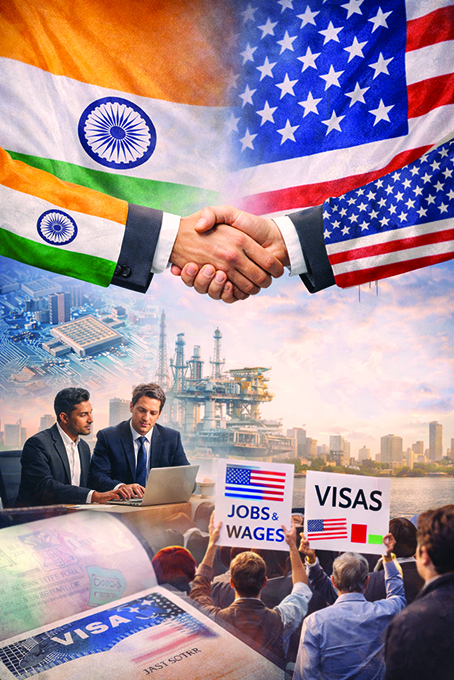
For both sides, trade dynamics have been an obstacle in an otherwise enduring relationship. As technology cooperation has deepened and defence ties flourished, trade has persisted as an unfortunate outlier. In an attempt to address the same, the joint statement explicitly talks about tackling non-tariff barriers and aligning on economic security and supply chain resilience. More importantly, it matters at the level of people-to-people ties, where jobs, wages, and visas are impacted in real time.
The Urgency
The past year has been marked by anxiety in labour-intensive hubs where a single tariff hike or order pause has had a multiplier effect on the business and the people involved therein. The US remains India’s largest trading partner, with bilateral trade of over $130 billion in FY25. Any disruption was bound to have a disproportionate impact. Following tariff escalations and retaliatory measures, effective duties on certain Indian products surged, rendering exports from India uncompetitive. This is illustrated by some crucial examples across sectors.
Surat (gems/diamonds): Government data reports show India’s diamond exports to the US fell from $5.93 billion (2023) to $2.42 billion as of September 2025, less than half the level seen two years earlier. For a city like Surat that produces nearly 90% of the world’s rough diamonds by volume, the fall in demand was felt the most in its small units, contractors, and the daily wage ecosystem.
Tirupur (knitwear): Tirupur’s knitwear industry exported around ₹40,000 crore worth of goods in 2024–25, and local reporting notes that the US accounts for roughly a third of its export market. With higher tariffs compared to its competitors like Bangladesh and Vietnam, exporters from Tirupur faced an immediate structural disadvantage. The loss of competitiveness threatened to shake the foundations of a very labour-intensive sector, sparking fears of mass unemployment.
Noida (merchandise cluster): Exporters of products ranging from leather goods to light electronics, saw a dip in new orders after the tariff hike. Noida’s ₹50,000 crore textile sector was directly impacted, with factories running below capacity.
Therefore, domestic pressures from multiple sectors and locations ensured that an international deal months in the making was deeply embedded in local issues.
Inside the Deal: What the Factsheet Tells Us
The White House joint statement and factsheet reflect a pragmatic compromise, aiming to reduce friction while lowering duties for exporters. The deal stands on the following key pillars:
The Tariff Trade-Offs: India is agreeing to slash or completely drop tariffs on US industrial goods and a whole host of agricultural products, from tree nuts, fruits, and soybean oil to wine, spirits, and animal feed. On paper, it's a straightforward market access win. On the ground in India, it's politically explosive. Any time you touch farming, food processing, or the broader "import sensitivity" debate, you run into massive domestic pushback, even if the items are carefully selected.
What India Gets in Return: Assuming this interim agreement holds up, the US is dropping its reciprocal tariffs on several key Indian exports. They specifically name-checked categories like generic pharmaceuticals, gems and diamonds, and aircraft components. These aren't just random industries; they are the lifeblood of massive employment and export clusters in India, making this a tangible, near-term win for local manufacturers.
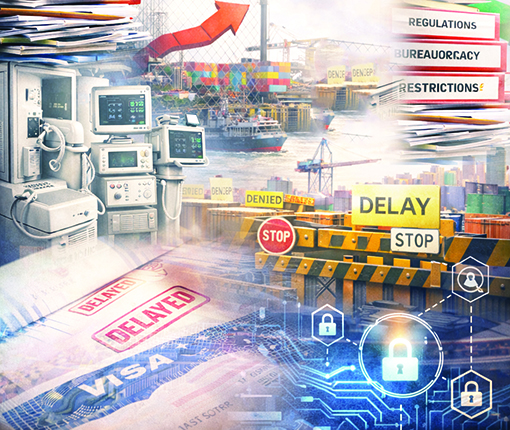
Tackling the "Invisible" Hurdles of the Non-Tariff Barriers: Modern trade deals rarely live or die by tariffs alone. It's the red tape, licensing delays, compliance bottlenecks, and behind-the-border rules, that quietly choke off trade volume. The agreement tackles this slow poison head-on. India has committed to fixing long-standing roadblocks for US medical devices, easing up on restrictive tech and IT import licenses, and streamlining testing standards within the next six months.
The headline grabber is India's "intention" to buy $500 billion worth of US goods over the next five years—heavyweight sectors like energy, coking coal, aircraft, precious metals, and high-end tech like GPUs and data centre gear. While this creates a massive upside for US exporters, there's a catch built right into the wording. Intent is a lot easier to announce at a summit than to execute over half a decade. If global prices spike, domestic politics shift, or supply chains snag, this massive pledge could easily turn into a sticky credibility test down the line.
Read between the lines, and you'll see this deal is just as much about economic security as it is about commerce. The language around "supply chain resilience," coordinating on export controls, and keeping an eye on the "non-market policies of third parties" (a clear, unspoken nod to China) gives the game away. This document is a blueprint for redrawing the industrial map of the Indo-Pacific.
Benefits and Risks
In the near term, the deal’s clearest gain is psychological as much as economic: it restores predictability to a market that had been living on the edge of a tariff-driven anxiety attack. By bringing punitive US duties down from 50% to a reciprocal 18%, it releases immediate pressure in precisely those sectors that live and die by a few percentage points on the margin—textiles, apparel, leather footwear, organic chemicals, and gems. At that level, India doesn’t just catch a break, it briefly acquires a price edge over regional competitors like Vietnam and Bangladesh, allowing exporters to quote multi‑year contracts without padding in “trade war risk” on every line item. That clarity feeds into consumer behaviour: buyers who had quietly rerouted or frozen Indian orders during the turbulence of late 2025 now have a reason to return, not out of sentiment, but because the rules of the game are finally legible again. The procedural side matters too: bilateral commitments to streamline standards, reduce licensing friction, and clarify compliance pathways tell investors and supply‑chain managers that moving goods across borders will involve fewer arbitrary choke points. Layered over this is a longer‑horizon bet that goes beyond tariff tables. The deal embeds India’s intent to purchase up to $500 billion in US energy, aircraft, coking coal, and high‑end hardware like GPUs over five years, effectively rewiring the relationship around the arteries of the modern economy—power, mobility, and compute—rather than just containers of merchandise goods. If this interim arrangement can be translated into a full‑fledged bilateral trade agreement, it would lock the relationship into an institutional framework governing digital trade, investment screening, and shared industrial standards, shifting it from a series of tactical bargains to a more durable economic architecture.
The risks, however, are both immediate and structural, and they run straight through India’s domestic political economy. To unlock tariff relief for its export hubs, New Delhi has had to open the door to American agricultural and industrial goods, including inputs like DDGs, red sorghum, tree nuts, soybean oil, and spirits. Even with core staples kept off the table, anything that brushes against farm‑linked value chains or import‑sensitive manufacturing will trigger localised resistance from farmer groups, unions, and small producers who see each concession as the thin end of a larger wedge. On the implementation side, the agreement’s promise to tackle non‑tariff barriers within tight timelines, such as a six‑month review window for medical devices and ICT standards, collides with a bureaucracy whose institutional reflex is delay. If those deadlines slip, today’s “resolved” irritants will quickly reappear as tomorrow’s flashpoints. Looking at the long term, there is a real danger of mistaking tariff relief for competitiveness. An 18% duty line does not upgrade port logistics, does not fix SPS‑related rejections in the US for marine and agricultural goods, and does not erase the cost of compliance for smaller firms. Without parallel movement on domestic reforms in logistics, factor markets, skills, standards, and infrastructure, the agreement risks becoming a stabiliser rather than a transformer: it buys India time, shores up sentiment, and offers exporters a cleaner playing field, but it does not, on its own, build the productive capacity needed to fully exploit that access. The underlying social contract remains fragile, the political limits on opening sensitive sectors are real, and any attempt to push past them without cushioning adjustment will invite rural and small‑town backlash. In that sense, the deal is best read as a window: it lowers the noise and creates space for India to do the harder internal work. Whether it becomes a turning point or just a well‑negotiated pause depends less on the tariff lines signed in Washington and more on the reforms actually executed at home.
External Catalysts: The EU Deal and Trade Diversification
Seen from Delhi, the India–US trade deal only really snaps into focus when you place it inside the broader diversification story that’s been building over the last few years. India has been quietly but deliberately trying to spread risk by reducing overdependence on any single market while plugging into multiple, large consumer bases.
Over the past few years, India has stitched together a dense web of trade agreements—with the UAE (CEPA), Australia (ECTA), the UK, Oman, EFTA, the EU, and most recently New Zealand, that all push in the same direction. UAE has emerged as a preferential Gulf hub, Australia has eliminated duties on all its tariff lines for Indian exports with bilateral trade around the mid‑$20 billion mark and double‑digit export growth in textiles, apparel, leather, agriculture, and engineering, while the New Zealand FTA promises zero‑duty access for virtually 100% of Indian exports by value, with India offering concessions on roughly 70% of its tariff lines covering about 95% of
current trade.
The EU piece of that puzzle is central, not peripheral. India’s exports to the European Union sit in the mid‑$70 billion range against imports of about $60 billion, giving New Delhi a surplus of over $15 billion and a strong incentive to deepen that corridor. Overall India–EU trade is roughly $136–137 billion in FY2025 with a surplus of about $15.2 billion, and both sides are already talking about pushing it towards $200 billion by 2030. That is not marginal hedging, it is a deliberate effort to anchor India more firmly in a $20‑trillion bloc and to chip away at long‑standing disadvantages, such as higher EU tariffs on Indian textiles compared with Bangladesh and other LDC rivals. Layer in parallel tracks with EFTA, a more purposeful ASEAN agenda, and a push into Africa and the Middle East, where marine products, engineering goods, and other categories are finding fresh demand, and you get a coherent diversification strategy for merchandise exports hovering in the $450–470 billion band, not a set of one‑off experiments.
Viewed from Washington, the political‑economy logic is simple: when India demonstrates that it is not structurally tied to any single geography, it can bargain harder, insist on better terms, and resist pressure more calmly. For the US, ensuring that its economic ties with India remain thick, predictable, and forward‑leaning is now part of a wider Indo‑Pacific strategy, not just a trade office agenda. Locking in more durable access to a $450‑plus billion export economy is a way of making sure that, as India diversifies, it doesn’t drift.
Looking Ahead with An Eye on the Indo-Pacific
Looking ahead, the India–US trade deal marks a pivot where economics and geopolitics lock arms more tightly than before. The joint statement’s focus on supply chain resilience, tech flows like GPUs, and “non-market” distortions sketches a clear China silhouette without naming it, while tying tariff relief to India’s Russian oil pullback shows how transactional levers now serve strategic ends. For Washington, it is a way to diversify away from China using India’s manufacturing heft and location; for New Delhi, it bolsters strategic autonomy, letting it deepen US ties without sacrificing its multi-alignment with Europe, ASEAN, or others.
In the Indo-Pacific, this matters because trade interdependence builds stakes in stability by turning episodic alignment into something more institutional. If the interim deal delivers and a full BTA follows, the relationship shifts from crisis-to-crisis firefighting to system-level habits of working through friction. For the US, ensuring that its economic ties with India remain thick, predictable, and forward‑leaning is now part of a wider Indo‑Pacific strategy, not just a trade agenda.
Vivek Mishra, Yuvvraj Singh
(Dr. Vivek Mishra is Deputy Director, Strategic Studies Programme, Observer Research Foundation & Yuvvraj Singh is a Research Assistant at Centre for Land Warfare Studies (CLAWS))
(The content of this article reflects the views of writer and contributor, not necessarily those of the publisher and editor. All disputes are subject to the exclusive jurisdiction of competent courts and forums in Delhi/New Delhi only)





















Leave Your Comment