


India has strongly rejected a recent report by the U.S. Commission on International Religious Freedom (USCIRF) that criticized the country for alleged violations of religious freedom and recommended designating India as a "country of particular concern." The Ministry of External Affairs (MEA) has dismissed the report as an attempt to "peddle a motivated narrative," further discrediting the U.S. federal government commission.
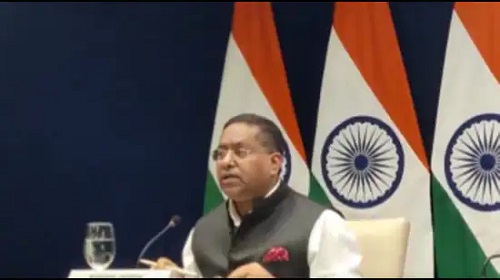
Responding to queries regarding the USCIRF's annual report, Randhir Jaiswal, spokesperson for the MEA, reiterated India's well-established stance on the commission, labeling it a "biased organisation with a political agenda."
"Our views on the United States Commission on International Religious Freedom (USCIRF) are well known. It is a biased organisation with a political agenda. It continues to misrepresent facts and peddles a motivated narrative about India. We reject this malicious report, which only serves to discredit USCIRF further," Jaiswal said.
Jaiswal also called on the USCIRF to reflect on domestic issues within the United States, suggesting the commission could more productively focus on addressing human rights concerns in its own country. "We would urge USCIRF to desist from such agenda-driven efforts. The USCIRF would also be well advised to utilise its time more productively on addressing human rights issues in the United States," he added.
In its annual report, the USCIRF alleged that misinformation and disinformation have been used to incite violence against religious minorities in India. The report documented what it referred to as "systematic, ongoing, and egregious violations of religious freedom," urging the U.S. State Department to designate India as a "country of particular concern." It cited instances of violence throughout 2024, including vigilante attacks, the arbitrary arrests of religious leaders, and the demolition of homes and places of worship as key examples of the deteriorating religious freedom in the country.
"This report highlights how, throughout 2024, individuals have been killed, beaten, and lynched by vigilante groups, religious leaders have been arbitrarily arrested, and homes and places of worship have been demolished. These events constitute particularly severe violations of religious freedom," the commission stated.
This is not the first time India has pushed back against the USCIRF. Earlier, in May 2024, when a report by the commission was released during India's Lok Sabha elections, the MEA had also dismissed it as interference in the country’s democratic processes. At that time, the ministry expressed doubt that the USCIRF would make any effort to understand India's "diverse, pluralistic, and democratic ethos," and emphasized that its attempts to interfere in the world's largest electoral process would not succeed.
India's rejection of the USCIRF's latest report underscores the country's continued opposition to the commission's assessments, which it views as politically motivated and unreflective of India's reality. The Indian government remains steadfast in its assertion that the commission's efforts are based on a distorted understanding of the country's social and religious landscape.
As the debate between the two nations on religious freedom continues, the Indian government stands firm in its position, advocating that the USCIRF should focus inward on issues at home rather than issuing reports perceived as biased by foreign nations.





















Leave Your Comment