


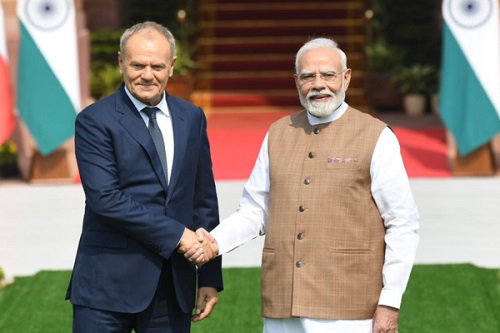
Prime Minister Narendra Modi’s bilateral talks with Polish Prime Minister Donald Tusk in New Delhi aim to give fresh momentum to India-Poland strategic ties, with trade, defence, emerging technologies and renewable energy high on the agenda. The expected signing of several agreements could strengthen economic engagement and expand cooperation between the two countries amid shifting global and geopolitical priorities.
Prime Minister Narendra Modi is holding bilateral talks with his Polish counterpart Donald Tusk in New Delhi, with discussions expected to focus on expanding strategic cooperation, boosting economic engagement and strengthening collaboration in emerging technologies. The visit reflects the growing importance of India-Poland relations amid evolving geopolitical and economic priorities, with several agreements expected to be signed following the talks.
Tusk arrived in New Delhi on Wednesday evening for a three-day visit, accompanied by Poland’s Finance and Economy Minister Andrzej Domanski and a large business delegation. This is his second visit to India as Poland’s Prime Minister, underlining the importance Warsaw attaches to its partnership with New Delhi.
The discussions are expected to cover the full spectrum of bilateral relations, alongside regional and global developments of mutual interest. Trade and investment, defence, renewable energy, education, culture and people-to-people exchanges are among the key areas offering scope for deeper engagement.
External Affairs Minister S. Jaishankar met Tusk earlier on Thursday and welcomed discussions on expanding cooperation across multiple sectors. He also expressed confidence that the Polish leader’s meeting with Modi would help advance the bilateral Strategic Partnership.
Tusk also visited Rajghat to pay tribute to Mahatma Gandhi, marking a symbolic element of his visit as both countries seek to broaden their diplomatic engagement.
Beyond political dialogue, the Polish Prime Minister’s planned visit to Bengaluru is expected to provide an important economic dimension to the engagement. Meetings with business stakeholders, particularly in the information technology and space sectors, could help identify new opportunities for investment, innovation and industrial collaboration.
Poland’s position as India’s largest trading and investment partner in Central and Eastern Europe gives the relationship a strong economic foundation. However, the larger challenge will be to translate diplomatic goodwill into sustained commercial growth, stronger business partnerships and concrete outcomes in strategic sectors.
The talks between Modi and Tusk therefore carry significance beyond routine bilateral diplomacy. Progress in emerging technologies, defence and clean energy could diversify the partnership, while closer business engagement could help both countries tap new opportunities in an increasingly competitive global economy. The agreements expected during the visit will be an important indicator of how effectively the two sides intend to turn their shared priorities into practical cooperation.



















Leave Your Comment