


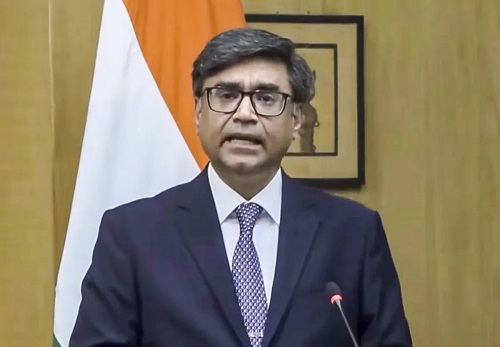
Moments after the announcement of ceasefire talks, Foreign Secretary Vikram Misri addressed a press conference on Saturday, confirming a significant development in the India-Pakistan relations. The talks, facilitated by the Directors General of Military Operations (DGMOs) from both nations, marked a pivotal moment in the ongoing geopolitical landscape of South Asia.
Foreign Secretary Vikram Misri disclosed that Pakistan's DGMO initiated contact with India's DGMO earlier in the afternoon, resulting in a mutual agreement to cease all firing and military actions across land, air, and sea. The ceasefire, effective from 1700 hours Indian Standard Time, aims to de-escalate tensions that have persisted between the two nuclear-armed neighbors.
Misri emphasized the importance of this understanding, highlighting that operational instructions have been issued to enforce the ceasefire on both sides. Additionally, he announced scheduled follow-up talks set for May 12th at 1200 hours, underscoring a commitment to maintaining the dialogue and stability.
Union External Affairs Minister Dr. S Jaishankar reaffirmed India's principled stance against terrorism, noting that the agreement aligns with India's ongoing efforts to ensure regional stability and security.
However, in a surprising turn, US President Donald Trump claimed credit for mediating the ceasefire talks, praising the leadership of both India and Pakistan for choosing diplomacy and reason over escalation. Trump's assertion on social media platform Truth Social sparked mixed reactions, with Pakistan's Deputy Prime Minister and Foreign Minister Ishaq Dar echoing the sentiment and emphasizing Pakistan's commitment to regional peace while upholding sovereignty.
The White House, through Press Secretary Karoline Leavitt, acknowledged the longstanding conflict between India and Pakistan and expressed the US administration's commitment to de-escalation. Secretary of State Marco Rubio's involvement in direct talks with both nations underscored US efforts to mitigate tensions and promote stability in the region.
Leavitt highlighted the complexity of the Indo-Pakistani conflict, stressing ongoing diplomatic engagements aimed at preventing further hostilities.
The India-Pakistan ceasefire agreement, brokered through diplomatic channels and international mediation, represents a significant step towards reducing tensions in one of the world's most volatile regions. As both nations prepare for further discussions, the global community watches closely, hopeful for sustained peace and stability in South Asia.
The upcoming talks on May 12th hold promise for continued dialogue and the potential for lasting peace dividends amidst historical animosities.




















Leave Your Comment