


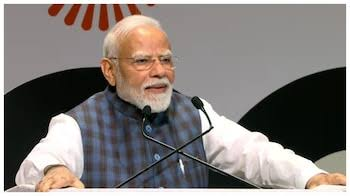
India’s economic journey over the next two decades will depend not merely on government policies and investment figures but also on the vision, commitment and global ambitions of its industrial sector. Prime Minister Narendra Modi has given Indian businesses a clear message: make ‘India First’ the guiding principle of every long-term investment decision. Addressing the centenary convention of the Federation of Indian Chambers of Commerce and Industry (FICCI) in New Delhi, he called upon industry leaders to look beyond immediate commercial gains and align their business strategies with the larger national objective of building a self-reliant, prosperous and globally competitive India. His message was significant because it connected the aspirations of Indian industry with the country's economic transformation and its ambitions for the next 20 years.
Speaking at the 100th anniversary of FICCI, Modi observed that the organisation had witnessed several important phases of India's economic development. From the restrictions of the License Quota Raj and the unsuccessful experiment of excessive nationalisation to the period when India was counted among the Fragile Five economies, the country had experienced considerable economic difficulties. However, he said, the determination and hard work of young people, farmers, workers and industrialists over the past 12 years had helped change the country's economic direction. The Prime Minister emphasised that the achievements of the previous century should now inspire Indian industry to think about what it could accomplish in the next two decades. His appeal for an 'India First' approach was essentially an invitation to businesses to become partners in national development rather than viewing investment decisions exclusively through the lens of short-term profitability.
Highlighting India's current economic performance, Modi said the country was today the world's fastest-growing major economy, with growth projected at around seven per cent. He also pointed to the country's impressive export performance, noting that merchandise exports had touched nearly $50 billion in the previous month, marking the highest monthly figure ever recorded. The upward revision of India's growth projections by international institutions such as Moody's Ratings, S&P Global Ratings, Fitch Ratings, the World Bank and the Asian Development Bank, he said, reflected growing confidence in the Indian economy. These developments indicate that India is increasingly emerging as an important destination for global investment, manufacturing and trade. However, sustaining this momentum will require continuous improvements in productivity, infrastructure, technology, quality and innovation. The Prime Minister's message to industry was therefore not simply to expand domestic operations but to develop the confidence and capacity to compete with the world's best.
One of the most significant points in Modi's address concerned poverty reduction. Referring to a recent World Bank report, he said that approximately 50 crore Indians had come out of poverty in just 12–13 years. He contrasted this achievement with the political slogan of 'Garibi Hatao' popularised in the 1970s, when India's population was approximately 50 crore. According to the Prime Minister, the difference demonstrated the importance of effective policies and genuine political commitment. He argued that slogans alone could not eliminate poverty; what mattered was the determination to translate promises into measurable outcomes. His observation was intended to underline the connection between economic growth, governance and the improvement of ordinary people's lives. The expansion of economic opportunities, improved access to basic services and greater participation in productive activities are essential components of sustainable poverty reduction.
Modi also urged Indian businesses to take full advantage of the trade agreements concluded with different countries. He stressed that entering international markets required more than producing goods and expecting customers to purchase them. Companies must understand the preferences of global consumers, maintain international quality standards, improve product design and establish dependable distribution networks. He cautioned against treating the domestic market as a comfortable destination that could limit business ambitions. India's large consumer base, he suggested, should provide industrialists with the financial strength and confidence to compete internationally. This is particularly important at a time when global supply chains are undergoing significant changes and countries are looking for reliable manufacturing and sourcing partners. Indian enterprises have an opportunity to occupy a larger position in these emerging economic arrangements, provided they focus on quality, competitiveness and technological advancement.
The Prime Minister also highlighted the government's efforts to create a more business-friendly and taxpayer-friendly economic environment. He pointed to the reduction in the basic corporate tax rate from 30 per cent in 2014 to 22 per cent, the expansion of income-tax relief through exemption of income up to Rs 12 lakh under the new tax regime, simplification of tax returns and refunds, and reductions in GST rates on several goods. These measures, he said, were aimed at strengthening purchasing power, encouraging investment and stimulating demand. He also emphasised that national progress depended on respecting and supporting every contributor to the economy, including farmers, small entrepreneurs, industrialists, wealth creators and taxpayers. This broader approach recognises that economic development cannot be sustained by large corporations alone. Small businesses, manufacturing units, agricultural enterprises and emerging entrepreneurs must also become active participants in the country's growth story.
The centenary of FICCI provided an appropriate occasion for the Prime Minister to place these responsibilities before the business community. Congratulating the organisation on completing 100 years, he described its continued relevance and ability to evolve with changing economic circumstances as a remarkable achievement. Founded during India's freedom struggle, FICCI has remained an important platform for dialogue between industry and policymakers. However, the challenges before Indian industry today are considerably different from those faced in the past. Artificial intelligence, technological disruption, global competition, energy transition and changing international trade patterns will determine the future of businesses. Indian companies must therefore invest in research, innovation, skill development and advanced manufacturing if they wish to remain competitive.
Ultimately, Modi's 'India First' appeal is a call for a partnership between national ambition and private enterprise. The government can provide infrastructure, policy support and an enabling business environment, but it is industry that must translate these opportunities into employment, innovation, exports and wealth creation. The next 20 years will test India's ability to transform its economic potential into lasting global leadership. For Indian businesses, the challenge is to think bigger, invest with confidence and recognise that national progress and corporate success need not be competing objectives. When industrial growth strengthens the country, creates opportunities for its people and enhances India's position in the global economy, the principle of 'India First' becomes more than a slogan; it becomes the foundation of a new economic vision.





















Leave Your Comment