


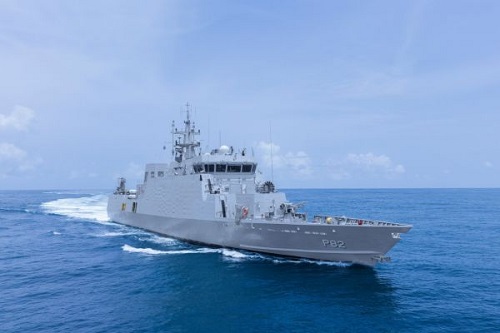
The commissioning of INS Mangrol at the Naval Dockyard in Mumbai marks another significant milestone in India’s drive towards a modern, self-reliant and technologically advanced maritime force. Built by Cochin Shipyard Limited (CSL), Kochi, the third Anti-Submarine Warfare Shallow Water Craft (ASW-SWC) strengthens the Indian Navy’s capacity to identify and counter underwater threats in coastal waters. With more than 80 per cent indigenous content, the warship also reflects the growing capabilities of India’s domestic shipbuilding industry and the strategic importance of indigenisation in national defence.
The Indian Navy has commissioned INS Mangrol, reinforcing its efforts to improve coastal surveillance and strengthen its ability to respond to evolving maritime security challenges. The commissioning ceremony was presided over by Vice Admiral Sanjay Vatsayan, Flag Officer Commanding-in-Chief of the Western Naval Command, who highlighted the vessel’s contribution to India’s naval preparedness and indigenous defence manufacturing.
At a time when maritime security is becoming increasingly complex, the induction of specialised anti-submarine warfare platforms carries considerable operational significance. Submarines can pose serious challenges to surface vessels and critical maritime infrastructure, particularly in coastal zones, where shallow waters and congested sea routes complicate detection and tracking. Purpose-built vessels such as INS Mangrol are designed to address these challenges by combining specialised sensors, weapons and surveillance systems.
The warship’s operational importance lies in its ability to detect, track and counter underwater threats close to India’s coastline. Its equipment includes the Abhay hull-mounted sonar, lightweight torpedoes, an indigenous anti-submarine rocket launcher and the Mareech Advanced Torpedo Decoy System. Together, these systems enhance its capacity to identify potential submarine activity and respond to hostile underwater operations. The torpedo decoy system also provides a defensive measure against incoming torpedo threats, adding to the vessel’s survivability in a contested maritime environment.
Addressing the commissioning ceremony, Vice Admiral Vatsayan underlined the importance of the ship’s more than 80 per cent indigenous content. He described it as evidence of India’s engineering expertise, technological advancement and national determination to strengthen domestic defence capabilities. The emphasis on indigenous production is particularly relevant as India seeks to reduce dependence on foreign suppliers, improve control over critical military technologies and develop a stronger industrial base for sustained defence preparedness.
Warship construction involves a complex network of engineering, electronics, propulsion, weapons integration and specialised manufacturing. Greater domestic participation in this process can help build technical expertise, encourage industrial innovation and strengthen supply chains. It can also improve the Navy’s ability to maintain and upgrade its platforms over their operational life. However, the long-term benefits of indigenisation will depend on consistent investment in research, quality manufacturing, timely delivery and the ability to develop increasingly sophisticated systems within the country.
INS Mangrol also forms part of a broader programme to expand and modernise the Indian Navy’s fleet. Vice Admiral Vatsayan stated that ten ships had been commissioned in 2026, with another eight expected to enter service soon. He further indicated that by 2034, around 60 per cent of the Navy’s platforms were expected to have an average age of less than ten years. This projected shift reflects an effort to create a younger fleet equipped to meet emerging operational requirements.
Fleet modernisation is not simply a matter of adding more vessels. It also involves ensuring that ships possess the right capabilities, can operate effectively alongside other platforms and are supported by trained personnel, maintenance facilities and reliable logistics. The induction of specialised coastal warfare vessels is therefore important because it strengthens a particular operational requirement rather than merely increasing the overall number of ships.
The vessel’s name carries a connection to India’s maritime heritage. INS Mangrol is named after the coastal town of Mangrol in Gujarat’s Junagadh district, a prominent fishing harbour with a longstanding relationship with the sea. It also carries forward the legacy of an earlier INS Mangrol, a minesweeper that served the Navy until April 7, 2004. The new vessel represents a continuation of that association, adapted to the demands of contemporary maritime security.
India’s extensive coastline, busy ports and growing dependence on seaborne trade make coastal defence an essential element of national security. The protection of maritime approaches requires sustained surveillance, effective coordination and the ability to respond quickly to emerging threats. Anti-submarine warfare capabilities are particularly important because underwater threats may be difficult to detect and can have serious implications for naval operations and maritime commerce.





















Leave Your Comment