


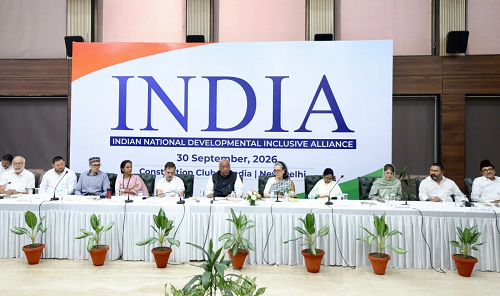
The September 30 meeting of the INDIA bloc brings together an impressive cross-section of opposition politics, but its guest list also exposes the limits of sustained coordination.The absences are significant. The DMK and AAP are staying away, while Akhilesh Yadav is represented by party leaders because of his commitments related to the Uttar Pradesh Rajya Sabha elections. Uddhav Thackeray is participating virtually. The contrast underlines a central challenge for the opposition: bringing diverse parties together for a specific political objective is easier than maintaining uniform participation and a common organisational rhythm.
The INDIA bloc’s September 30 meeting in New Delhi comes at a moment when the opposition is attempting to turn the controversy surrounding the Special Intensive Revision (SIR) of electoral rolls into a broader institutional and political campaign. The immediate focus is on alleged irregularities in the revision exercise and the functioning of the Election Commission, with opposition parties considering a coordinated agitation as well as a fresh parliamentary move seeking the removal of Chief Election Commissioner Gyanesh Kumar. Yet, the meeting also exposes a second challenge for the bloc: maintaining unity when some important constituents have chosen to stay away or participate only through representatives.
The INDIA bloc’s latest deliberations are centred on an issue that goes beyond the routine contest between the government and opposition: the integrity and credibility of the electoral process. Opposition parties have alleged irregularities in the SIR exercise and questioned decisions taken by the Election Commission. The Election Commission, however, has rejected allegations of institutional dysfunction, maintaining that differences of opinion can form part of internal deliberations and that its decisions have legal and procedural backing.
Against this backdrop, the bloc is seeking to formulate a common programme of agitation. Congress general secretary KC Venugopal has indicated that the party wants a broad-based movement involving opposition parties, with the INDIA bloc’s programme to be coordinated with the Congress's own campaign.
The composition of the September 30 meeting illustrates both the reach and limitations of opposition coordination. Congress leaders Sonia Gandhi, Rahul Gandhi and Mallikarjun Kharge are participating, alongside TMC leaders Mamata Banerjee and Abhishek Banerjee, RJD leader Tejashwi Yadav, National Conference leader Omar Abdullah, PDP chief Mehbooba Mufti and representatives of several Left and regional parties.
However, the absence of the DMK and AAP is politically noteworthy. Samajwadi Party chief Akhilesh Yadav is also not attending personally and is sending representatives because of commitments linked to the Rajya Sabha elections in Uttar Pradesh. Uddhav Thackeray is participating virtually, while several smaller parties are represented through their leaders or nominees.
The participation gap matters because the INDIA bloc is attempting to present the SIR issue as a common democratic concern rather than a Congress-led campaign. The broader the participation, the easier it becomes for the opposition to portray the agitation as a collective institutional demand. Conversely, absences provide space for the government and the Election Commission to argue that there is no complete opposition consensus on the issue.
The DMK’s decision is particularly significant because it has publicly distanced itself from the present configuration of the alliance, while AAP’s relationship with the bloc has also weakened. Recent reporting has therefore highlighted internal differences even as the parties seek common ground on the Election Commission.



















Leave Your Comment