


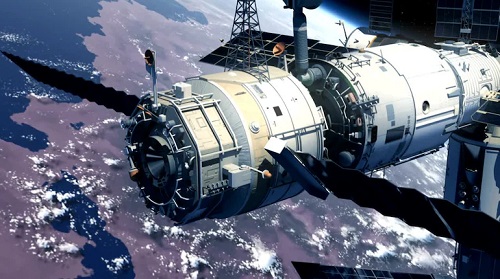
India has achieved a significant milestone in its space exploration journey by successfully docking two spacecraft in space, becoming the fourth country in the world to accomplish this feat. Before India, only Russia, the United States, and China had demonstrated this advanced technology. The Indian Space Research Organisation (ISRO) announced that the docking experiment was completed on January 16, marking a historic achievement.
This mission is a critical step for India's upcoming space programs, including Chandrayaan-4, Gaganyaan, and the proposed Indian Space Station. The Chandrayaan-4 mission aims to bring lunar soil samples back to Earth, while Gaganyaan plans to send humans into space.
The space docking experiment was launched on December 30, 2024, from the Satish Dhawan Space Centre in Sriharikota at 10 PM. The experiment utilized the PSLV-C60 rocket, which deployed two spacecraft—referred to as the "Target" and "Chaser"—into low Earth orbit, approximately 470 km above the planet.
Initial attempts to dock the spacecraft on January 7 and January 9 were postponed due to technical challenges. On January 12, the two spacecraft were brought within 3 meters of each other before being safely distanced again for further checks. Finally, on January 16, ISRO declared the docking process a success.
The docking involved reducing the distance between the spacecraft from 15 meters to 3 meters with extreme precision. Advanced instruments, including laser range finders, docking cameras, and visual cameras, were used to ensure accuracy during the final approach. After docking, the two spacecraft functioned as a single unit, demonstrating successful control and connectivity.
The mission, known as SPADEX (Space Docking Experiment), had the following key objectives:
This docking experiment is a cornerstone for India's future space missions:
ISRO has developed and patented its own docking mechanism, called the Indian Docking System. This innovation was essential as no other space agency shares the complex technical details of their docking systems.
The SPADEX mission also included 24 payloads for microgravity experiments, housed in the PSLV’s fourth stage, known as the PSLV Orbital Experimental Module (POEM). Among these, 14 payloads were from ISRO, and 10 were contributed by non-governmental entities.
ISRO celebrated this success as a historic moment for India. Following the docking, the spacecraft will undergo tests for power transfer and undocking. The mission is expected to provide valuable data over the next two years, further strengthening India's position in global space exploration.
With this achievement, India has not only showcased its technical prowess but also paved the way for ambitious future missions, making it a proud moment for the nation and its space science community.




















Leave Your Comment