


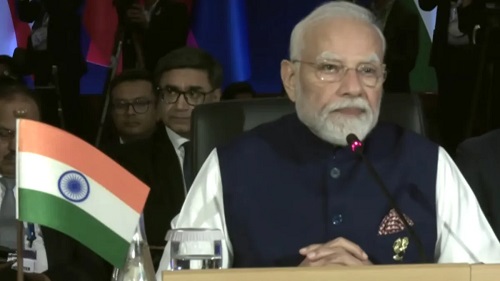
At a time when geopolitical uncertainties, economic disruptions and regional conflicts are reshaping the global order, India is looking towards stronger partnerships in its neighbourhood and beyond to secure a stable and prosperous future. Reinforcing this approach, Prime Minister Narendra Modi, while addressing the India-ASEAN Summit in the Philippines, highlighted how the Act East Policy has transformed India's engagement with Southeast Asia by adding greater momentum, substance and strategic depth to bilateral relations. Emphasising the need for peace, stability and predictability in an increasingly turbulent world, Modi described the India-ASEAN partnership as an important force for regional cooperation and collective progress. He also called for a future built on collaboration rather than competition, underlining the shared responsibility of India and ASEAN in shaping the emerging global landscape.
Prime Minister Modi pointed out that India and ASEAN together account for nearly one-fourth of the world's population, giving the partnership enormous demographic, economic and strategic significance. He stressed that such collective strength must translate into greater responsibility towards regional development. Rather than allowing competition to divide countries, the region should prioritise cooperation, mutual understanding and shared opportunities. According to the Prime Minister, the destinies of India and ASEAN are closely connected, making their partnership essential not only for economic advancement but also for maintaining peace and stability across the Indo-Pacific.
Referring to the changing international environment, Modi observed that the world has experienced multiple challenges and uncertainties over recent years. In such circumstances, dependable partnerships have become increasingly important. India and ASEAN, with their shared interests and commitment to regional engagement, can contribute towards building an environment where economic growth, security and diplomatic cooperation reinforce one another. He underlined that the relationship should evolve beyond traditional diplomatic exchanges and become a meaningful instrument for addressing common challenges.
Act East Policy Strengthens People-to-People Connections
Highlighting the achievements of India's Act East Policy since 2014, the Prime Minister said New Delhi has undertaken more than 100 initiatives to strengthen people-to-people relations with ASEAN countries. Around 250 Quick Impact Projects have also been launched, while approximately 10,000 scholarships have been provided to support capacity building and human resource development. These initiatives reflect India's effort to make regional cooperation meaningful at the grassroots level rather than restricting it to government-to-government engagements.
Modi also drew attention to the growing connectivity between India and Southeast Asia. The expansion of direct air services and increasing tourist movement are encouraging closer interaction among people, businesses and cultural communities. Greater mobility has opened new avenues for tourism, trade, education and cultural exchanges, further strengthening the social foundations of the partnership. The Prime Minister's emphasis on these developments reflects India's belief that durable international relationships are built not merely through agreements and diplomatic meetings but also through closer connections between ordinary citizens.
Viksit Bharat 2047 and ASEAN Community Vision 2045
Looking towards the future, Modi highlighted the complementary development ambitions of India and ASEAN. He said India's journey towards becoming a developed nation by 2047 and ASEAN's Community Vision 2045 could become important drivers of their shared aspirations. Both visions provide an opportunity to align development priorities, encourage investment, promote innovation and expand cooperation across emerging sectors.
The Prime Minister reiterated that India's development and ASEAN's prosperity are deeply interconnected. A stronger Indian economy can create wider opportunities for Southeast Asian partners, while a prosperous and stable ASEAN region can strengthen India's economic and strategic engagement with the wider Indo-Pacific. Cooperation in connectivity, trade, technology, education, tourism and capacity building can therefore deliver benefits across the region.
The broader message emerging from Modi's address was that India views ASEAN not simply as a geographical neighbour or an economic partner but as an important pillar of its regional and global engagement. The Act East Policy has provided the framework for this growing relationship, while people-to-people initiatives have given it a wider social dimension. As the world navigates geopolitical uncertainty and economic transformation, India and ASEAN have an opportunity to demonstrate that cooperation, mutual respect and shared development can offer a more dependable path forward.






















Leave Your Comment