


India and Japan are taking their strategic defence partnership to a higher level, with maritime security, advanced military technologies and joint defence manufacturing emerging as key areas of cooperation. The decision to fast-track agreements relating to the Unified Complex Radio Antenna (UNICORN), a next-generation stealth naval mast project, reflects the growing convergence of their security interests in the Indo-Pacific. Coming amid increasing geopolitical uncertainties, disruptions in global supply chains and changing patterns of warfare, the initiative underlines the determination of both countries to strengthen their defence capabilities through technological collaboration and greater industrial integration. The fourth India-Japan 2+2 Foreign and Defence Ministerial Dialogue in Tokyo has provided fresh momentum to this partnership, which is expected to assume greater significance as the two countries approach the 75th anniversary of their diplomatic relations in 2027.
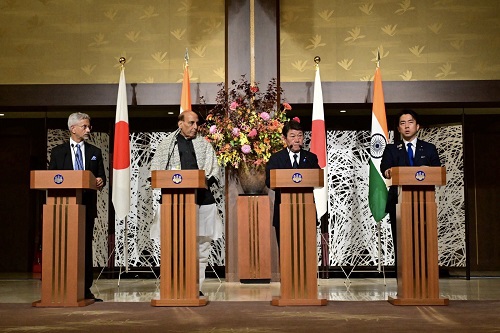
India and Japan have agreed to accelerate negotiations and arrangements concerning the UNICORN stealth naval mast project, signalling a new phase in their defence industrial cooperation. The understanding emerged during the fourth India-Japan 2+2 Foreign and Defence Ministerial Dialogue in Tokyo, attended by Defence Minister Rajnath Singh, External Affairs Minister S. Jaishankar, Japanese Foreign Minister Toshimitsu Motegi and Defence Minister Shinjiro Koizumi. Addressing a joint press briefing, Rajnath Singh emphasised that discussions covered an extensive range of bilateral and regional security concerns under the framework of the Special Strategic and Global Partnership. The latest deliberations build upon the Joint Declaration on Security Cooperation signed in August 2025, demonstrating that both countries are interested in translating their strategic understanding into concrete defence projects and operational cooperation.
The UNICORN project is particularly significant because it represents an opportunity to combine technological expertise and manufacturing capabilities for developing advanced naval systems. Stealth naval mast technology is designed to integrate antenna systems while reducing the radar signature of warships, thereby improving their survivability in contested maritime environments. Expediting the associated agreements could consequently strengthen India's efforts to modernise its naval platforms while creating opportunities for Japanese technological participation in India's expanding defence manufacturing ecosystem. The proposed collaboration also fits into the broader vision of 'Design with Japan, Make in India', which seeks to move bilateral defence relations beyond conventional equipment procurement towards technology development, industrial partnerships and indigenous manufacturing. Rajnath Singh stressed that cooperation should extend to specialised areas, including underwater systems, missile technologies and other niche defence capabilities.
The progress achieved in recent months suggests that this partnership is gradually acquiring a more operational character. Rajnath Singh welcomed the participation of Japan Air Self-Defense Force fighter aircraft for the first time in the bilateral air exercise Veer Guardian 2026, conducted in India. Such exercises improve interoperability, strengthen mutual understanding between armed forces and provide opportunities to exchange operational experience. He also highlighted the third India-Japan Defence Industry Forum, held in Tokyo on October 13, as an important platform for bringing together defence manufacturers and encouraging industrial collaboration. Both countries have also advanced discussions concerning air and space domain awareness, an increasingly important component of modern security planning as military activities become more technology-intensive.
Maritime cooperation received particular attention during the dialogue. India and Japan agreed to implement their recently signed Memorandum of Arrangement through enhanced cooperation in maritime and air domain awareness, search and rescue operations and information sharing. Both sides also called for an early conclusion of an agreement permitting reciprocal access to ship repair facilities. This arrangement could prove valuable for improving logistical support and operational flexibility, particularly as both countries seek to maintain a stronger presence across the Indo-Pacific. Cooperation in mine countermeasure capabilities was another important area of discussion. With maritime trade routes and strategic waterways becoming increasingly vulnerable to geopolitical tensions, the ability to detect and neutralise underwater threats has acquired greater importance for regional security.
External Affairs Minister S. Jaishankar placed these defence initiatives within a wider geopolitical framework, arguing that India and Japan have an important role in supporting a multipolar Asia and a multipolar world. He observed that the international environment is becoming increasingly unpredictable, with geopolitical rivalries and economic uncertainties creating new challenges for countries dependent on interconnected global systems. Both nations, he said, possess the potential to contribute more substantially to shaping the emerging global order. Jaishankar also reaffirmed their commitment, alongside their Quad partners, to preserving a free, open and inclusive Indo-Pacific based on international law, respect for sovereignty and freedom of navigation.
An important dimension of his remarks concerned the growing weaponisation of connectivity, natural resources, services, supply chains and market access. Jaishankar cautioned that excessive dependence on particular routes, resources or economic networks could expose countries to strategic vulnerabilities. Recent developments in the Gulf, particularly the risks associated with maritime choke points, have reinforced the need for diversified connectivity and resilient supply chains. For India and Japan, both major trading nations with significant dependence on maritime commerce, securing uninterrupted access to international shipping routes is not merely an economic consideration but an essential national security priority. Their cooperation in maritime surveillance, information exchange and naval capabilities therefore has implications extending well beyond bilateral relations.
The discussions also addressed the changing character of warfare, particularly the growing use of smart weapons and innovative technologies. Modern military preparedness increasingly depends on artificial intelligence, advanced sensors, autonomous systems, space-based surveillance and precision-guided weapons. Jaishankar indicated that cooperation in these emerging fields could complement the wider partnership between the two countries in innovation and startups. This creates an opportunity to connect defence research with the private sector, encourage technological entrepreneurship and develop solutions suited to the requirements of future security environments.
The timing of the dialogue is also significant. As India and Japan prepare to celebrate 75 years of diplomatic relations in 2027, both countries appear determined to give their partnership a more ambitious and practical direction. Their cooperation is no longer confined to diplomatic exchanges or economic engagement; it increasingly encompasses defence production, advanced technologies, maritime security and strategic coordination. The acceleration of the UNICORN project could become an important example of this evolving relationship. Ultimately, the strength of the India-Japan partnership will depend on how effectively both sides convert their shared strategic vision into tangible outcomes. In an Indo-Pacific increasingly shaped by military competition, technological disruption and economic vulnerabilities, a stronger India-Japan defence partnership could serve as an important pillar of regional stability.





















Leave Your Comment