


From a symbol of India's freedom struggle to a centre of technological excellence, IIT Kharagpur represents the remarkable transformation of the country over the past 75 years. Prime Minister Narendra Modi, attending the institute's Platinum Jubilee celebrations, called upon its students and alumni to carry forward this legacy by turning their knowledge, innovation and ambition into instruments for building a self-reliant and developed India.
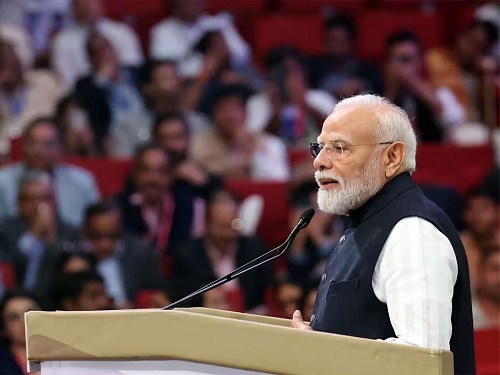
Prime Minister Narendra Modi attended the Platinum Jubilee celebrations of IIT Kharagpur, the country's first Indian Institute of Technology, marking 75 years of its contribution to India's educational, scientific and technological progress. During the occasion, he interacted with students at the institute's Netaji Auditorium under the initiative '75 Voices for Viksit Bharat', highlighting the role of young minds in shaping India's future.
Addressing students, the Prime Minister observed that IIT Kharagpur had played a significant role in the country's transformation over the past seven and a half decades. He described the institution as an important pillar of India's nation-building journey, pointing out that its achievements reflected the country's transition from the struggle for political freedom to the pursuit of technological and economic independence.
Recalling the historical significance of the land on which the institute stands, Modi said the campus had once housed detention camps where Indians who aspired for self-rule demonstrated extraordinary courage and determination. The same place has now been transformed into a centre of learning, research and innovation, nurturing young people whose ideas are contributing to India's self-reliance.
The Prime Minister drew a powerful connection between the aspirations of India's freedom fighters and the ambitions of the present generation. He noted that the land which once symbolised the desire for self-rule now represented the determination to achieve self-reliance. The dream of freedom had gradually evolved into an opportunity for the younger generation to shape the country's future through knowledge, scientific advancement and innovation.
According to Modi, this transformation from aspiration to self-reliance captures the essence of India's journey towards becoming a developed nation. He emphasised that Viksit Bharat was not merely an economic objective but a collective national mission requiring the participation, creativity and commitment of young Indians.
Highlighting IIT Kharagpur's contribution to strategic sectors, the Prime Minister pointed out that its students and alumni had made valuable contributions to India's space and atomic energy programmes. The institution had also played an important role in strengthening the country's technological capabilities at a time when scientific research and indigenous innovation were becoming increasingly important for national development.
He further acknowledged the contribution of IIT Kharagpur graduates to India's expanding software and information technology industry. As global economic opportunities expanded, many of its alumni became instrumental in strengthening India's position in the international technology sector, with several going on to lead some of the world's largest companies.
Modi said the institute had consistently responded to the changing requirements of the nation, demonstrating that educational institutions must remain connected to national priorities. Its legacy, he suggested, was not confined to academic excellence but extended to its ability to produce professionals, entrepreneurs, scientists and innovators who could address complex national and global challenges.
Expressing confidence in the capabilities of the students and alumni, the Prime Minister said they would have an important responsibility in fulfilling the aspirations of today's India. He urged them not to regard difficulties as obstacles but as opportunities to demonstrate their determination and capabilities.
Sharing his own approach towards challenges, Modi remarked that he believed in confronting difficulties rather than avoiding them. He said his instinct was to challenge a challenge itself, encouraging students to develop a similar mindset of courage, confidence and perseverance.
West Bengal Chief Minister Suvendu Adhikari, Governor R. N. Ravi and Union Minister of State for Education Sukanta Majumdar were also present at the Platinum Jubilee celebrations.
The 75-year journey of IIT Kharagpur reflects a larger story of India's emergence as a major centre of education, science and technology. As the country looks towards 2047 and the goal of Viksit Bharat, the institute's next chapter will be defined by its ability to encourage original research, develop indigenous technologies and prepare young innovators for emerging global challenges. The Prime Minister's message placed this responsibility firmly on the shoulders of the next generation, reminding them that the country's future will depend not only on the opportunities they receive but also on what they create for the nation.





















Leave Your Comment