


Electoral violence in West Bengal has a long and complex history, rooted in intense political competition, cadre-based mobilisation, and deep local rivalries. During the Communist Party of India (Marxist)-led Left Front’s dominance (1977–2011), elections were often marred by allegations of voter intimidation, booth capturing, and clashes between party workers. While the Left Front established relative political stability, critics argued that violence was institutionalised at the grassroots level. The 2011 transition of power to the All India Trinamool Congress did not eliminate electoral violence; rather, the pattern persisted with new actors. There has been large-scale electoral violence resulting in a large number of deaths.
West Bengal is one of India’s most densely populated states with a rich culture. The majority community is Hindu (about 70%), followed by Muslims (around 27%), making it one of the largest Muslim populations among Indian states. Scheduled Castes and Scheduled Tribes form a significant share of the population. Migration, both internal and cross-border, has also influenced its demographic composition.
Since 2011, the government in West Bengal, led by Mamata Banerjee, has delivered welfare gains through schemes such as Kanyashree Prakalpa and Sabuj Sathi, which have boosted girls’ education and student mobility. However, critics cite limited industrial growth, unemployment concerns, and allegations of corruption in recruitment and local governance. Political violence, crime against women, and law-and-order issues during elections have also drawn scrutiny.
The 2021 West Bengal Legislative Assembly Election was a high-stakes contest marked by intense polarisation. The All India Trinamool Congress, led by Mamata Banerjee, secured a decisive victory, winning 213 of 294 seats, while the Bharatiya Janata Party emerged as the principal opposition party with 77 seats. However, the election was marred by post-poll violence, reflecting deep political divisions across the state. The Congress and the left parties are struggling to survive.
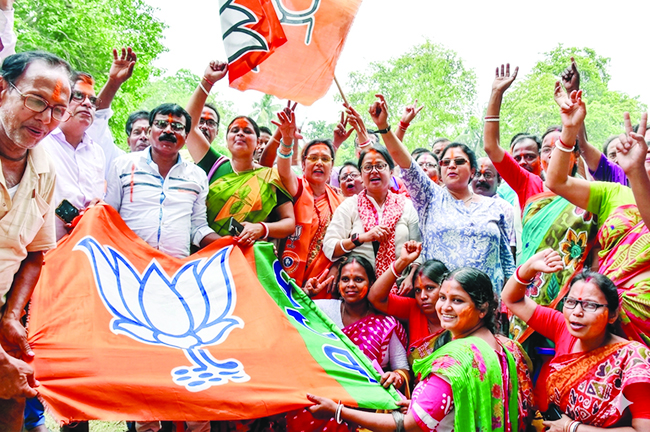
The 2026 assembly elections were held in two phases under heavy security; over two and a half lakh paramilitary personnel were deployed to ensure free and fair elections. An anti-incumbency wave against the Mamata Banerjee government was evident, with people unhappy about unemployment, limited development, and a poor law-and-order situation. She managed the campaign effectively, but people wanted a change after 15 years. On the other hand, the BJP began its campaign strategy immediately after the 2021 elections. In the last couple of months, Prime Minister Modi led the campaign, supported by Amit Shah and other senior party leaders. They exposed the weaknesses of the TMC government and promised employment, better law and order, and industrialisation of the state. The BJP secured only three seats with 10% of the vote in 2016 and increased its tally to 77 seats with 38% of the vote in the 2021 elections. In the 2026 election results, the BJP secured 206 seats with a 45.8% vote share. TMC won 81 seats with 41.0% of the vote. Voting for one constituency will be held on 21st May. This is the first BJP victory in West Bengal; such a landslide victory was not expected by psephologists. In this Modi wave, Mamata Banerjee also lost her Bhabanipur seat.
Assam
Assam has a population of about 31 million and is marked by significant ethnic, linguistic, and religious diversity. Hindus constitute around 61%, while Muslims make up about 34% (the highest in all states), with a higher concentration in lower Assam and the Barak Valley. Scheduled Tribes and Scheduled Castes also form an important share.
In the 2021 Assam Legislative Assembly Election, the Bharatiya Janata Party-led NDA retained power, winning 75 of 126 seats. The BJP, along with allies Asom Gana Parishad and United People's Party Liberal, benefited from a mix of welfare schemes, strong leadership under Himanta Biswa Sarma, and the consolidation of Hindu votes. The opposition Indian National Congress-led alliance performed better in minority-dominated areas but fell short overall. Issues such as identity politics, citizenship debates, the Rohingyas, and development shaped voter behaviour.
The government of Himanta Biswa Sarma in Assam (since 2021) has recorded notable achievements alongside significant criticism. On the positive side, the government focused on infrastructure and development, clearing large-scale projects and attracting investments to boost growth. Strong action on social issues led to a sharp decline in child marriage and improved women’s welfare indicators. The administration also strengthened policing and internal security, while insurgent influence, particularly of ULFA, has declined compared to earlier decades. Welfare schemes and youth-oriented initiatives have also been emphasised. Himanta Biswa Sarma has emerged as a popular BJP face in the state.
However, critics highlight several failures. Concerns include unemployment, limited industrialisation, and a gap between investment promises and actual outcomes. Opposition parties have raised allegations of corruption, misuse of state machinery, and political targeting. Policies on eviction drives and identity politics have sparked social tensions and accusations of divisiveness.
The Indian National Congress faced several challenges in Assam. A key problem was organisational weakness at the grassroots, compared with the Bharatiya Janata Party's well-structured network. Leadership issues and a lack of a strong, unified face in the state also undermined campaign coherence. Alliance management posed difficulties, with coordination gaps among opposition partners diluting efforts to consolidate votes. The BJP’s strong narrative on identity, nationalism, and welfare schemes resonated more effectively with voters, especially in upper Assam. Congress struggled to counter this messaging convincingly. Some prominent senior leaders joined the BJP. Factionalism within the party, limited resources, and reduced voter trust due to past governance perceptions further weakened its position, leading to an underwhelming electoral performance.
In the present elections, the BJP+ secured 102 seats with 48% of the votes in the 126-member assembly. This 4/5th majority was more than political pundits had expected. This is the party's third successive win. Himanta single-handedly campaigned for the elections and attempted to unite the Hindus. Gaurav Gogoi, the Congress chief ministerial candidate, lost his Jorhat seat.
Kerala
In the last decade, the government in Kerala, led by the CPI (M)-headed Left Democratic Front (LDF) under Pinarayi Vijayan, has delivered notable achievements while also facing criticism. The state strengthened its public health system, social welfare schemes, and public education, and digital initiatives such as e-governance expanded. Infrastructure projects such as roads, IT parks, and the Kochi Metro (in its expansion phase) have boosted connectivity and urban mobility.
However, high public debt and fiscal stress have raised concerns about fiscal sustainability. Unemployment, especially among educated youth, remains a concern. The government has also faced allegations of corruption and controversies, including the Kerala gold smuggling case. Environmental concerns, such as flood management after recurrent floods, and debates over large projects, have also drawn criticism. There was strong anti-incumbency against the LDF government. The United Democratic Front (UDF), led by Congress, won 102 seats, a comfortable 2/3 majority, with a 46.5% vote share, in the house of 140 in these elections. LDF secured 35 seats with 37.6% of the vote, and BJP+ won 3 seats with 14.2% of the vote.
The Bharatiya Janata Party has steadily strengthened its position in Kerala through a mix of organisational expansion, targeted strategy, and narrative-building. It has focused on select constituencies, grassroots and local party expansion, local leadership, development, and nationalism. The party is positioning itself as a “third alternative” to the traditional Left–Congress system. Rather than seeking immediate power, the BJP aims to increase its vote share and influence outcomes across multiple constituencies. Recently, the party won the Thiruvananthapuram corporation elections.
Tamil Nadu
M.K. Stalin is leading the DMK government in Tamil Nadu with the support of the Congress. Its achievements include social welfare schemes (healthcare, food security, education), expansion of public health infrastructure, and sustained leadership in industrialisation and automobile manufacturing. Tamil Nadu has remained among India’s top states in GDP, exports, and human development indicators. Urban infrastructure, including metro rail expansion in Chennai, has improved connectivity.
However, challenges include rising state debt, youth unemployment, and periodic concerns over power and water management. Allegations of corruption and governance inefficiencies have persisted across regimes. Environmental issues, such as pollution and flood management, remain key concerns despite overall economic and social progress. There was anti-incumbency against this government.
The BJP is strengthening booth-level structures, recruiting cadre, and building grassroots networks to challenge the dominance of Dravida Munnetra Kazhagam and All India Anna Dravida Munnetra Kazhagam. Leaders such as K. Annamalai have given the party a more assertive and visible regional presence, helping it reach younger and urban voters.
TVK
The Tamilaga Vettri Kazhagam (TVK) is a political party in Tamil Nadu, founded in 2024 by actor-turned-politician Vijay. Drawing on his strong fan base, TVK positions itself on governance, social justice, youth empowerment, and anti-corruption. The party seeks to offer an alternative to the established Dravidian parties, such as the DMK and the AIADMK. TVK emphasises welfare with accountability, education reforms, and employment generation. Though new, it has generated significant public interest, especially among young voters, and aims to reshape Tamil Nadu’s political landscape.
In the recent elections, TVK emerged as the single largest party, winning 107 seats with 35% of the vote; the incumbent DMK+ won 74 seats with 31.4% of the vote; and AIADMK+ secured 53 seats with 27.2% of the vote. The NDA was part of the AIADMK alliance. M.K. Stalin lost his Kolathur seat. Joseph Vijay Chandrashekhar’s TVK emerged as a dark horse in these elections. Leveraging his larger-than-life image, his grassroots network of film clubs, and his cult status among the young, Vijay has successfully broken the Dravidian duopoly that held for half a century. He made his manifesto loaded with welfare schemes.
Conclusion
Mamta Banerjee was voted to power in 2011 by the people after 34 years of left rule, as an agent of change. But her regime became entangled in ‘tolabazi’, ‘syndicate’, and ‘cut money’ culture. In some areas, the government appeared to be outsourced to local strongmen. Violence in Murshidabad, Malda, and Sandeshkhali was cited as evidence of selective governance and folded into a broader narrative of imbalance. A series of disturbing crimes against women altered the mood. The rape of a doctor at R G Kar Hospital and the incident at Durgapur Medical Hospital College eroded the trust she had built among women voters. Reports of attacks on Hindus in Bangladesh lent urgency to the BJP’s messaging of infiltration, framing the issue of ‘demographic anxiety’.
BJP’s victories in Bengal and Assam demonstrate the steady consolidation of Hindu votes, despite the substantial Muslim presence in both states. In Assam, the Congress is largely confined to Muslim-dominated pockets. Of the 19 Congress MLAs, 18 are Muslims. Assam’s recent investment surge, highlighted by high-profile projects such as the Tata semiconductor plant, has contributed significantly to the state’s development.
In Tamil Nadu, Stalin’s tenure struggled under the shadow of rising crime, particularly against women and SCs. Corruption, though not unique to his administration, became increasingly visible, amplified by the arrest of senior ministers. DMK’s attempts to mobilise sentiment through sharp anti-Sanatan rhetoric did not quite hold its coalition together. This anti-incumbency was exploited by Vijay.
In Kerala, allegations of corruption, including the Sabarimala temple gold theft, the Karuvannur Cooperative Bank scandal, and the entry of women into the Sabarimala shrine, eroded voter trust, and the Congress-led UDF was brought back to power. Now, there is no left-party government in the country.
It is hoped that the new governments will fulfil the people's aspirations and implement the promises made to them.
When the BJP failed to retain its 2014 and 2019 parliamentary majorities in 2024, it appeared to mark the beginning of the decline of its dominance in national politics. Assembly results post-2024 Lok Sabha elections show that such assessments were incorrect. The BJP has 17 chief ministers in India today, and with alliance partners, it is in power in five other states and Union Territories. The NDA governments are ruling over 76% of the country's area and 77% of its population. While the BJP now rules every Hindi-speaking state and UT except Jharkhand and Himachal Pradesh, it also has chief ministers in three non-Hindi-speaking states in eastern India (Assam, West Bengal, and Odisha).
It is a triumph for the world's largest democracy. A vibrant democracy requires a strong opposition. The regional parties are losing their relevance; the grand old Congress party must reinvent itself, look beyond a family, and regain its lost glory.

Manoj Dubey
(The content of this article reflects the views of writer and contributor, not necessarily those of the publisher and editor. All disputes are subject to the exclusive jurisdiction of competent courts and forums in Delhi/New Delhi only)




















Leave Your Comment