


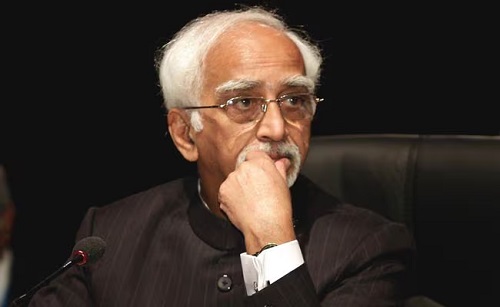
Former Vice President Hamid Ansari has once again triggered a political debate with remarks on the perceived threat of Hindu right-wing communalism in India. Speaking at the A.G. Noorani Memorial Lecture, Ansari cited a historical observation attributed to former Prime Minister Jawaharlal Nehru, saying that Hindu right-wing communalism posed a greater danger to India than communism. The remarks drew a sharp response from the BJP and revived an older political debate over communalism, nationalism and the interpretation of Indian history.
Former Vice President Hamid Ansari's remarks at the A.G. Noorani Memorial Lecture have sparked a fresh political controversy, bringing questions of communalism, political ideology and India's historical narrative back into the spotlight.
Addressing the gathering, Ansari referred to A.G. Noorani's book The RSS: A Menace to India, published in 2019. He cited a passage from the book's introduction that refers to an observation attributed to former Prime Minister Jawaharlal Nehru. According to Ansari, Nehru had told officers of the Ministry of External Affairs that the danger facing India was not communism but Hindu right-wing communalism.
Ansari presented the remark in the context of Noorani's discussion of the political and social sentiment prevailing among sections of Indian Muslims. By invoking Nehru's observation, he placed the historical statement within a broader discussion about communal politics and the concerns surrounding India's plural social fabric.
The remarks, however, immediately became a political flashpoint. The BJP strongly criticised Ansari and linked his statement to the Congress party's broader political outlook. BJP national spokesperson Pradeep Bhandari alleged that Ansari's remarks were being made in line with the thinking of Congress leader Rahul Gandhi. He also referred to a reported 2009 remark by Gandhi concerning the perceived threat posed by Hindu groups in comparison with Lashkar-e-Taiba.
The BJP used the occasion to accuse the Congress of pursuing what it described as an anti-Hindu political approach. Such allegations form part of a larger political contest in which both the Congress and BJP have frequently accused each other of adopting positions driven by ideological and communal considerations.
At the heart of the controversy is the distinction between citing a historical statement and endorsing it as a contemporary political position. Ansari's immediate reference was to Noorani's book and the historical observation attributed to Nehru. The BJP, however, interpreted the remarks through the lens of present-day political discourse.
The controversy also comes against the backdrop of earlier disputes involving Ansari's comments on Indian history. In January 2026, a remark concerning medieval ruler Mahmud of Ghazni had also drawn criticism from BJP leaders.
In an interview, Ansari was heard referring to rulers who are generally described in Indian history as foreign invaders as “Indian looters”. He argued that describing them simply as outsiders had, in his view, also been politically convenient. The comments generated a strong political reaction because Ghazni is associated with repeated raids into the Indian subcontinent, including the attack and desecration of the Somnath temple.
The latest controversy therefore goes beyond a single statement. It reflects a continuing political struggle over how India's history should be interpreted and how questions of religion, nationalism and communalism should be discussed in public life.




















Leave Your Comment