



RSN Singh
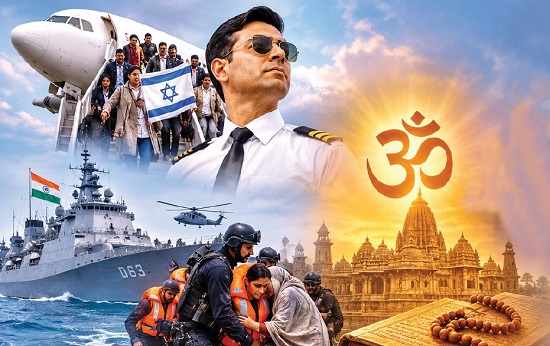
Recently, two significant events demonstrated the civilizational moorings and character of Bharat and Bharatiyata in the volatile Middle East. Both involved the rescue of citizens of two principal protagonists, Israel and Iran, by air and sea, respectively. These incidents may also be viewed through the broader prism of the Jewish and Shia Muslim communities.
RESCUE OF JEWS IN THE AIR
In the first incident, on 30 September, an Indian pilot, Captain Smit Machchhar, commanding a Flydubai aircraft flying from Dubai to Tel Aviv, was confronted by a jihadi co-pilot who sought to crash the aircraft, carrying 174 Israeli passengers, into the ground. Despite being bloodied and suffering serious injuries, Captain Smit managed to save the aircraft and its passengers. Had the jihadi co-pilot succeeded, given the level of animosity towards Israel and Jews, many sections of the Islamic world would have celebrated the incident.
The Leader of the Opposition in India was so dismayed by this rescue that he refused to commend the bravery of Captain Smit, his fellow Indian. He made no comment despite being prodded by his octogenarian party president. His desperation to rule India seems to have killed the Bharatiyata in him, if he possessed any innately.
RESCUE OF SHIA MUSLIMS AT SEA
A month later, on 2 November, an Iranian fishing vessel, MV Azini, carrying 20 crew members, was hijacked by Somali pirates in the Arabian Sea, approximately 3,000 kilometres off the Mumbai coast. The Indian Government readily responded to the Iranian Government's urgent request and executed a highly complex rescue mission involving the guided-missile destroyer INS Kolkata, maritime patrol aircraft, MARCOS naval commandos and C-17 transport aircraft.
Had the vessel not been rescued, the pirates could have used it as a platform to hijack several other vessels in this strategically sensitive maritime region. It needs to be underscored that the 20 Iranians rescued by the Indian Navy and the Indian Air Force were Shia Muslims.
Both these incidents testify to Hindu philosophy and its humane values. Those who are given to lecturing India on human rights and secularism must realise that doing so amounts to offering light to the blazing sun.
HINDUISM AND THE SENSE OF KARMA
Indian Navy veteran Harinder Sikka, in an interview, narrated a telling incident illustrating the Hindu belief in dispassionate karma and the sense of duty.
He recounted the devastating floods in Kashmir in 2014. At the time, he was employed with the Piramal Group and, in coordination with the Cabinet Secretariat, was providing relief to flood victims.
The group's outreach to the victims was extraordinary in that it involved deploying water-purification machines, which were critical for the survival of both human beings and their livestock. Each of these heavy machines had the capacity to purify 5,000 litres of water per hour.
He stated that, in terms of physical assistance and willingness to help, none but the RSS came to their rescue. On one occasion, when their boat was to proceed to an area that was a stronghold of separatists, Commander Sikka confesses that he was momentarily consumed by the thought that these were the very people responsible for the killings of so many security personnel. He wondered whether they really deserved such outreach.
He then recounted how RSS volunteers stepped in to explain that, according to their teachings and their sense of karma, making such distinctions was considered blasphemous.
ASIM MUNIR'S ANTI-HINDU AGENDA
However, the unfortunate reality is that such humanitarian outreach and gestures do not find many takers in the Islamic world. History, too, bears testimony to this. The world has progressed, but the Islamic attitude in this regard has not.
Ironically, coinciding with this Indian outreach, representatives of four Islamic nations, namely Turkey, Iran, Saudi Arabia and Pakistan, met in Tehran on 26 October 2026. Pakistan was represented by none other than Field Marshal Asim Munir.
Mohsen Rezaei, Secretary of Iran's Supreme National Security Council, disclosed that during the meeting, Asim Munir, in a foreboding tone, declared that a growing compact was emerging between Jews and Hindus against the Muslims of the world. The Lahore-based news outlet that carried the video report attributed it to the Iranian state broadcaster, IRIB.
The reference to India and Israel was obvious. Pakistan's obsession with Hindus appears incorrigible. Similarly, hatred towards Jews among sections of the Muslim world in the Middle East also appears deeply entrenched.
On this Pakistani foreboding, all the representatives appeared to be on the same page. Turkey was represented by its intelligence chief, Ibrahim Kalin. Prince Khalid bin Salman, the Defence Minister of Saudi Arabia, also participated. Other participants included Iran's President Masoud Pezeshkian, Foreign Minister Abbas Araghchi and Speaker Mohammad Bagher Ghalibaf.
The focus of the meeting was a regional security architecture encompassing the Strait of Hormuz and a non-aggression framework among Islamic countries in the region. Thus, any new architecture proposed by Pakistan would be hostile to Israel (Jews) and India (Hindus).
Another four-nation meeting, envisaged by Tehran for the coming months, is expected to focus on Afghanistan. Representatives from Pakistan, China and Russia are expected to participate.
NEW ISLAMIC ALLIANCES
In the Middle East, the latest defence alliances and defence cooperation partnerships are anchored in a historical Islamic narrative. This possibly serves as a common glue and galvanising force.
The first is the Mecca Pact, signed in August 2026 between Turkey, Saudi Arabia and Pakistan. The central principle of the agreement is that an attack on one member would be considered an attack on all three, modelled partially on NATO's collective defence framework. This pact is an extension of the Strategic Mutual Defence Agreement (SMDA) signed between Pakistan and Saudi Arabia in September 2025.
The second, the Badr Pact, was signed between Turkey, Pakistan, Qatar and Indonesia in October 2026. As stated, it primarily envisages defence-industrial cooperation. Beyond its immediate potential and stated objectives, this pact may be construed as a form of Pan-Islamic defence manufacturing initiative, potentially leading to a wider strategic partnership.
PAKISTAN: PIVOT OF THE ISLAMIC WORLD?
In both these pacts, Turkey and Pakistan are the two common countries.
The strategic importance of Turkey lies in the fact that it is a member of NATO and an important regional balancer. As Europe declines, Turkey, with the second-largest military within NATO, is becoming an increasingly important player in the Middle East. Under Erdogan, who fancies himself as an Ottoman Caliph, Turkey's geopolitical orientation is increasingly shifting towards West Asia and South Asia. Turkey was among the first countries to recognise Pakistan. Given its historical links with the Indian subcontinent through the Ottoman Caliphate, Turkey has considerable influence over the Muslims of the subcontinent.
Pakistan is being courted by both Saudi Arabia and Iran because Islamabad occupies a unique position as a strategic pivot, a military heavyweight and a potential bridge state in the fierce geopolitical and sectarian competition among Muslim countries in the Middle East and South Asia.
Saudi Arabia wants to keep Pakistan within the Sunni fold so as to contain Iran. Pakistan's nuclear and military capabilities are an advantage for Saudi Arabia.
Iran, on the other hand, courts Pakistan because the two countries share a 900-kilometre border. Border security and counter-terrorism requirements mandate close cooperation and coordination between them.
Before the advent of the Islamic revolutionary regime, Iran and Pakistan were close strategic partners. Whenever Iran has faced a crisis involving Israel or the United States, Pakistan's posture has generally been one of neutrality or diplomatic sympathy towards Iran.
To break its international isolation, Iran has also evinced substantial interest in the China-Pakistan Economic Corridor (CPEC). If there is a catastrophic confrontation between Iran and Israel, it will tear apart Pakistan's domestic sectarian fabric as well.
CONCLUSION
While the Mecca Pact is limited to West Asia, with oil-rich Saudi Arabia at its centre, the Badr Pact extends from West Asia to Southeast Asia, with gas-rich Qatar at its centre.
While Qatar is located on the Persian Gulf, in the vicinity of the Strait of Hormuz, Indonesia overlooks the Strait of Malacca. It may be recalled that the Sukarno government in Indonesia had openly supported Pakistan during the 1965 war.
Notwithstanding other geopolitical imperatives, the tendency of Islamic countries to come together will always remain. To counter this tendency, India must vigorously promote its civilizational soft power, particularly since most South Asian and Southeast Asian countries share a Hindu and Buddhist past.
(The content of this article reflects the views of writer and contributor, not necessarily those of the publisher and editor. All disputes are subject to the exclusive jurisdiction of competent courts and forums in Delhi/New Delhi only)




















Leave Your Comment