


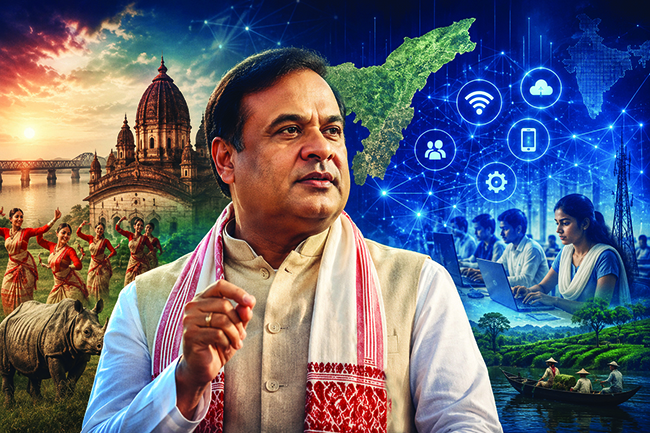
The 2026 Assam Assembly election was not merely a contest between political parties. It was a battle over identity, perception, and narrative — fought as intensely on mobile screens as on the ground. From Facebook reels and WhatsApp forwards to aggressive X campaigns and hyper-local digital messaging, Assam witnessed one of the most sophisticated political communication exercises in its history. At the centre of this transformation stood Himanta Biswa Sarma, the man who has not only reshaped Assam’s political landscape but also redefined the Bharatiya Janata Party’s electoral playbook in the Northeast.
As the BJP prepared to form the government again in Assam after the 2026 elections, political observers increasingly viewed the result as a validation of Sarma’s extraordinary political journey — from being one of Congress’s most powerful strategists in the Northeast to emerging as one of the BJP’s most influential regional leaders. His rise has coincided with the BJP’s transformation from an outsider party in Assam into the state’s dominant political force.
The BJP’s 2026 campaign was built on a combination of governance messaging, welfare delivery, regional nationalism, and an aggressive digital strategy that targeted both emotion and aspiration. While opposition parties focused heavily on rallies and conventional campaigning, the BJP appeared to understand that public opinion in modern Assam was increasingly shaped online. Political communication was no longer confined to speeches or newspaper headlines; it was flowing continuously through short videos, memes, emotional slogans, regional cultural references, and hyper-targeted identity narratives.
Across social media platforms, the BJP ecosystem in Assam operated with remarkable coordination. Supporters, influencers, local party workers, and affiliated digital handles amplified campaign themes almost in real time. The messaging revolved around three core ideas: development under BJP rule, protection of Assamese identity, and the portrayal of the Congress as disconnected from regional concerns. The campaign often projected Sarma as both a modern administrator and a cultural guardian — a leader capable of balancing infrastructure growth with indigenous anxieties around demography and illegal migration.
Political analysts believe this narrative engineering played a major role in consolidating support among large sections of Assamese voters. The BJP’s digital campaign did not merely promote policies; it attempted to shape a larger political psychology. The emphasis on identity politics, particularly around “indigenous rights” and concerns over demographic change, became central to online discourse throughout the election period.
What made the BJP’s campaign particularly effective was its ability to merge local political language with national political branding. Unlike earlier elections where regional identity and national politics often clashed in Assam, the BJP under Sarma managed to present the two as complementary. The party projected itself as both the defender of Assamese civilisation and a vehicle of national strength under Prime Minister Narendra Modi. This synthesis became one of the defining features of the 2026 campaign.
Sarma himself emerged as the dominant face of the election. Unlike many chief ministers who rely heavily on party machinery, he cultivated a direct political connection with voters through relentless visibility. His speeches, interviews, quick digital responses, and highly active social media presence ensured that he remained constantly in public conversation. Even critics acknowledged that few politicians in contemporary India understand political communication as instinctively as Sarma.
Yet, the election also revealed the increasingly blurred line between political mobilisation and digital polarisation. Several controversies erupted during the campaign over provocative online content allegedly linked to BJP-affiliated handles. AI-generated videos, communal messaging, and highly inflammatory posts became subjects of criticism from opposition parties and activists. Some posts triggered legal and political backlash, intensifying debates around the ethics of digital campaigning in India’s electoral politics.
The BJP, however, consistently defended its broader political messaging as a response to genuine concerns over illegal immigration, demographic change, and indigenous rights. Sarma himself repeatedly argued that the election was fundamentally about protecting Assamese identity and securing political stability. In interviews following the victory, he downplayed the significance of social media popularity alone, insisting that elections are ultimately won through grassroots organisation and voter connect rather than digital optics.
Still, there is little doubt that digital strategy became one of the BJP’s strongest political weapons in Assam. Unlike previous elections where social media played a supplementary role, the 2026 contest showed how online ecosystems could shape political momentum itself. Campaign narratives were now born digitally before being reinforced physically through rallies and organisational outreach.
The roots of this political dominance, however, lie deeply intertwined with Himanta Biswa Sarma’s own political evolution. Few politicians in India have undergone a transformation as dramatic as his. Once regarded as the organisational backbone of the Congress in Assam, Sarma was instrumental in keeping the party electorally competitive during the later years of former Chief Minister Tarun Gogoi’s tenure. He was widely viewed as a skilled strategist with deep administrative understanding and unmatched grassroots networks.
But tensions within the Congress leadership altered the course of Assam politics permanently. Feeling sidelined within the party structure and increasingly frustrated by what he reportedly saw as leadership indecision, Sarma left the Congress in 2015 and joined the BJP. At that moment, many considered it a major setback for Congress. In retrospect, it marked the beginning of a political realignment that would fundamentally reshape Assam.
Sarma brought with him not just personal ambition but a sophisticated understanding of Congress’s organisational architecture, regional caste equations, and electoral vulnerabilities. Under his leadership, the BJP expanded rapidly across Assam and the wider Northeast. The party, which once struggled to establish itself in the region, suddenly acquired a leader capable of blending ideological aggression with administrative pragmatism.
The 2016 election first demonstrated this shift when the BJP came to power in Assam for the first time. By 2021, Sarma had consolidated himself as the state’s most powerful political figure. The 2026 election further strengthened that image. Political observers noted that the BJP campaign increasingly revolved around Sarma’s personal authority rather than merely party symbolism.
One of the most striking aspects of the 2026 election was the BJP’s ability to neutralise opposition narratives before they could gain traction. Congress attempted to project new leadership under Gaurav Gogoi, but the BJP successfully framed the Congress campaign as lacking ideological clarity and organisational depth. Sarma’s long experience inside Congress appeared to give him a tactical advantage in anticipating opposition moves.
The BJP also benefited from its welfare and infrastructure record. Roads, connectivity projects, welfare schemes, and administrative visibility helped reinforce the party’s governance credentials. At the same time, the campaign consistently returned to themes of identity and demographic anxiety, ensuring emotional mobilisation alongside developmental messaging.
The Assam election of 2026 may ultimately be remembered as a milestone in the evolution of Indian electoral politics. It demonstrated how digital ecosystems, regional nationalism, leadership branding, and ideological messaging can merge into a powerful political machine. More importantly, it cemented Himanta Biswa Sarma’s position not merely as Assam’s dominant politician but as one of the BJP’s most significant strategists nationally.
His journey from Congress insider to BJP strongman reflects more than personal ambition. It mirrors the broader transformation of Indian politics itself — where political success increasingly depends on controlling narratives as much as controlling organisation. In Assam, the BJP did not simply win another election. It succeeded in shaping the political imagination of a large section of the electorate.
And in that transformation, Himanta Biswa Sarma remains the central architect.
(The content of this article reflects the views of writer and contributor, not necessarily those of the publisher and editor. All disputes are subject to the exclusive jurisdiction of competent courts and forums in Delhi/New Delhi only)



















Leave Your Comment