


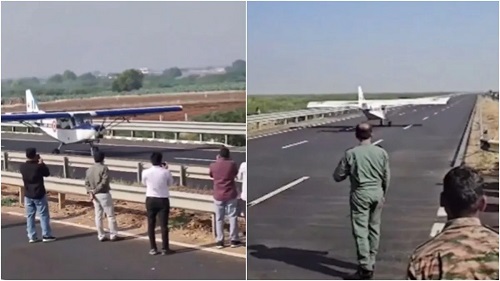
In a significant demonstration of India's growing defence preparedness and infrastructure capabilities, four Indian Army microlight aircraft have successfully landed and taken off from a section of the Amritsar-Jamnagar Economic Corridor in Gujarat. The exercise demonstrated how modern highways, beyond facilitating the movement of passengers and goods, can also serve strategic military requirements, particularly during emergencies. Conducted under the Army's 'Wings of Valour and Unity Expedition', the operation highlighted the growing coordination between the Indian Army and the National Highways Authority of India (NHAI), opening up new possibilities for integrating civilian infrastructure with national security needs.
The exercise marked an important milestone in India's efforts to develop infrastructure that can serve multiple strategic purposes. Four aircraft belonging to the Indian Army's 'Team Mountain Eagles' successfully carried out landing and take-off operations on a designated stretch of National Highway-754A, between kilometre 946 and kilometre 949, along the Amritsar-Jamnagar Economic Corridor in Gujarat.
The formation comprised two fixed-wing microlight aircraft and two flexible-wing powered hang gliders. The aircraft included the X-Air 'Hanuman' and Savannah MXP 740 microlights, alongside the Tanarg Bionix and Nuvix Skypper powered hang gliders.
The operation went beyond demonstrating the ability of light aircraft to use a highway as a runway. The team also conducted precision landings, ground refuelling and turnaround procedures, showcasing the operational preparedness and flying capabilities of the participating personnel.
The exercise demonstrated that carefully selected stretches of India's expanding road network could potentially provide alternative landing facilities for light aircraft when conventional airfields are unavailable or inaccessible. Such infrastructure could prove useful during emergencies, disaster-response operations and specialised military requirements.
A major feature of the operation was the coordination between the Indian Army, NHAI, state police and local administration. The successful execution required detailed technical assessments and extensive safety arrangements to ensure that the highway could temporarily function as an aviation facility.
Before the aircraft arrived, NHAI's technical and incident management teams examined the road surface, alignment, geometry and other safety parameters. Traffic diversions were arranged, and the designated section was cleared to facilitate uninterrupted aviation operations.
Army ground support personnel also demonstrated mobile refuelling and aircraft turnaround capabilities. Once the exercise was completed, traffic movement was restored after the necessary operational and safety procedures.
Union Road Transport and Highways Minister Nitin Gadkari highlighted the achievement, describing it as an example of effective cooperation between the Army and NHAI. He emphasised that the country's highway infrastructure should not be viewed merely as a network for transportation but also as an asset capable of supporting strategic and operational requirements.
The broader significance of the exercise lies in the concept of dual-use infrastructure. Roads developed primarily for economic connectivity can, if designed and equipped appropriately, provide additional support to defence operations and emergency services. This approach can strengthen national preparedness without necessarily requiring the construction of separate infrastructure for every specialised requirement.
However, not every highway can function as an aircraft runway. Road width, surface strength, approach and departure conditions, surrounding obstacles and traffic-management arrangements remain critical considerations. Such operations therefore require technical clearance and close coordination among the concerned agencies.
The highway landing was organised as part of the Indian Army's 'Wings of Valour and Unity Expedition', which was flagged off on November 14, 2026. Organised by the Army Adventure Nodal Centre at the Military College of Telecommunication Engineering (MCTE), Mhow, the expedition is scheduled to conclude at Mhow on November 28 after passing through Madhya Pradesh, Gujarat and Rajasthan.
The initiative, conducted under the Army Adventure Wing, seeks to showcase the Army's aviation-related capabilities, adventure activities, teamwork and operational skills. The participation of Team Mountain Eagles has brought attention to the importance of precision flying, coordination and adaptability in challenging operational environments.
The successful use of the highway also draws attention to the strategic importance of the Amritsar-Jamnagar Economic Corridor. Connecting important regions of northern and western India, the corridor is designed to improve freight movement, reduce transportation time and strengthen economic connectivity.
Its potential strategic significance adds another dimension to the country's infrastructure development. In a geographically diverse country with extensive security requirements, infrastructure that can support both economic activity and emergency preparedness offers considerable advantages.
The Gujarat exercise therefore represents more than an unusual aviation demonstration. It reflects an emerging approach to national infrastructure planning in which connectivity, defence preparedness and disaster management can complement one another. As India continues to expand its expressways and national highways, integrating suitable stretches with specialised operational capabilities could become an important component of its broader infrastructure and security strategy.




















Leave Your Comment