


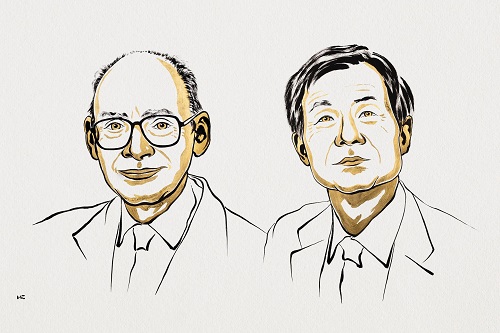
The 2026 Nobel Prize in Chemistry has honoured Henri Kagan and Kenso Soai for their pioneering discovery of non-linear effects and autocatalysis in asymmetric organic synthesis, recognising research that has deepened understanding of how chemical reactions can amplify molecular asymmetry. The Royal Swedish Academy of Sciences announced the award in Stockholm on Wednesday, placing their work among this year’s most significant contributions to science.
The 2026 Nobel Prize in Chemistry has been awarded to Henri Kagan and Kenso Soai for their pioneering work on non-linear effects and autocatalysis in asymmetric organic synthesis, highlighting the importance of understanding how chemical reactions can amplify molecular asymmetry. The Royal Swedish Academy of Sciences announced the prestigious award in Stockholm on Wednesday, recognising research that has helped deepen scientists’ understanding of how complex organic molecules can be produced with a preferred three-dimensional structure.
The work of Kagan and Soai is particularly significant because asymmetry lies at the heart of organic chemistry. Many molecules exist in forms that are mirror images of one another, yet biological systems can respond very differently to each form. The ability to selectively produce one molecular form is therefore an important principle in modern chemistry and has broad implications for the development of pharmaceuticals and other advanced chemical products.
Their recognition also underscores the Nobel tradition of rewarding fundamental discoveries whose wider significance may extend far beyond the laboratory. By examining non-linear effects and autocatalysis, their research contributed to a better understanding of how small differences in chemical reactions can be amplified, ultimately influencing the composition and structure of the products formed.
The Chemistry prize is part of a week of Nobel announcements spanning medicine, physics, literature, peace and economics. This year's awards began with the Medicine prize on Monday, followed by the Physics prize on Tuesday. The Literature prize is scheduled for Thursday, the Peace prize for Friday, while the Nobel Memorial Prize in Economic Sciences will be announced on Monday.
The Chemistry Nobel also forms part of a broader scientific narrative this year. Last year's Chemistry laureates were recognised for developing molecular structures capable of holding substantial quantities of gas, with potential applications including greenhouse-gas capture and moisture collection in dry regions. This year's award, by contrast, focuses on the intricate mechanisms through which chemical reactions can generate and amplify molecular asymmetry.
The sequence of Nobel announcements reflects the breadth of scientific and intellectual achievement recognised by the Nobel system. With medicine, physics and chemistry already announced, attention now turns to literature and peace before the economics prize concludes the week's announcements.
The award to Kagan and Soai therefore represents not merely a celebration of two chemists, but recognition of a deeper principle in science: seemingly small molecular differences can produce significant chemical consequences. Their work has helped illuminate the mechanisms behind that phenomenon and strengthened the theoretical foundations of asymmetric organic synthesis.






















Leave Your Comment