


A joke was very popular about roadside food joints:
A customer ordered Dal Makhani, and it was served to him. Dal was stale and gave off a foul smell. The customer complained, and the waiter fired him saying,” it is the same Dal Makhani which you were praising last week”. I don’t know what happened to that customer but Indian voters in Haryana and Jammu and Kashmir have refused to vote for a stale recipe of general election which places the Constitution, Jawan and Kisan in danger. Post-general election result a non-political Information technology wizard told me that the media and the Indian National Developmental Inclusive Alliance (I.N.D.I.A) has scared the public and reaped benefits but within three months they will be exposed. I took it lightly that time but the present results have proved him right.
Misinformation has eroded the public’s confidence in the narrative set by opposition.
A segment of media and political pandits are treating the results as 1-1 for BJP and Congress but this is a misinformation once again. National Conference entered in alliance with Congress to get a few seats in Jammu region. However, Congress failed miserably and could get only one seat there and out of 32 candidates fielded it won a total 6. It is the worst performance by any standard. Despite less seats BJP has garnered highest vote percentage.
On the other hand, Haryana's election result has blasted the narrative set with so much effort, the ripple effects will redefine strategies for both national and regional parties. As power shifts and alliances are being tested. There might be leadership crisis in I.N.D.I Alliance. The stakes have never been higher for the BJP, Congress, and their key allies and setbacks are even higher for the losing one. The outcome of the Haryana election has spoiled the game plan of Congress which wanted to lead the alliance to project Rahul Gandhi as PM in waiting. Rahul Gandhi has destroyed whatever goodwill he gained from his long Yatra last year.
What does this crucial battleground state tell us about the future of Indian politics?"
The Bhartiya Janata Party (BJP) winning in Haryana has significant political and strategic mileage for the party for several reasons:
1. Stronghold in Northern India
With opposition government in Punjab, Himachal and Jammu and Kashmir, Haryana will play a crucial role in maintaining the BJP's influence in the region. Victory has strengthened the party’s grip on the Hindi heartland. The state shares borders with Delhi, Punjab, and Uttar Pradesh, making it strategically important for safeguarding Delhi from motivated agitations. Right from the days of Asian games 1982 Haryana has acted as the safety valve to diffuse pressure on Delhi.
2. Rural and Urban Voter Base
Haryana is a mix of rural and urban populations along with good number of people joining armed forces. Winning here proves that the BJP has managed to strike a chord with these voter bases. The opposition was questioning the sanctity of the Agniveer scheme and was seeking a mandate with a promise to withdraw the scheme, the win here is crucial as it sets a template for other states with a similar demographic mix. Haryana’s rural votes, especially from the agricultural communities like Jats, set a new trend in North India.
3. Farmers' Issues
Despite the nationwide farmers' protests, a win in Haryana shows that the BJP has managed to either recover or sustain its support among the farming communities in the state. Haryana was a key region during the protests, and regaining power here could signal the party's ability to navigate controversial issues like agricultural reforms.
4. Caste and Community Politics:
Haryana’s caste dynamics, particularly among Jats, non-Jats, Dalits, and other communities, has been closely analysed. Election results have highlighted that caste-based voting patterns have shifted. An alternative has emerged which has reduced the impact of traditional strong allegiances. This will have implications for future electoral strategies in caste-sensitive regions across India. The steam of caste based census issue has been lost.
5. Impact on National Politics
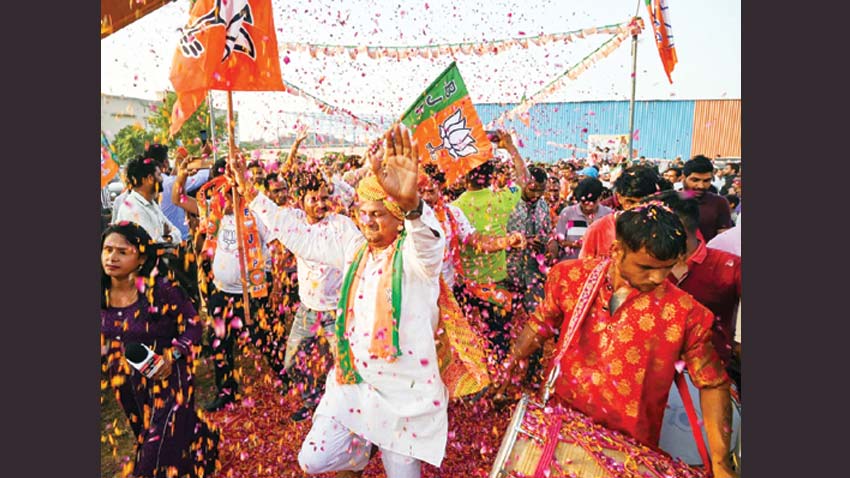
Haryana’s win strengthens the narrative that the BJP remains the dominant political force in the country. It has created a crisis in opposition alliance where claim for leadership by Congress will be challenged. Despite getting 240 seats in general election BJP was being projected as looser these results has changed this narrative. Haryana result could also influence coalition dynamics at the national level. The rejection suffered by Jannayak Janta Party (JJP) after leaving BJP will be a guiding force for other allies of BJP.
6.Regional Leadership Development
A victory here also strengthens local BJP leaders, who played an important role in shaping the party’s image in Haryana. Khattar’s leadership reflects the party’s ability to stay relevant and effective even in the absence of strong regional faces from political dynasties. It also shows its ability to manage post-crisis electoral battles, and builds momentum for future elections. (R).
7.Policy Implications
● Agriculture and Economic Policies: IBJP win may emboldened it to continue with its existing economic and agricultural policies, including reforms in the farming sector.
● State-Level Governance: The new government led by the BJP will have to address key issues like rural distress, unemployment, infrastructure development, and law and order in Haryana. The results reflected public satisfaction or dissatisfaction with these issues effectively by retaining BJP and allowing Congress to give a good fight. Therefore the winner will be on toes and will pursue future governance priorities without fail.
The Test of Leadership and Revival for Congress has suffered a great setback.
Haryana was very crucial for the Congress as it sought to revive itself in North India to project the party's ability to compete with the BJP. The leadership of Bhupinder Singh Hooda, a key Congress figure in Haryana had taken a drubbing. The loss has weakened his position and raised questions about the party’s leadership strategy in the state, while the rival leaders like Ms Selja are raising serious questions. The Congress has struggled with internal factionalism in Haryana and elsewhere. Many senior leaders had left the party and the trend may get stronger now.
Congress’ Rural Appeal
Post-farmers' protests, the Congress has tried to position itself as the champion of farmers' as well as minorities rights.Nuh violence-accused Mamman Khan won Ferozepur Jhirka with a record margin of 98,441 votes. yet the party could not win the desired numbers.The underperforms in Haryana indicates that the party’s messaging hasn’t resonated with agricultural communities, weakening its stance in other agrarian states.
4. Electoral Strategy and National Narrative
The poor performance suggests that its national-level critiques of the BJP—on issues like inflation, unemployment, and farmers' concerns—are not translating into state-level electoral success. It is also a symbolic blow, signalling that the Congress has not yet fully recovered from its decline. This could force the Congress to rethink its electoral approach ahead of more significant state elections.
What went wrong for Congress
Failing to see the ground realities and not keeping the house in order cost heavily. Despite winning 5 MP seats only in the general election, BJP had led in 44 assembly seats and had been lagging behind by a very small margin in 7 seats. To reduce these numbers, Congress needed to project its success stories in the states ruled by it. Unfortunately, it neither had such stories to narrate and nor the will to find these. To the contrary Himachal Pradesh ruled by Congress is in financial mess and finding it difficult to pay salaries of the employees even.
“Salary delay worries Himachal government employees” (HT, Sep 04, 2024)
This has affected the districts closer to Himachal Pradesh.
Infighting did the rest, Selja Kumari a Dalit leader from Congress was sidelined, ticket distribution also created rebels and the lead campaigners were talking only about farmers, Agniveer and wrestlers. BJP cashed it to project Congress as anti Dalit leaders.
What lies ahead for Kashmir
The election results have indicated that the national conference has lost the trust of Hindus and BJP could not convert the growth and development performance in the valley to winnability despite increasing its vote share. Terrorists failed to stop people from voting but ably kept Muslim reformists in check. Killing of pilgrims just before the elections hurt the national interest badly.
Issues with Kashmiri leadership
Kashmiri leadership has no loyalty and has courted with Congress, Janta party, Janta dal, BJP as per their convenience. They have sided with terrorists many times and have been mute spectators of ethnic cleansing, the former chief minister left the country at that time. So-called ‘Shere Kashmirs’ have more assets and interest outside Kashmir. Their children who live elsewhere mostly do not participate in agitations. They are planted from top as ministers. Chances are there that the new leadership will instigate agitation to bring back 370 etc. the only difference is that this time they will be without meaningful power to do so. Time will tell how fast they adjust to new realities.
Centre on the other hand has retained major power by making it union territory. One may see a repeat of the tussle between LG and the ruling party as happened in Delhi.
Ground well set for attempting to secure PoK now
PoK is boiling, People there are able to see the loss they have suffered under dictatorial Pakistan. The Indian government is closely monitoring; ministers are talking openly about the possibility. (Confident that PoK will itself merge with India": Rajnath Singh, TOI, March 24, 2024)
Faruq Abdollah the leader of national conference has reacted with anger, (’Pakistan not wearing bangles’: Farooq Abdullah’s reminder as Rajnath Singh says ’PoK will be merged with India’. Mint, 5th MAY 2024)
The question is why is he angry with this idea? Why does he want India to talk to Pakistan? Why does he not want his separated brothers to unite?
The answer is simple: the divided Kashmir has rewarded his family with power for three generations. They are like the Gandhi family in India who enjoyed power for 4 generations. If POK merges then the leader who makes it happen will be a bigger hero.
Had the Abdullah and Muftis been sincere they would have worked to unite Kashmir but they silently sided with the separatists. Passed draconian laws like “Roshani act” which granted ownership the lands to unauthorised occupants of those lands with the aim of raising money for power projects upon payment of a sum to be determined by the government. The cut-off year was set as 1990 by the Government of Farooq Abdullah, which was extended to 2004 and again to 2007 by the PDP. Why was the year chosen to be as effective as 1990? Did it mean to grab the property of the displaced pundits? Is it not a crime that the leadership which is empowered to protect citizens did the opposite ? There is no hope of resolution till a sizable population develops the courage to challenge this situation.
The job of the national government becomes tough as justice demands that the land should be returned to original owners and this attempt has antagonised the people enjoying the properties.
All is not lost.
The Government of India has a tough task ahead. Its pragmatic policies have improved its relations with Islamic nations. It is easier to build a Hindu temple in Abu Dhabi than expand the facilities at Amarnath OR Vaishno Devi. All the talk of love and culture evapourates as soon as one takes these issues. Kashmiri Pandits are still living in exile. The much hyped Kashmiriyat is only for a section of society. The NDA has worked relentlessly to improve the situation but what is missing is a nationalist Muslim leader like the great Khan Abdul Gaffar Khan who can build an army of volunteers and stand tall against all divisive forces. It is taking too much time yet I am confident that the day is not far.
It is needed not only for Kashmir but for the whole world to get rid of false jihad, cruelty and atrocities. Politics has to be separated from religion, caste and creed. Sooner is better.
(The content of this article reflects the views of writers and contributors, not necessarily those of the publisher and editor. All disputes are subject to the exclusive jurisdiction of competent courts and forums in Delhi/New Delhi only)
By Rakesh Kumar


















Leave Your Comment