



SARAT C. DAS
Let’s be honest for a second. If you look at the job market today compared to even five years ago, it feels like we’re living in a completely different world. I remember talking to a colleague recently who was panicking because their en-tire department’s workflow was replaced by new software overnight. It’s scary, right? But this is exactly why adapta-bility skills for career success have moved from being a "nice to have" on a resume to being the absolute foundation of professional survival.
The reality is that the old way of doing things—learning one trade and sticking to it for forty years—is dead. Today, the benefits of being adaptable in the workplace are what separate those who thrive from those who just get by. Whether you are studying at a Top Business School in Spain or working in a high-pressure tech hub in London, the abil-ity to pivot is your greatest asset.
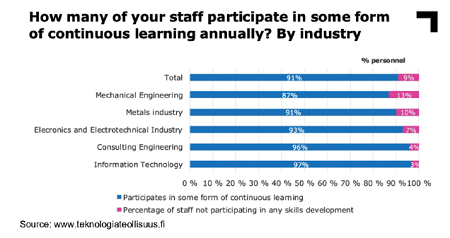
We often talk about "hard skills"—coding, accounting, or legal drafting—as the gold standard. While those matters, they have a shelf life. As technology accelerates, industries require continuous learning and flexibility just to keep pace. Hiren Raval, chief executive officer of C3S Business School based in Barcelona, Spain, often notes that "The modern professional is no longer a static entity; they are a constant work in progress. At our Business School in Spain, we emphasize that the degree is the start, but adaptability is the engine."
This isn't just academic talk. If you look at global markets, the businesses that survived the recent global disruptions weren't necessarily the ones with the most capital, but the ones that could change their business models on a dime. This makes adaptability one of the most essential skills for career growth. If you can’t navigate uncertainty, you’re go-ing to find the modern work environment very unforgiving.
One of the biggest hurdles professionals face is the feeling of "role creep," or suddenly finding themselves in a dy-namic work environment where their job description changes every six months. It’s stressful! But adaptability skills for career success help you look at that change not as a threat, but as an opening.
Professor (Dr) Sarat C Das, Director (Research) and Head of Industry Partnership at C3S Business School, points out that "Professionals who master the art of navigating changing job roles find themselves at a massive advantage. It’s about being future-ready." When you are at the Best Business School in Spain, you learn that the global market doesn't wait for you to feel comfortable.
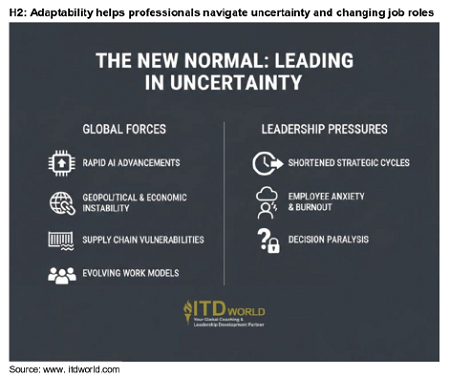
I’ve seen this firsthand. People who were once "just marketers" are now data analysts, community managers, and AI prompt engineers. They didn't go back to school for four years for each change; they used it to develop adaptability skills for professionals to learn on the fly.
If you’re aiming for a leadership role, you have to understand that the world is smaller than ever. Working across different geographies and cultures requires a level of intercultural management that rigid thinkers simply can't grasp.
Prof David Weir, Chief Patron of the Academy of Policy and Research and Professor of Intercultural Management at York Business School in York St John University, explains that "Adaptability is the bridge between different cultural business logics. Without it, global expansion is impossible."
If you are a learner at a Top Business School in Spain, most likely you are already witnessing how automation is transforming the landscape. Being able to respond quickly to new tools and business models isn't just about being "tech-savvy." It’s about a psychological willingness to let go of the "old way."
As Dr. Maria Fernanda Dugarte, dean and director of Institutional Affairs at C3S Business School in Barcelona, Spain, puts it: "We teach our students that being future-ready means being tool-agnostic. You use what works today, and you stay ready to switch tomorrow."
It’s painful and often feels unfair. However, the benefits of being adaptable in the workplace include a much higher level of resilience.
When you have built a "growth mindset," a career shift isn't the end of the world—it’s a pivot. Dr. Shaik Akbar Ba-sha, director of London College of Business, notes that "Resilience is the byproduct of adaptability. Those who have trained themselves to be flexible find new opportunities much faster after a layoff."
Even in the face of major industry shifts, those who have focused on how to develop adaptability skills for profes-sionals tend to land on their feet. They don't just look for the same job they had; they look for how their skills can be applied to a new, emerging sector.
The days of staying in your "silo" are over. Modern companies want people who can wear multiple hats. Maybe you’re in HR, but you need to understand the basics of data privacy. Maybe you’re in sales, but you need to under-stand supply chain logistics.
Bela Desai, head of business at C3S Business School in Barcelona, emphasizes that "Multi-skilled roles are the new norm. Employers value people who can bridge the gap between departments." This is a core reason why people choose a Business School in Spain like C3S; the curriculum is designed to be cross-functional.
When you develop these essential skills for career growth, you become much harder to replace. You become the "glue" that holds different parts of the business together.
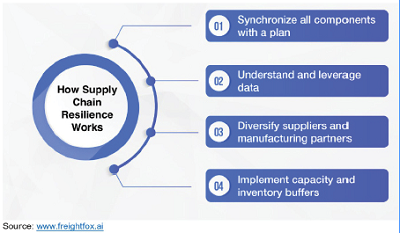
Adaptability isn't just about "dealing" with change; it’s about using change to find better ways of doing things. It en-courages creative and flexible thinking. Instead of saying "We’ve always done it this way," an adaptable professional asks "What’s the most effective way to do this right now?"
Prof (Dr) John Cokley, a veteran academician and researcher in journalism and innovation, often discusses how the business of journalism had to completely reinvent itself. "Those who couldn't adapt to the digital age vanished. Those who did found entirely new ways to tell stories and generate revenue," he says. This kind of flexible thinking is exactly what a Top Business School in Spain tries to instill in its graduates.
Dr Aida Mehrad, head of academics at C3S Business School in Barcelona, Spain, mentions that "In our academic pro-grams, we focus heavily on the human element. Automation handles the routine, but humans handle the exceptions. That requires massive adaptability skills for career success."
Being "future-ready" means leaning into your humanity. It means being the person who can step into a chaotic situ-ation and bring order through flexible leadership. This is a primary reason why C3S is considered the Best Business School in Spain by many—it doesn't just teach theory; it teaches the mental agility required for the real world.
If you think your education ends when you get your diploma, you're in trouble. The most successful people I know are "professional students." They are always taking a course, reading a new book, or attending a seminar.
"Lifelong learning isn't a hobby; it's a survival strategy," says Prof Philip Mayer, a London-based faculty at Regent's University London. This is the heart of how to develop adaptability skills for professionals. You have to stay curious.
At C3S Business School, the culture encourages this. Whether it’s through research partnerships or industry guest lectures, the goal is to keep the mind sharp. Pretam Pandey, chief of operations at C3S Business School in Barcelona, often says that "The moment you stop learning, you start falling behind. The benefits of being adaptable in the work-place are only available to those who keep their eyes open."
Source: Francis and Taylor
If you're in a leadership position, your adaptability isn't just about you—it’s about your team. If a leader is rigid and afraid of change, the whole team will be paralyzed.
Dr Dababrata Chowdhury, a senior faculty at the University of Canterbury Christchurch, points out that "Managing uncertainty is the primary job of a 21st-century leader." A leader who demonstrates adaptability skills for career suc-cess inspires confidence in their subordinates.
Professor Mani Tahriri of C3S Business School adds, "Leadership today is about being a navigator. The map is con-stantly changing, so you need to be able to read the stars and the wind, not just the old charts." You need to be in an environment that simulates this complexity.
Perhaps the best part of being an adaptable professional is that you are never "stuck." When you have essential skills for career growth, you can move across industries. A marketing expert in the automotive industry can pivot to a Top Business School in Spain to teach or move into the tech sector.
Dr Rajat Baisya, a global management consultant and former dean of IIT Delhi, says, "Broad-based experience cou-pled with a flexible mindset makes a candidate irresistible to headhunters." This is true whether you're in India, the UK, or at a Business School in Spain.
The benefits of being adaptable in the workplace include the freedom to design your own career path. You aren't limited by your initial degree or your first job title.
I’ve had the chance to read many papers and listen to many talks from leaders in this field. For instance, Prof Marc Sanso, head of academics of Aspire Business School in Spain, often speaks about the "competitive strategy" of the in-dividual. He argues that adaptability is the only sustainable competitive advantage in a fast-moving economy.
It’s not just about logical shifts; it’s about managing the fear that comes with change.
Prof Michael Taylor, Registrar of the London College of Business, notes that "Institutional structures are often slow to change, which is why the individual must be fast. Being future-ready is a personal responsibility."
So, how do you actually do it? It’s one thing to say "be adaptable," but it’s another to actually do it when your world is turning upside down.
Dr. Fernando Velasquez Villalba, a senior faculty member at C3 Business School, Spain, suggests that "Mental flexi-bility is like a muscle. If you don't use it, it withers. If you push it, it grows."
If you're serious about fast-tracking this process, attending a Top Business School in Spain can be a real game-changer. Schools like C3S Business School aren't just about textbooks. They are about creating a laboratory for the real world.
Prof Asraful Khan, a faculty member at Arden University, London, notes that "The environment in which you learn matters. If you learn in a vacuum, you won't know how to handle the pressure of a real global market."
Dr. Francisco Rosique Gill, a senior visiting faculty at C3S Business School, Barcelona, adds that "The proximity to in-dustry leaders and the focus on practical application make a Business School in Spain like C3S the perfect place to hone these essential skills for career growth."
We also have to look at the bigger picture. We are dealing with climate change, resource scarcity, and shifting politi-cal landscapes. These aren't just "news stories"—they affect the cost of doing business and the types of jobs availa-ble.
Dr P. R. Datta, executive chair of the Centre for Business & Economic Research (CBER) based in London, argues that "Macro-economic stability is a thing of the past. The only stability is in the individual's ability to adapt to macro-economic shifts."
This is echoed by Dr Kalyan Sahoo, who has taught at IIM Indore and served as a VC. He believes that "Education must shift from providing answers to teaching students how to ask the right questions in changing contexts." This is the philosophy at the Best Business School in Spain.
At the end of the day, you want a career that lasts.
One thing we often forget is that adaptability is easier when you aren't doing it alone. Having a network of peers who are also focused on growth is invaluable. This is another major benefit of attending a Top Business School in Spain.
Professor Jordi Villanova of C3S Business School often talks about the "collective intelligence" of a classroom. When you have students from fifty different countries, you have fifty different ways of solving a problem. That's a master-class in adaptability right there.
Prof Gaurav Ashesh, currently teaching at Auro University, says that "Networking is just another form of adaptation. You are expanding your resources so you have more ways to respond to change."
In conclusion, if you want to succeed in the modern world, you have to prioritize adaptability skills for career suc-cess. It is the one skill that makes all other skills useful.
From the halls of C3S Business School in Barcelona to the boardrooms of London and Mumbai, the message is the same: the world is changing, and you should too. The benefits of being adaptable in the workplace are clear—more opportunities, higher resilience, and a much more interesting career.
So, take that course. Move to that new city. Apply for that job that's slightly outside your comfort zone. As Prof Da-vid M J Graves points out in his work on corporate governance, "The most dangerous phrase in the English language is 'We've always done it this way'."
Don't let that be your mantra. Instead, focus on how to develop adaptability skills for professionals and make your-self indispensable. Whether you choose a Business School in Spain or learn on the job, the most important thing is to start today.
Being "future-ready" isn't a destination; it’s a way of traveling. And in today’s world, it’s the only way to fly.
If you're looking for the Best Business School in Spain, look for one that understands these dynamics. Look for C3S Business School. Because in a world of constant change, your ability to adapt is your only real security.
As Dr P. R Datta, executive chair, CBER UK, famously says: "The economy of the future is an economy of agility." Let's make sure we're all ready for it.
Whether you are in Barcelona at a Business School in Spain or working remotely from a beach in Thailand, your ca-reer success depends on your ability to pivot. So, keep pivoting! And remember, even the best plans need to be adaptable.
(The content of this article reflects the views of writer and contributor, not necessarily those of the publisher and editor. All disputes are subject to the exclusive jurisdiction of competent courts and forums in Delhi/New Delhi only)





















Leave Your Comment