


By Vishal Ranjan
The Union Budget 2026–27 arrives at a time when India’s neighbourhood is more turbulent than at any point in the past decade. With China relentlessly expanding its military footprint in the Indo-Pacific and Pakistan persisting with its provocations, the strategic environment demands seriousness, stamina, and sustained investment in national security. The wider global strategic landscape increasingly shaped by Trump’s gunboat diplomacy adds to this urgency. It is in this context that Finance Minister Nirmala Sitharaman has delivered one of the most consequential Defence Budgets in recent years, one that quietly but firmly reinforces India’s commitment to military modernisation, indigenisation, and strategic readiness.
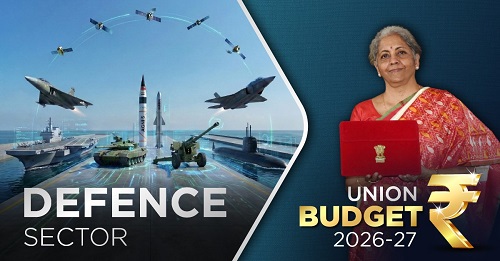
According to the Ministry of Defence’s official charts, the Defence Budget has risen to . This is not a cosmetic jump; it reflects a structural shift. For the first time, defence is being treated not merely as a requirement but as an economic and geostrategic lever in India’s long-term rise.₹7.85 lakh crore, an approximate 15% increase over the previous fiscal year, continuing a steady multi-year climb from ₹4.48 lakh crore in 2021-22 to this year’s historic allocation. Of this, the allocation of ₹2.19 lakh crore has been made under capital head
The scale of the allocation matters, but what matters more is how it is being used. The Budget leans heavily into the idea that India’s defence preparedness must be multi-dimensional, ranging from military hardware to cyber capability, from border infrastructure to naval expansion, and from research ecosystems to self-reliant manufacturing. It is a Budget that sees defence not in silos but in systems.
The increase comes at a moment when global defence economies are being reshaped. Nations worldwide are recalibrating their military priorities because threats today are no longer confined to land borders. They exist in the grey zones of cyberwarfare, in the contested seas of the Indo-Pacific, in the vulnerabilities of global supply chains, and in the coercive economics of maverick leaderships and authoritarian states. India’s response to all this, as reflected in this Budget, is a blend of vigilance and vision.
One of the first visible shifts is the Budget’s emphasis on modernisation, not merely maintenance. The government has committed to expanding allocations for advanced platforms, fighter aircraft, naval vessels, air defence systems, next-generation armaments, UAVs, and battlefield technologies. The rise in capital expenditure for defence signals a clear message: India will not fall behind in the regional arms race, nor will it remain dependent on capricious foreign suppliers.
At the same time, the Budget strengthens the Atmanirbhar Bharat pillar in defence manufacturing. Indigenous production is no longer a rhetorical flourish but a measurable reality. With more than 75% of defence procurement now reserved for domestic industry, private-sector innovators and Indian startups, particularly in AI, robotics, drones, and space technologies, are being integrated into the national security architecture. The exemption of custom duties on raw materials, components and parts for civilian and training aircraft is further aimed at boosting indigenisation. The push for defence corridors, joint ventures, export promotion, and MSME participation ensures that military capability also becomes a multiplier for economic growth.
Another powerful dimension of this Budget is its strategic investment in infrastructure. Along India’s northern borders, where harsh terrain and extreme weather remain a formidable challenge, the government continues to fund all-weather roads, tunnels, forward airstrips, and logistical enhancements. These investments are critical for rapid troop mobility and sustained standby readiness, two elements the armed forces repeatedly emphasise.
But India’s security challenges today extend far beyond its land borders. The Budget also pushes for a stronger maritime presence, reflecting New Delhi’s expanding responsibilities as a net security provider in the Indian Ocean Region. With China increasing its submarine patrols, militarising islands, and forging closer partnerships in the region, India’s naval modernisation has become a strategic imperative. The enhanced allocation supports warship construction, naval aviation, underwater platforms, and maritime domain awareness systems.
In addition to traditional defence priorities, the Budget acknowledges the new frontiers of warfare. Cybersecurity, intelligence fusion, surveillance, and space capability have received renewed attention. As global conflicts, from Ukraine to the Middle East, demonstrate, wars of the future will be fought as much with satellites, data, drones, and electronic systems as with tanks and aircraft. India’s investment in these arenas is timely and essential.
While appreciating the government’s focus, one must also recognise the Budget’s clear refusal to indulge in populism. In a year when global inflation, geopolitical tension, and market uncertainty could have driven political short-termism, the government has chosen the steadier path. It understands that national security cannot be compromised for electoral convenience. This seriousness is visible not just in defence but in the entire fiscal philosophy of the Budget.
Markets may react with initial anxiety, as they often do when confronted with a non-populist Budget—but stability, predictability, and long-term strategic focus are precisely what investors ultimately reward. Defence modernisation, unlike subsidies, yields economic dividends by boosting manufacturing, innovation, exports, and skilled employment.
India today stands at a pivotal moment. It is the fastest-growing major democracy, and its rise will be closely watched by both partners and adversaries. Budget 2026–27 strengthens the military pillar of that rise. It sends a message of resolve: India is prepared, India is confident, and India is investing in the tools necessary to safeguard its sovereignty for all time.
In this sense, the Defence Budget of 2026–27 is both a shield and a strategy, a demonstration that national security is not an afterthought but the foundation of Viksit Bharat 2047.
Dr. Vishal Ranjan, PhD (School of International Studies, JNU), is an independent Foreign Affairs and International Relations analyst based in Pune. He also serves as an Adjunct Senior Fellow at the AusInd Bridge Foundation, Melbourne.
Miscellaneous info
* First budget after Operation Sindoor
* Defence spending at around 1.9% of projected GDP
* Defence capex at 2.19 lakh crore, an increase of 18% compoared to last year’s revised estimates – 21% increase
* 27% of total on capex,
* 75% of defence 1.39 lakh crore to push domestic defence manufacturing
* Defence R&D, infrastructure creation and indigenous projects such as aero engine development
* Upcoming projects include next-generation fighter aircraft, ships and submarines, UAVs, drones, smart weapons, and specialist vehicles.
(The writer, PhD (School of International Studies, JNU), is an independent Foreign Affairs and International Relations analyst based in Pune. He also serves as an Adjunct Senior Fellow at the AusInd Bridge Foundation, Melbourne.)




















Leave Your Comment