


India is poised to secure a significant strategic advantage in the Indian Ocean Region after the National Green Tribunal (NGT) cleared the Centre’s ambitious Great Nicobar mega project, dismissing multiple petitions that had challenged the environmental and ecological implications of the development. The tribunal ruled that adequate safeguards had been incorporated into the plan and found no justification at this stage to stay or interfere with the project, noting the broader national security considerations involved.
The decision marks a crucial milestone for one of India’s largest infrastructure initiatives in a strategically sensitive maritime zone, paving the way for accelerated development on Great Nicobar Island in the Andaman and Nicobar archipelago.
The Great Nicobar mega project is an approximately ₹81,000-crore infrastructure plan envisioned as a multi-dimensional economic and strategic hub on Great Nicobar Island. Spread across nearly 166 square kilometres, the project involves diversion of about 130 square kilometres of forest land and the felling of nearly one million trees — factors that had triggered environmental challenges before the tribunal.
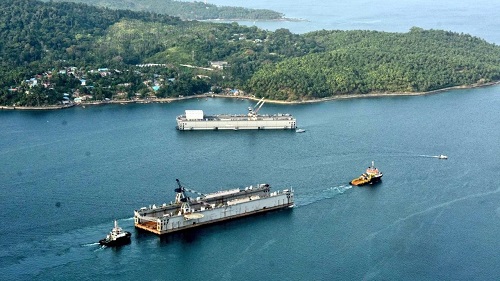
The proposed development includes a deep-sea transshipment port at Galathea Bay, an integrated township designed to support future population and economic growth, a dual-use civil and military airport, and a 450 MVA power plant powered by a mix of gas and solar energy. The transshipment port, a central component of the project, will function under the Ministry of Ports, Shipping and Waterways and is expected to position India as a major logistics and shipping hub in the eastern Indian Ocean.
Great Nicobar Island occupies one of the most strategically valuable positions in the Indo-Pacific. Located roughly 40 to 90 nautical miles from the northern entrance of the Strait of Malacca, the island sits close to one of the world’s busiest maritime corridors connecting the Indian Ocean with the Pacific Ocean.
A substantial portion of global trade — including energy shipments — passes through these waters. The island’s proximity to alternative sea routes such as the Sunda Strait and the Lombok Strait further enhances its strategic relevance, as these channels serve as critical pathways for shipping moving between the South China Sea and the Indian Ocean.
The establishment of a naval-capable deep-water port and an advanced airfield is expected to significantly strengthen India’s tri-services Andaman and Nicobar Command. Enhanced infrastructure will allow deployment of naval vessels, surveillance aircraft, and drones closer to vital sea lanes, improving monitoring capabilities and operational readiness in the eastern Indian Ocean.
The project carries particular geopolitical significance amid evolving power dynamics in the Indo-Pacific. For China, the Strait of Malacca represents a critical energy lifeline, with a large share of its oil imports from West Asia and Africa transiting through the corridor — a vulnerability often referred to as the “Malacca dilemma,” a concept popularised by former Chinese President Hu Jintao.
Strengthening infrastructure on Great Nicobar enhances India’s ability to observe maritime traffic entering and exiting the strait, potentially providing strategic leverage during periods of heightened regional tension.
China’s expanding presence in the Indian Ocean through port development and naval deployments under the Belt and Road Initiative — including projects such as Gwadar Port in Pakistan and Hambantota Port in Sri Lanka — has heightened India’s security concerns. Analysts view the Great Nicobar project as part of India’s effort to reinforce its forward maritime posture and maintain balance in the region.
The development also aligns with India’s Act East policy and broader Indo-Pacific strategy, aimed at securing sea lanes, strengthening maritime partnerships, and deepening cooperation with Southeast Asian nations and frameworks such as the Quadrilateral Security Dialogue grouping of India, the United States, Japan, and Australia.
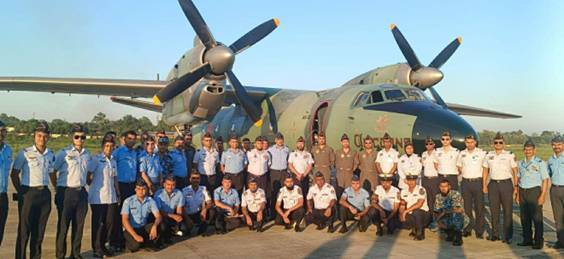
The Great Nicobar initiative comes alongside ongoing military infrastructure upgrades across the Andaman and Nicobar Islands. On January 2, Chief of Defence Staff Anil Chauhan inaugurated an upgraded runway at the Indian Air Force’s Car Nicobar Air Force Station air base, enhancing operational capabilities in the region.
Expanded apron areas now allow smoother aircraft movement, while the upgraded runway enables more efficient long-range firing exercises and supports civilian connectivity under the UDAN regional air connectivity scheme.
Officials noted that the strengthened infrastructure will also bolster Humanitarian Assistance and Disaster Relief operations, enabling faster deployment of aid during natural disasters in a region vulnerable to earthquakes and tsunamis. During the visit, General Chauhan reviewed the operational readiness of the Andaman and Nicobar Command and emphasised deeper integration among the Army, Navy, Air Force, and Coast Guard to enhance surveillance, deterrence, and rapid response capabilities.
While the NGT’s clearance removes a major legal obstacle, debates surrounding environmental sustainability and indigenous community protection are expected to continue as implementation progresses. The tribunal’s observation that safeguards are in place indicates that monitoring and compliance mechanisms will remain central to the project’s execution.
For the government, however, the Great Nicobar project represents more than infrastructure development — it is a strategic investment aimed at reshaping India’s maritime posture in the Indo-Pacific. As geopolitical competition intensifies and global trade increasingly hinges on secure sea lanes, the development of Great Nicobar could transform the island into a critical node of economic activity, military readiness, and regional connectivity, reinforcing India’s role as a key security provider in the Indian Ocean region.





















Leave Your Comment