


The astrologers and media have an interesting job year after year, i.e. prediction of election results.
Sarcasm apart, the nation is losing revenue as well as democratic values. We have reached to a level where more then 50 percent of elected legislature and parliamentarian have criminal cases against them. A gangster can win an election while he is imprisoned. The police are forced to protect him. The people who gave us the constitution must be feeling ashamed that such gangsters are empowered to amend the same
The nation building is much more important than managing or manipulating the elections. Present system is defeating the basic purpose of democracy. if the equation of caste, bahubalis and freebies is balanced tactfully then everything else is of no use.
Upcoming elections present the same scenario.
Survival or Shift: Is Mamata Banerjee Facing Her 2011 Moment in Reverse? The challenger has to prove competence.
As Mamata Banerjee heads into the upcoming elections, her challenge goes well beyond governance—it is about surviving, and shaping, a fiercely contested narrative. While her administration highlights welfare delivery and a strong sense of regional identity, the Bharatiya Janata Party continues to sharpen its attack on alleged corruption, law and order concerns, and recurring political violence.
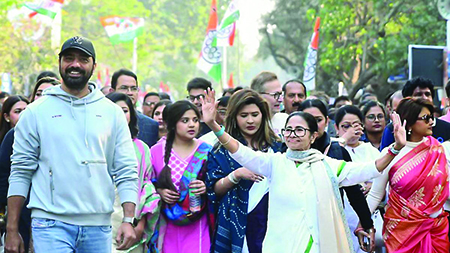
The narrative battle has intensified further with allegations of minority appeasement and claims around illegal immigration—particularly accusations of Aadhaar issuance to Bangladeshi nationals. This has triggered the Special Intensive Revision (SIR) of electoral rolls, bringing voter lists under sharper scrutiny. The implications go beyond administrative exercise—it could directly influence voter confidence, turnout, and ultimately, electoral legitimacy. Combined with anti-incumbency pressures and the rising aspirations of an urbanising electorate, the contest is becoming increasingly complex—and deeply perception-driven.
At its core, the election may hinge on a simple but decisive question: can the state ensure both control over violence and confidence among voters?
For those who routinely cite law and order or voter safety as barriers to free elections, 2011 offers a powerful counterpoint. Mamata Banerjee dismantled the seemingly invincible Left Front, ending over three decades of uninterrupted rule.
She transformed deep public discontent into a mass movement. Through sustained grassroots mobilisation, emotive messaging, and a strategic alliance with the Indian National Congress.
The same leadership now confronts visible grassroots anger, persistent allegations of corruption, and rising institutional scrutiny, with courts increasingly asking tough questions.
The reported arrest of an American national along with Ukrainian citizens for allegedly attempting to destabilise parts of the Northeast has once again brought regional security into focus. It raises uncomfortable questions about perceived vulnerabilities and compromises in West Bengal. In an era where threats are no longer confined by borders, a state’s credibility in maintaining order and resilience becomes central—not just to governance, but to national confidence itself.
Yet, the deeper issue is not merely discontent—it is direction. Political energy is clearly building once again. But the unanswered question remains: Will the opposition has the will power to ride this rising tide for a decisive mandate?
One Remark on Sanatan! Big Fallout: Can Stalin Ride the Storm?
In Tamil Nadu, M. K. Stalin heads into the upcoming election facing not just a contest—but a far more layered and volatile political test than before. The Dravida Munnetra Kazhagam has long drawn strength from Dravidian ideology and social justice narratives. But recent controversies around perceived “anti-Sanatan” rhetoric have handed the Bharatiya Janata Party a sharper, emotionally charged cultural plank to mobilise voters.
At the same time, the NDA is pushing aggressively to expand its footprint—projecting younger, more assertive leadership of BJP and tapping into the ambitions of first-time and aspirational voters. This is not just political expansion; it is a calculated attempt to disrupt Tamil Nadu’s entrenched electoral patterns.
For Stalin, the challenge is no longer just governance—it is calibration. He must sustain a welfare-driven model that has defined his administration, while ensuring that ideological positioning does not drift into political isolation. The margin for error is narrowing.
Complicating matters further is the rising visibility of Udhayanidhi Stalin, whose preference for direct, head-on confrontation sharpens the party’s messaging—but also risks deepening polarisation.
Meanwhile, Puducherry often reflects electoral currents from Tamil Nadu. This is not incidental but structural—driven by shared language, culture, and media ecosystems. A significant Tamil-speaking population, coupled with deep political and organisational linkages, means that shifts in Tamil Nadu’s political mood frequently echo in Puducherry’s electoral outcomes
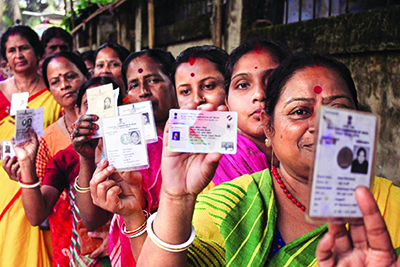
He Sets the Agenda, Others React: The Sarma Dominance in Assam:
In Assam, politics today moves to a rhythm set by Himanta Biswa Sarma—and everyone else is forced to respond. His dominance is not accidental; it is built on narrative control, timing, and a sharp understanding of public sentiment.
Those who play against nationalist sentiment would do well to remember: public mood in India can shift swiftly—and decisively. Few would have imagined Assam emerging as a stronghold of the Bharatiya Janata Party. Yet, that transformation was accelerated by a single turning point—a disillusioned grassroots leader who chose to walk away from the Indian National Congress and rewrite the political script.
The now-famous “biscuit anecdote,” narrated by Sarma about Rahul Gandhi—whether entirely factual or politically sharpened—captures a deeper truth about politics.
Sarma understood this—and inverted it. He built his politics on engagement, visibility, and responsiveness, turning personal equations into political capital. Today, the contest in Assam is no longer just about governance versus opposition—it is about whether the opposition can even produce a credible challenger to a leader who is consistently a step ahead.
Enough discussion on winning let’s delve on bigger issues;
How Money, Muscle, and Family Rule Distort India’s Mandate—and How to Reclaim It”
India’s democracy is not failing—it is being captured. Three forces dominate the system today: money power, muscle power, and entrenched family control.
Money power has turned elections into high-stakes investments. Campaigns demand enormous funding, pushing parties into opaque financing and quid-pro-quo politics. The result: policy influence tilts toward those who can pay, not those who need representation.
Muscle power continues to shadow the process. Candidates with criminal backgrounds or coercive influence weaken the sanctity of free choice, especially at local levels, where fear can quietly shape outcomes.
Family-run parties convert public institutions into private inheritances. Leadership pipelines shrink, internal democracy disappears, and merit takes a backseat to lineage—visible across parties led or influenced by figures like Rahul Gandhi or regional dynasties such as that of M. K. Stalin, Yadavs, Abdullas, Thackeray and so on.
Together, these forces don’t just compete within democracy—they distort it. The voter still votes, but the choices are often pre-shaped by power structures.
What can change this?
• Transparent political funding: Full disclosure of donations, stricter caps, and revisiting opaque instruments like electoral bonds.
• Inner-party democracy: Mandatory internal elections and leadership accountability within parties.
• Stronger institutions: Empower the Election Commission of India with greater autonomy and enforcement teeth.
• Disqualification of serious offenders: Fast-track courts to bar candidates with grave criminal charges quickly. This may need a special investigation setup as well.
• State funding of elections (partial): Level the playing field for credible candidates without deep pockets.
• Simultaneous elections debate: Reducing frequency to curb cost and constant fundraising pressures.
Perpetual Poll Mode: How Constant Elections Are Crippling Indian Democracy”
India is no longer just a democracy—it is a nation trapped in a permanent election campaign. Let’s examine.
Every year, elections somewhere keep the politicians in constant campaign mode. Governance is repeatedly disrupted by electoral calculations.
Policy suffers first. Actions are shaped less by long-term national interest and more by short-term electoral gains. Tough reforms are deferred, while populism becomes the default. Even opposition leaders like Rahul Gandhi operate within this same cycle of optics over outcomes.
The Model Code of Conduct, launched as a safeguard, ends up pausing governance again and again—stalling projects and slowing administration. At the same time, continuous elections demand continuous funding, strengthening the grip of money power and making politics increasingly exclusionary.
The voter, meanwhile, faces fatigue. Frequent voting risks turning democratic participation into routine rather than reflection. It is common practice among disgruntled voters to go for picnic using the holiday declared for voting.
The result is hurting the most: The nation is over-electing and governing less and less.
Continuous elections can create a more permeable environment for influence operations by non-Indian players. The real battleground today is less about cash transfers and more about control over narrative, perception, and information flows.
One Nation, One Election: Efficiency Without Compromising Federalism
Moving to One Nation, One Election (ONOE) is not a slogan shift—it’s a structural reform already in motion. The groundwork has begun, but its success will depend on whether India executes it in a phased, legally sound, and politically negotiated manner.
What Has Already Been Done
The idea is no longer theoretical—several concrete steps have been taken:
• A high-level committee chaired by Ram Nath Kovind has submitted a detailed roadmap for simultaneous elections.
• The Union government has accepted the principle and initiated the legislative pathway.
• The proposed Constitution (129th Amendment) Bill seeks to enable synchronised elections by amending tenure-related provisions.
• The Election Commission of India has examined logistical feasibility, including EVM/VVPAT scaling and security deployment.
• Policy discussions increasingly converge around a phased synchronisation model, not a sudden shift.
In essence: political intent, legal drafting, and institutional consultation are already underway.
1. Start with a Two-Cycle Synchronisation
Instead of forcing full alignment at once, India can move to two national election windows:
• Cycle 1: Lok Sabha + half the states
• Cycle 2 (2.5 years later): Remaining states
This reduces election frequency immediately while avoiding abrupt disruption—and aligns with the phased approach already under consideration.
2. Constitutional & Legal Changes
ONOE requires careful amendments to provisions governing tenure:
• Articles 83, 85 (Lok Sabha)
• Articles 172, 174 (State Assemblies)
The introduction of the amendment bill marks a critical shift from idea to actionable law, though consensus remains essential.
3. Align Terms Gradually
To synchronise cycles:
• Some assemblies may need short-term extensions
• Others may face curtailed tenures
This is politically sensitive and must be handled transparently—with broad agreement across states.
4. Safeguard Against Government Collapse
India’s biggest practical risk is instability. Solutions include:
• A constructive vote of no-confidence (as seen in Germany)
• Caretaker governments until the next fixed election cycle
• Mid-term elections only for the remainder of the term, not a fresh five-year cycle
These safeguards are already being discussed in policy circles as non-negotiable stabilisers.
5. Strengthen the Election Commission
ONOE will massively scale logistics:
• More EVMs/VVPATs
• Larger security deployment
• Coordinated national-level planning
The Election Commission of India will need significant upgrades in capacity before rollout.
6. Political Consensus is the Real Test
Leaders across the spectrum—from Narendra Modi advocating ONOE to regional voices like Mamata Banerjee and M. K. Stalin expressing concerns—must find common ground.
Without federal buy-in, ONOE risks being perceived as central overreach rather than national reform.
7. Protect Federalism
Efficiency must not dilute diversity:
• Separate ballots and clear campaign cycles
• Safeguards to ensure regional issues are not overshadowed by national narratives
ONOE should streamline elections—not centralise politics.
Making ONOE Viable by 2034
If India is serious about transitioning to ONOE by 2034, the time to act is now—not later. This reform demands preparation, not proclamation.
• Phase the transition early: Begin aligning states into two cycles by 2026–27 to create a bridge toward full convergence.
• Secure constitutional clarity: Amendments must be backed by broad political and state consent—this cannot be a simple majority exercise.
• Build political consensus: Continuous engagement with states is essential.
• Ensure institutional readiness: Equip the Election Commission of India with the resources to handle nationwide simultaneous polls.
• Embed stability safeguards: Fixed cycles and no-confidence reforms must prevent disruption.
• Preserve federal balance: National efficiency should not come at the cost of regional voice.
Conclusion.
2034 is achievable—but only if India treats ONOE as a carefully engineered transition over the next few years, not a rushed political milestone.
Done right, it can bring governance back to the centre of democracy.
Done in haste, it risks unsettling the very federal balance it seeks to reform.
Successful implementation GST provides the hope that the nation can take a plunge.

RAKESH KUMAR
(The content of this article reflects the views of writer and contributor, not necessarily those of the publisher and editor. All disputes are subject to the exclusive jurisdiction of competent courts and forums in Delhi/New Delhi only)

















Leave Your Comment