



Rakesh Kumar
While travelling on a Vande Bharat train, a co-passenger narrated an interesting incident. Being from a village and unfamiliar with technology, he went to the railway reservation counter to book his ticket. The passenger ahead of him was a senior citizen, dressed like a Maulana, who submitted his reservation form.
The booking clerk struggled to read the name of the train and asked the applicant. The reply was, “Varanasi Vande Bharat.” The clerk asked again, and the applicant repeated it, a little louder. When the clerk asked for the name a third time, the applicant repeated it once more before the ticket was finally booked.
Surprised by the clerk's behaviour, my co-passenger asked him why he had made an elderly man repeat himself so many times. The clerk replied, “The old man is my neighbour. Just yesterday, he was boasting that he would rather die than ever say 'Vande Mataram'. So, it was a pleasant surprise to hear him say it today. I simply wanted to relish the moment a little longer!”
Literally or as a reflection of a larger social reality, this raises an uncomfortable question about the contradictions we have come to accept in India.
We have reached a stage where a Muslim accepting organs donated by a Hindu is perfectly acceptable, but respecting the values and beliefs that inspire the same Hindu to make such donations is somehow considered objectionable.
The question is not about denying anyone their rights or imposing one community's beliefs on another. It is about the fundamental principle of mutual respect. Can we accept the generosity, resources and compassion of a society while showing contempt for the values that sustain them? A truly inclusive society must be built on mutual respect, not selective acceptance.
Vande Mataram: Not Just a Song, but a Civilisational Philosophy
“Vande Mataram” is the timeless echo of Indian civilisation, expressing a reverence for the motherland that is far older than the 19th-century poem itself. While Bankim Chandra Chattopadhyay penned these immortal words in his 1882 novel Anandamath, the philosophy underlying them—the idea of worshipping the land as a divine mother—is deeply rooted in ancient Indian civilisation.
The Vedic Roots of Reverence for the Motherland:The idea of treating the Earth and one's homeland as a mother is firmly embedded in India's ancient scriptures and cultural traditions. The Prithvi Sukta of the Atharva Veda declares: “Mata Bhumi Putro Aham Prithivya”—the Earth is my mother, and I am her child. This is not merely a poetic expression but a profound civilisational philosophy that regards the land as a source of life, nourishment and identity. Sanatan Dharma has traditionally revered nature, rivers, mountains and the land itself as divine manifestations, seeing the soil not merely as territory or real estate, but as a living, nurturing mother—Bhumi Devi. Even Sita, in the Ramayana, ultimately returns to the lap of Mother Earth, invoking Bhudevi as her eternal refuge.
Vande Mataram: The Soul of India's Freedom Struggle.
The song gave a powerful modern expression to a spiritual sentiment that Indians had cherished. An age-old cultural reverence for the motherland into a potent rallying cry for national unity and independence. Its message was carried forward by some of India's most distinguished intellectuals and freedom fighters. Rabindranath Tagore first sang it publicly at the 1896 session of the Indian National Congress in Calcutta. Sri Aurobindo popularised it through his nationalist writings and the newspaper Bande Mataram, making it an important intellectual force in the freedom movement. Bipin Chandra Pal helped spread its message through the Swadeshi movement, while Mahatma Gandhi supported its place as a symbol of national patriotism. Madam Bhikaji Cama, too, adopted Vande Mataram as an emblem of Indian nationalism and, in 1907, unfurled an early Indian national flag at Stuttgart, Germany, reportedly bearing these words in Devanagari script.
What now deserves greater attention now is not merely its chronology, but its sanctity, civilisational significance and the timeless spirit that made it the soul of India's freedom struggle.
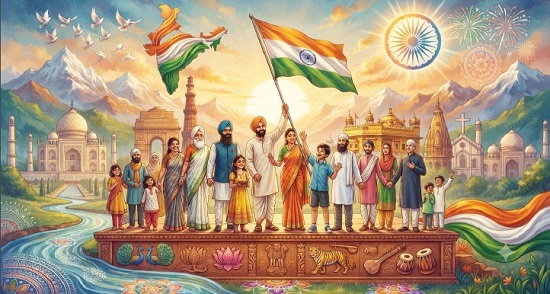
Beyond Wealth and Power: India's Eternal Bond with Its Motherland
This profound sentiment finds one of its most enduring expressions in the Ramayana, traditionally attributed to Sage Valmiki. It establishes a sacred bond between an individual and the land of one's birth, a bond that has resonated through Indian civilisation for millennia.
“Janani Janmabhumishcha Swargadapi Gariyasi”
The context behind this immortal shloka highlights its deep ethical and philosophical significance. After defeating Ravana and conquering Lanka, Lakshmana was mesmerised by the city's magnificent architecture, immense wealth and unparalleled opulence. He suggested to his elder brother, Lord Rama, that rather than returning to the hardships of forest life and the political turmoil of Ayodhya, they could stay back and rule over this golden kingdom. Rama firmly rejected the suggestion, reminding Lakshmana:
“Api Swarnamayi Lanka Na Me Lakshmana Rochate,
Janani Janmabhumishcha Swargadapi Gariyasi.”
— Even if Lanka is made of gold, it does not appeal to me, Lakshmana, for mother and motherland are greater than heaven itself.
India's traditional ethos does not regard territorial conquest or the accumulation of land as an end in itself. A kingdom may be conquered, wealth may be acquired and power may be attained, but none can replace the emotional and cultural bond with one's motherland. India's role in the creation of Bangladesh in 1971 offers a modern illustration of this spirit. Having intervened militarily, India did not annex the liberated territory but respected its right to emerge as an independent nation.
Vande Mataram: Honoured in Principle, Compromised in Practice.
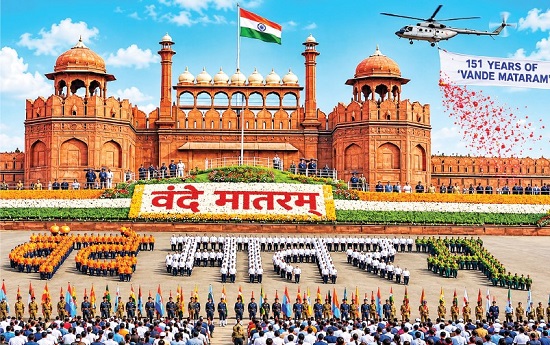
In 1950, the Constituent Assembly of India accorded Jana Gana Mana the status of the National Anthem while recognising Vande Mataram as the National Song, in acknowledgement of its unparalleled contribution to the freedom struggle. Unfortunately, subsequent practice failed to preserve the sanctity and spirit of the National Song.
Khilafat Movement onwards the Congress became increasingly eager to secure the support of Muslim leadership. This marked a visible shift in its approach and, in my view, laid the foundation for a politics of appeasement. What made this approach particularly unfortunate was its failure to recognise the inherent cultural affinity that many Indian Muslims, despite their conversion, continued to share with India's civilisational traditions. They had not abandoned Indian classical music, poetry or the cultural practice of expressing admiration for Hindu deities, despite religious interpretations that might discourage such expressions.
Under Jawaharlal Nehru's leadership, a convention emerged whereby only the first two stanzas of Vande Mataram were sung at public gatherings. These stanzas describe the beauty, fertility and nurturing qualities of the motherland without explicitly invoking Hindu deities. This compromise, however, left both sides dissatisfied: the Muslim clergy remained aware of the religious imagery in the remaining stanzas, while many Hindus felt deeply disappointed that an integral part of their national song had been set aside. In attempting to accommodate one section, the nation ended up hurting the sentiments of another.
Was it important to cut it short, Vande Mataram?
No! From Maharana Pratap to Mohammed Rafi, India's Shared Heritage depicts a different story.
Hindus and Muslims in India had lived in harmony for centuries, sharing trade, culture, music and even military responsibilities. Long before the arrival of European colonial powers, Indian traders maintained commercial relations with the Roman Empire through established trade networks, while Arab and Muslim merchants connected India's western coast with distant lands through maritime routes. Malabar and Zanzibar were part of these trading networks, and Muslim traders regularly visited India. Kerala's Cheraman Juma Mosque, traditionally regarded as one of the earliest mosques in India, stands as a testament to these early cultural and commercial exchanges. Muslims also served Hindu rulers with distinction. Prominent examples include Hakim Khan Sur, who commanded the vanguard of Maharana Pratap's army; Ibrahim Khan Gardi, the celebrated military commander who served the Marathas; and Ghaus Khan, who fought alongside Rani Lakshmibai.
The spirit of Sharanagati (offering refuge) was equally evident in Indian history. Even rulers fleeing defeat or persecution found shelter in Hindu kingdoms. Akbar was born at Amarkot, under the protection of the Hindu ruler Rana Prasad Sodha, while his father, Humayun, was fleeing the advancing forces of Sher Shah Suri.
During the Revolt of 1857, Hindus and Muslims again came together against British rule. Hindu rebels accepted Bahadur Shah Zafar as their symbolic leader. Azimullah Khan and Begum Hazrat Mahal joined hands with Nana Sahib and Rani Lakshmibai in the struggle against the British.
Gandhi and the Congress leadership sought Hindu-Muslim unity through khilafat movement, but the political consequences proved different from what they had anticipated. In my view, this approach inadvertently strengthened communal politics. Leaders such as Muhammad Iqbal and Muhammad Ali Jinnah, who had earlier been associated with the Congress, eventually moved towards a separate Muslim political identity, while British policies further encouraged communal divisions.
Yet, despite these political developments, the cultural bond between Hindus and Muslims has endured. Muslim poets have continued to compose poetry celebrating Lord Rama and Lord Krishna. Even today, several Muslim classical music gharanas regularly perform bandishes depicting the divine love of Radha and Krishna. The author has personally witnessed Ustad Zakir Hussain paying tribute to Shankar and telling an audience that music originated from the damru of Lord Shiva.
The examples are numerous. Among poets, Sahir Ludhianvi and Shakeel Badayuni made lasting contributions to Hindi cinema and its musical heritage. Among composers, the list includes stalwarts such as Naushad and Bade Ghulam Ali Khan, whose musical traditions transcended religious boundaries. Even A. R. Rahman, who has composed the patriotic anthem Maa Tujhe Salaam, has contributed to the music of the forthcoming film Ramayana. And when it comes to singers, Mohammed Rafi occupies a special place for his unforgettable renditions of devotional bhajans in Hindi cinema.
The Politics of Secularism and the Marginalisation of Hindu Traditions
On 16 September 1988, CBSE introduced a revised scheme of studies in which Sanskrit was absorbed into the Hindi 'A' course instead of being retained as an independent language option. This decision led to a legal challenge by Santosh Kumar and others.
On 25 August 1994, Lok Sabha member Rameshwar Patidar pointed out that the words Satyam Shivam Sundaram, which had appeared on Doordarshan for 32 years, had suddenly disappeared a month or two earlier. He also alleged that, about two years before that, Shivam had been replaced by Priyam, changing the phrase to Satyam Priyam Sundaram.
On 14 March 1995, during a Lok Sabha debate on the Cable Television Networks Regulation Bill, a member questioned the disappearance of the traditional greeting, asking: “When will we restart greeting people with ‘Ram-Ram’ in farmers' programme on Radio and TV?”
The morning devotional bhajans on Rajdhani Express were discontinued in 1996–97.
If the original Constitution could carry illustrations of Lord Rama and other Hindu deities while remaining secular in spirit, where was the problem?
These developments coincided with a growing trend of challenging Hindu religious practices through PILs. Courts, which generally avoid intervening in the religious affairs of other communities, took an active interest in deciding how Abhishek should be performed at Mahakal Temple or whether women should be allowed into Sabarimala. Meanwhile, more and more temples have come under the control of state governments.
Vande Matram is more neutral and forward looking.
Invaders from West Asia attacked India with the war cry “Allahu Akbar”, while those defending the land raised their own religious and regional battle cries. India has a rich tradition of military war cries (Jai Ghosh), reflecting the courage, patriotism, faith and pride of its soldiers. These cries inspired generations of warriors to face the enemy fearlessly. Some of the most popular include “Jo Bole So Nihal, Sat Sri Akal” of the Sikh Regiment; “Ayo Gorkhali” of the Gorkhas; “Jat Balwan, Jai Bhagwan”; “Raja Ramchandra Ki Jai” of Rajput soldiers; “Bajrang Bali Ki Jai” of the Grenadiers; and “Har Har Mahadev”, “Jai Mahakal” and “Jai Bhavani”, associated with the Maratha warrior tradition.
Though rooted in different religious, cultural and regional traditions, these battle cries converge on one sentiment: courage, sacrifice and devotion to the motherland.
During the freedom struggle, people from all religions, regions and communities joined hands, and new slogans emerged that transcended religious identities and celebrated the motherland. “Bharat Mata Ki Jai” and “Jai Hind” became expressions of national pride, while “Vande Mataram” emerged as a powerful rallying cry for independence. Even Muhammad Iqbal, who later wrote Pakistan's national anthem, had earlier penned the immortal “Sare Jahan Se Achchha, Hindostan Hamara.” Where, then, is the conflict between religious identity and love for the motherland?
Time to educate and inculcate nationalism in young minds as a inclusive proposition leading to vasudhaiv kutumbakm.
A nation lives by the values it practices. The zeal to impress the world by following rituals and symbols unknown to public kills the bonding. Reckless promotion of valentine day, Halloween type imported festivals and abandoning or criticising Holi Deepawali and other festivals, going to temples is helping none other than jihadis and conversion rackets. Singing Vande Matram is a step in the right direction. Many more such reforms are needed to create Ram Rajya, the eternal dream of Mahatma Gandhi.
This is the India we must remember: an India where political differences did not necessarily erase cultural bonds, where faith did not prevent friendship, and where music, poetry and shared traditions often united people more deeply than politics could divide them.
(The content of this article reflects the views of writer and contributor, not necessarily those of the publisher and editor. All disputes are subject to the exclusive jurisdiction of competent courts and forums in Delhi/New Delhi only)

















Leave Your Comment