



Dr. Vikas Bhardwaj
Rajnath Singh and Art of Fixing Broken Systems
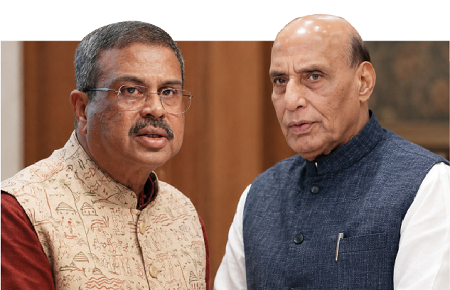
n the evening of 28 May 2026, three of India's most powerful cabinet ministers converged at the official residence of Defence Minister Rajnath Singh. The gathering — which also included Education Minister Dharmendra Pradhan and Communications Minister Jyotiraditya Scindia — was not convened to discuss a war. It was convened to rescue an examination. At the centre of the crisis: NEET-UG 2026, India's sole gateway to undergraduate medical education, which had been cancelled just over a fortnight earlier after a coordinated paper leak shattered public trust for the second consecutive cycle. The Central Bureau of Investigation had registered an FIR. Students had taken to the streets. The Supreme Court was expected to hear a fresh batch of petitions demanding sweeping reform. And the government, once again, had called Rajnath Singh.
The decision to seat this crisis at the Defence Minister's table — rather than the Ministry of Education's — was not procedural convenience. It was political communication. In a democracy where institutional credibility is as fragile as it is consequential, the choice of who sits at the head of the table sends a signal that no press release can replicate. And Rajnath Singh has been that signal, with extraordinary consistency, for more than three decades. The question worth examining is why.
The Examination That Broke Twice
NEET-UG is not merely an examination. It is the single point of convergence for the medical aspirations of over two million Indian families each year — families who have, in many cases, spent five to seven years and life savings preparing for a test that can be taken on a single day. When that test is corrupted, the damage is not administrative. It is civilisational. The 2024 paper leak — in which Bihar Police revealed that students paid between ₹30 and ₹32 lakh to obtain question papers in advance, with at least 13 arrests and the CBI eventually taking over the case — had already forced the Supreme Court to cancel results for 1,563 grace-mark recipients and compel a partial retest. An expert committee was constituted. Structural reforms were announced. The NTA's credibility was placed on intensive care.
Then 2026 arrived. NEET-UG was administered on 3 May across 5,400-plus centres in 551 Indian cities and 14 international locations. Twelve days later, on 15 May, the NTA announced cancellation. A chemistry coaching teacher in Sikar, Rajasthan, had circulated leaked questions disguised as a 'guess paper' before exam day. The CBI, invoking the newly enacted Public Examination (Prevention of Unfair Means) Act, 2024, traced the conspiracy across Rajasthan, Maharashtra, and other states — and later found evidence that the 2025 cycle had been compromised by the same racket. Education Minister Pradhan publicly acknowledged that 'the command chain was breached.' On 18 May, CBI arrested the owner of Renukai Chemistry Classes in Maharashtra's Latur. Students died by suicide. Parents held vigils outside Shastri Bhavan. The Supreme Court had seen this before, and it was not prepared to see it a third time.
Into this furnace walked Rajnath Singh. The 28 May meeting at his residence produced a landmark decision: the Indian Air Force would be used to transport question papers for the June 21 re-examination — the first time in the history of Indian public examinations that military aircraft would be deployed as a security measure against civilian cheating networks. 'The government is committed and thoroughly ready to administer free and fair exams,' Dharmendra Pradhan stated. The re-examination was rescheduled. The IAF was put on notice. And a Defence Minister had been handed the informal chairmanship of India's most visible education crisis.
This was not improvisation. It was pattern recognition. Those who have watched Singh across five decades of public life understood immediately what the choice signified: that the government needed a credibility anchor, and there is only one man in the cabinet with a thirty-five-year record of providing exactly that.
Where It Began: Lucknow, 1991
The story of Rajnath Singh as institutional stabiliser does not begin in the Union Cabinet. It begins in a cabinet room in Lucknow, where Singh — then the Education Minister in Chief Minister Kalyan Singh's BJP government — tabled a proposal that nearly every colleague in the room opposed. The examination system of Uttar Pradesh in 1991 had ceased, in any meaningful sense, to function as an examination system. A 'copying mafia,' protected by political networks and entrenched across east and central UP, had made mass cheating the default mode of credentialing. Students arrived at examination centres with chits, 'suplees,' and in some cases pre-obtained answer sheets. The board certificate had become a marketable commodity rather than a measure of learning.
Singh's Anti-Copying Act of 1992 — drafted by him and forced through by Chief Minister Kalyan Singh over unanimous cabinet resistance — made the use of unfair means in examinations a cognisable, non-bailable offence and permitted police to enter and search examination premises. The consequences were immediate and severe. In the 1992 UP Board examinations, only 14.70 per cent of intermediate students passed; barely 30.30 per cent of high school candidates cleared. Approximately 17 per cent of registered students abandoned the examination midway rather than face a genuinely supervised test. The photographs of handcuffed students on the front pages of Lucknow newspapers shocked the public — and enraged the vested interests who had profited from the old system. The Samajwadi Party made repeal of the Act a central campaign promise in 1993. Mulayam Singh Yadav's government honoured that promise the moment it came to power.
The Act's repeal is instructive. It reveals the structural fragility of governance reform that is anchored in individual political will rather than institutional architecture. Singh had diagnosed the problem correctly and prescribed a drastic cure; but the cure lasted only as long as his political moment did. Three decades later, the same cheating networks — more sophisticated, more distributed, and now operating across state lines and examination categories — were still at work. The NEET crisis of 2024 and 2026 is, in a precise sense, the inheritor of the same challenge that Singh first confronted in Lucknow. The question of how a state convinces citizens that merit rather than money determines opportunity remains, after thirty-five years, unanswered.

The Fixer the BJP Turns To
The BJP's defeat in the 2004 general election was a crisis of confidence unlike anything the party had experienced since its formative years. The NDA's 'India Shining' campaign had, in hindsight, spoken to urban aspirations while missing the more urgent anxieties of rural India. The result — 138 Lok Sabha seats for the BJP against the Congress-led UPA — was not merely an electoral reversal. It was an organisational crisis, a narrative crisis, and a succession crisis rolled into one. L.K. Advani, the party's most senior figure, remained party president but the question of who would lead the BJP into the next cycle — and how — was unresolved and toxic.
Singh was appointed National General Secretary of the BJP in July 2004, taking charge of Chhattisgarh and Jharkhand — and delivering BJP victories in both. By 31 December 2005, backed by the RSS and accepted by competing internal factions as a figure without threatening personal ambition, he was elected BJP national president. His tenure followed a recognisable template: extensive national tours to rebuild cadre morale, the 'Bharat Suraksha Yatra' campaign to reconnect with ground-level anxieties, and an emphasis on organisational discipline over ideological confrontation. He also held the position through the 2009 general election, stepping down after the party's performance fell short of expectations — another demonstration of the personal accountability that has marked his career.
His second tenure as BJP president, from January 2013, brought him to the most consequential internal political crisis in the party's modern history. When the BJP Parliamentary Board in June 2013 named Narendra Modi as the chairman of the party's election campaign committee, L.K. Advani resigned from all organisational positions — a public rupture that threatened to fracture the party at the precise moment when unity was essential. It was Singh who spoke on behalf of the Parliamentary Board and, within 24 hours, announced that Advani had agreed to withdraw his resignation following consultation with the RSS. He also personally travelled to meet Shiv Sena president Uddhav Thackeray to assure the NDA's oldest ally that the BJP remained committed to the alliance. The crisis was contained without a public split. The 2014 election campaign proceeded on unified footing. Rajnath Singh's contribution to that unity was structural rather than spectacular — which is precisely what made it effective.
When the Stakes Were National Survival
In June 2017, Indian and Chinese soldiers locked into a 73-day standoff at Doklam — the most serious military confrontation between the two countries since 1987. China's People's Liberation Army had begun constructing a road in territory that Bhutan claimed as its own, and India's intervention in support of Bhutan triggered Beijing's demand for an Indian military withdrawal. The situation was diplomatically explosive: any escalation risked military confrontation between nuclear-armed neighbours; any capitulation risked establishing a precedent with strategic consequences along the entire LAC.
Rajnath Singh was Home Minister at the time, not Defence Minister. But he was called upon to perform a precise act of public communication at a moment when both belligerence and weakness would have been damaging. At an ITBP pipping ceremony in New Delhi on 21 August 2017, he delivered a formulation that walked a razor's edge with apparent ease: 'India is the only country which has never attacked any country nor does it have an ambition to expand its borders. Our security forces are equipped to handle any situation on the border. There will be a solution to the Doklam issue very soon.' The statement — simultaneously reassuring, resolute, and forward-looking — gave diplomatic space without signalling retreat. Business Standard's official press release carried the precise quote. Fourteen days later, the standoff ended.
Galwan was not a standoff. On the night of 15–16 June 2020, Indian and Chinese soldiers fought hand-to-hand in the dark at altitudes above 14,000 feet, using rocks, iron rods, and wire-studded clubs. Colonel B. Santosh Babu and nineteen of his soldiers did not return. It was the bloodiest confrontation between the two armies in 53 years — and it happened in the middle of a global pandemic, when India's institutional bandwidth was already stretched beyond capacity. Rajnath Singh, now Defence Minister, held a high-level meeting with the Chief of Defence Staff and service chiefs on the night of the attack, coordinating with the External Affairs and Home Ministers in a secure session chaired by Prime Minister Modi. In the following hours, Singh tweeted: 'The loss of soldiers in Galwan is deeply disturbing and painful. Our soldiers displayed exemplary courage and valour in the line of duty.' The formulation was not rhetorical. It was a statement of national grief paired with a reminder of national resolve — calibrated to neither inflame public anger beyond manageable levels nor deflate legitimate national pride.
When Parliament reconvened in September 2020 — the Monsoon Session held under COVID protocols, with socially distanced seating and reduced capacity — it fell to Singh to make the government's comprehensive statement on Galwan. His Rajya Sabha address on 17 September 2020, now available in full on the Press Information Bureau website, is a document of unusual institutional care. He named Colonel Santosh Babu. He named the nineteen soldiers. He traced the diplomatic sequence from the Senior Commander meeting of 6 June 2020 through the Chinese violation of the agreed disengagement protocol on 15 June. He stated India's position on the LAC with precision, asserted that Chinese troops had 'inflicted costs including casualties,' and committed India to both continued dialogue and military preparedness. He neither manufactured an artificial crisis nor minimised a genuine one. The statement was read, studied, and cited by strategic analysts as a model of crisis communication under pressure.
The Anatomy of a Crisis Manager
Across education, party organisation, and national security, a common structural logic operates in Singh's crisis interventions. First, he is deployed when the primary deficit is not operational but perceptual — when the problem is not that the government cannot do something, but that the public no longer believes it will. Second, his personal reputation for probity and procedural fairness functions as a trust instrument independent of the institution he represents: his involvement signals seriousness in ways that departmental communications cannot. Third, he consistently chooses formulations that are resolute without being escalatory, accountable without being self-flagellating, and forward-looking without dismissing present pain. This is an unusually rare combination in political communication.
What is less often acknowledged is the cost of this reliance. When individual credibility substitutes for structural institutional reform — when the trusted coordinator manages the crisis rather than eliminating its conditions — the underlying problem persists. The Anti-Copying Act was repealed within two years. The NEET reforms of 2024 failed within two years. The 'Rajnath Singh' solution, to put it plainly, is a high-quality emergency intervention, not a structural repair. Its effectiveness is real; its durability is contingent. A democracy that repeatedly needs the same crisis manager has not yet built institutions that do not produce the same crises.
Trust Is Not a Portfolio — But It Is a Policy
There is a scene that captures something essential about the Rajnath Singh story, and it occurred not in a cabinet room or a parliament but on a parade ground in Lucknow sometime in 1992. Students who had never before sat an honest examination were sitting one. Some walked out. Some were arrested for cheating. Pass rates fell to figures that seemed, to many observers, disastrously low. But to Rajnath Singh, they were the accurate figures — the real shape of a system that had pretended otherwise for decades. He had not improved Indian education. He had revealed what it actually looked like without the pretence.
That willingness to absorb the political cost of honest institutional confrontation — to be the minister who tells the public something it does not want to hear, and to do so without either dramatising or disguising it — is the thread that connects Lucknow 1992 to Galwan 2020 to NEET 2026. It is why, when institutions need someone capable of speaking uncomfortable truth to a sceptical public and making them believe the state is still operating in good faith, the phone call consistently goes to the same number.
The deeper governance lesson is this: a democratic state cannot sustain itself on the credibility of individuals, however exceptional. The institutions of examination integrity, border security, and party democracy must eventually acquire the structural robustness to function without a trusted fixer being deployed each time they fail. But until that robustness is built — and the evidence of 2024 and 2026 alike suggests it has not been — the value of a political figure whose personal credibility can temporarily restore public confidence is not ornamental. It is existential. Rajnath Singh has filled that role with a consistency that no other figure in contemporary Indian public life has matched. The unanswered question, as the June 21 NEET re-examination approaches, is whether this time the emergency will finally produce the structural reform that makes the next emergency less likely. If history is a guide, that question will outlast the re-examination — and will eventually require another trusted intervention to manage.
(The content of this article reflects the views of writer and contributor, not necessarily those of the publisher and editor. All disputes are subject to the exclusive jurisdiction of competent courts and forums in Delhi/New Delhi only)




















Leave Your Comment