


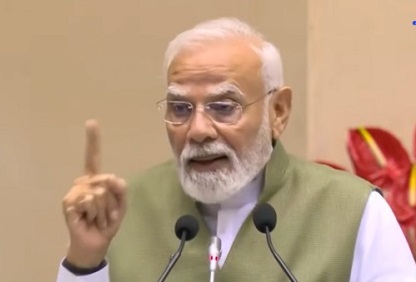
Prime Minister Narendra Modi has called for a more equitable global approach to climate responsibility, arguing that developing countries should not be unfairly burdened for emissions when their per-capita contribution remains substantially below that of developed nations. Addressing an international conference on environment and climate on Saturday, Modi highlighted India’s renewable-energy expansion, nuclear-energy ambitions and long-standing environmental traditions, while stressing that climate action must combine national development with collective global responsibility.
India’s climate message is increasingly centred on the principle that environmental protection and economic development need not be competing objectives. Addressing a gathering of environmental experts, Supreme Court judges, legal professionals and senior government officials, Prime Minister Narendra Modi underlined the need to examine climate responsibility through the lens of both historical emissions and present-day realities.
Modi pointed out that India’s per-capita carbon emissions remain less than half the global average. He argued that developing countries are often placed under disproportionate pressure in international climate discussions despite having contributed far less to cumulative emissions on a per-person basis than industrialised economies.
The argument reflects one of the longstanding fault lines in global climate negotiations: how responsibility for reducing emissions should be distributed between developed and developing nations. India has consistently maintained that climate action must take into account differences in historical emissions, development requirements and per-capita consumption.
At the same time, Modi presented India as a country seeking to contribute solutions rather than merely highlight inequities. He said India has been guided by traditions that place nature at the centre of social and cultural life for centuries. According to him, this philosophical foundation is now being combined with modern technology and policy initiatives to address contemporary environmental challenges.
India's approach, he suggested, is based on the idea that climate protection must become a collective global enterprise. The country is pursuing renewable energy, expanding clean-energy capacity and working towards reducing the carbon intensity of economic growth. This approach seeks to demonstrate that a rapidly developing economy can simultaneously pursue growth and environmental objectives.
A significant part of Modi's address focused on nuclear energy. India is seeking to expand nuclear power as part of its broader energy strategy, particularly because nuclear generation can provide electricity without direct carbon emissions during operation. Modi, however, pointed to what he described as a contradiction in sections of the environmental debate.
He said that whenever his government advances nuclear-energy projects, some of those who strongly advocate environmental protection subsequently approach courts seeking to stop such projects. His remarks highlighted the difficult policy balance between environmental safeguards, legal scrutiny, energy security and the country's growing electricity requirements.
For India, the energy transition involves more than simply replacing one source of electricity with another. The country must meet rising demand while reducing dependence on fossil fuels. Renewable energy can play an increasingly important role, but technologies such as nuclear power can also provide stable electricity generation. The challenge is therefore to build an energy system that is simultaneously reliable, affordable and environmentally sustainable.
Modi also pointed to India's progress in meeting its international climate commitments. He said India is the only G20 country to have already achieved its Paris Agreement commitments ahead of schedule. He cited the country's expansion of non-fossil-fuel energy and solar power as evidence of its changing energy landscape.
The broader significance of the Prime Minister's message lies in India's attempt to shape the climate debate around both responsibility and solutions. New Delhi's position is that climate action cannot become a mechanism for restricting the development aspirations of poorer and emerging economies.
India's environmental strategy is consequently evolving around multiple pillars—renewable energy, nuclear power, technological innovation, energy efficiency and international cooperation. The emphasis is increasingly on measurable outcomes rather than commitments alone.




















Leave Your Comment