


The political journey of Bengali actor Rukmini Mallick, popularly known as Koel Mallick, has taken an unexpected turn. Just months after entering the Rajya Sabha on a Trinamool Congress ticket and subsequently resigning following the party’s electoral setback in West Bengal, Mallick has now joined the Bharatiya Janata Party. Her induction, coupled with the BJP’s decision to nominate her for the vacant Rajya Sabha seat, is more than a personal political shift—it reflects the changing balance of political influence in Bengal and the BJP’s growing confidence in the state.
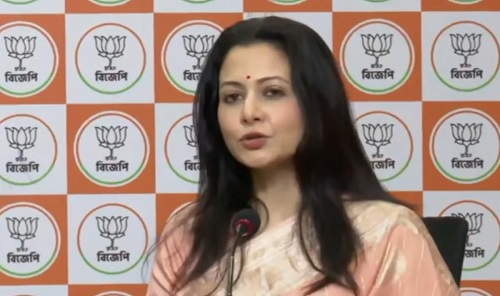
Koel Mallick formally joined the BJP in Kolkata on Monday, a day after the party announced her candidature for the upcoming Rajya Sabha by-election. Speaking after joining the party, she described herself as “honoured, blessed and delighted” and said that she was proud of the development taking place in the state. She also stressed that she knew how to serve people and invoked humanity as the greatest religion.
Her statement suggests that Mallick is seeking to establish her political identity around public service rather than merely leveraging her popularity as a film personality. Whether she succeeds in making that transition, however, will depend on how effectively she converts public recognition into political credibility.
Mallick is the daughter of veteran Bengali actor Ranjit Mallick and has a substantial public profile in West Bengal. Her entry into electoral politics initially came through the Trinamool Congress, which sent her to the Rajya Sabha on April 6. Her tenure, however, proved remarkably short. She resigned from the Upper House on July 16, following the TMC’s electoral debacle in the 2026 West Bengal Assembly elections.
The subsequent move to the BJP gives her political trajectory a distinctly different direction. The BJP has not merely welcomed her into its organisation; it has immediately placed her in contention for a parliamentary position. Party West Bengal general secretary Sashi Agnihotri said Mallick would file her nomination for the Rajya Sabha seat.
The timing is politically significant. The vacant Bengal Rajya Sabha seat is scheduled to go to a by-election on October 16, along with 11 other seats from Uttar Pradesh and Uttarakhand. The seat became vacant following Mallick’s resignation, even though her original Rajya Sabha term was to continue until April 2, 2032.
The BJP’s confidence is rooted in arithmetic. With the party commanding a clear majority in the West Bengal Assembly, it is strongly positioned to secure the vacant Rajya Sabha seat. Consequently, Mallick’s nomination appears less like a gamble and more like a carefully calculated political decision.
There is also a broader pattern worth noting. Mallick is not the only former TMC Rajya Sabha member to move towards the BJP after resigning from the Upper House. Sukhendu Sekhar Ray, Sushmita Dev and Prakash Chik Baraik also resigned in July and subsequently joined the BJP, winning re-election. The repeated movement of former TMC parliamentarians towards the BJP indicates that the political churn following the Assembly election has extended beyond the conventional party organisation.
For the BJP, Mallick offers several potential advantages. Her identity as a recognised Bengali actor provides visibility beyond the traditional political constituency. In a state where cultural identity, Bengali pride and celebrity influence have long played a role in public life, the induction of a prominent film personality can help the BJP broaden its social and cultural appeal.
Yet celebrity alone cannot guarantee political success. West Bengal politics remains intensely competitive, and voters are unlikely to equate popularity on the silver screen with legislative effectiveness. Mallick will therefore face the challenge of demonstrating that her move is rooted in a coherent political vision rather than simply an opportunity created by changing political fortunes.
Her own emphasis on development and public welfare provides an initial indication of the narrative she intends to build. If she can translate that message into substantive parliamentary engagement, her transition from cinema to national politics could acquire greater significance.
For the BJP, meanwhile, the nomination carries a larger message. The party is signalling that its political expansion in Bengal is not confined to traditional leaders or organisational cadres. It is also willing to embrace prominent figures from the state’s cultural landscape and give them immediate institutional responsibilities.






















Leave Your Comment